Mostrar el registro sencillo del ítem
dc.contributor.author
Martino, Gabriela Paula
dc.contributor.author
Perez Dezen, Cristian Emanuel
dc.contributor.author
Magni, Christian
dc.contributor.author
Blancato, Victor Sebastian
dc.date.available
2019-11-11T18:28:33Z
dc.date.issued
2018-10
dc.identifier.citation
Martino, Gabriela Paula; Perez Dezen, Cristian Emanuel; Magni, Christian; Blancato, Victor Sebastian; Implications of the expression of Enterococcus faecalis citrate fermentation genes during infection; Public Library of Science; Plos One; 13; 10; 10-2018; 1-18; e0205787
dc.identifier.issn
1932-6203
dc.identifier.uri
http://hdl.handle.net/11336/88504
dc.description.abstract
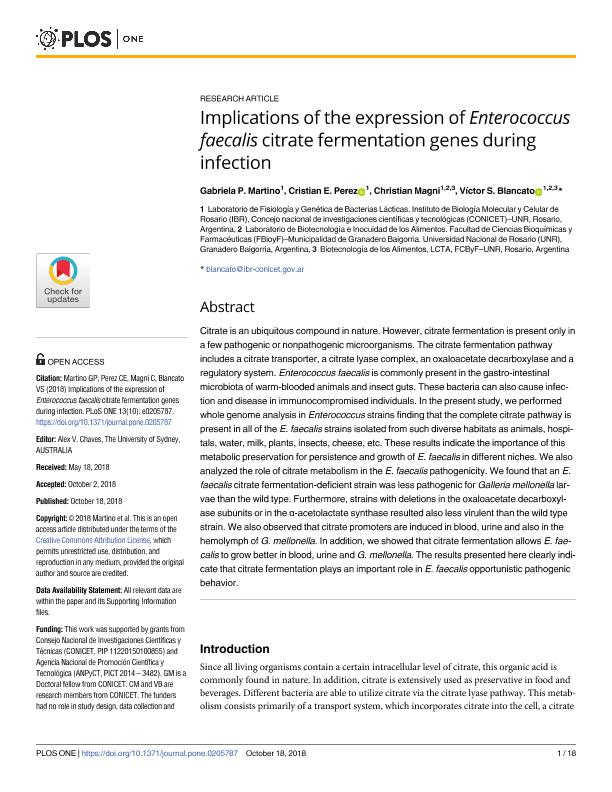
Citrate is an ubiquitous compound in nature. However, citrate fermentation is present only in a few pathogenic or nonpathogenic microorganisms. The citrate fermentation pathway includes a citrate transporter, a citrate lyase complex, an oxaloacetate decarboxylase and a regulatory system. Enterococcus faecalis is commonly present in the gastro-intestinal microbiota of warm-blooded animals and insect guts. These bacteria can also cause infection and disease in immunocompromised individuals. In the present study, we performed whole genome analysis in Enterococcus strains finding that the complete citrate pathway is present in all of the E. faecalis strains isolated from such diverse habitats as animals, hospitals, water, milk, plants, insects, cheese, etc. These results indicate the importance of this metabolic preservation for persistence and growth of E. faecalis in different niches. We also analyzed the role of citrate metabolism in the E. faecalis pathogenicity. We found that an E. faecalis citrate fermentation-deficient strain was less pathogenic for Galleria mellonella larvae than the wild type. Furthermore, strains with deletions in the oxaloacetate decarboxylase subunits or in the ∞-acetolactate synthase resulted also less virulent than the wild type strain. We also observed that citrate promoters are induced in blood, urine and also in the hemolymph of G. mellonella. In addition, we showed that citrate fermentation allows E. faecalis to grow better in blood, urine and G. mellonella. The results presented here clearly indicate that citrate fermentation plays an important role in E. faecalis opportunistic pathogenic behavior.
dc.format
application/pdf
dc.language.iso
eng
dc.publisher
Public Library of Science
dc.rights
info:eu-repo/semantics/openAccess
dc.rights.uri
https://creativecommons.org/licenses/by-nc-sa/2.5/ar/
dc.subject
citrate fermentation
dc.subject
gene expression
dc.subject
infection
dc.subject
Enterococcus faecalis; Galleria Mellonella
dc.subject.classification
Biología Celular, Microbiología
dc.subject.classification
Ciencias Biológicas
dc.subject.classification
CIENCIAS NATURALES Y EXACTAS
dc.title
Implications of the expression of Enterococcus faecalis citrate fermentation genes during infection
dc.type
info:eu-repo/semantics/article
dc.type
info:ar-repo/semantics/artículo
dc.type
info:eu-repo/semantics/publishedVersion
dc.date.updated
2019-10-24T18:19:31Z
dc.journal.volume
13
dc.journal.number
10
dc.journal.pagination
1-18; e0205787
dc.journal.pais
Estados Unidos
dc.journal.ciudad
San Francisco
dc.description.fil
Fil: Martino, Gabriela Paula. Consejo Nacional de Investigaciones Científicas y Técnicas. Centro Científico Tecnológico Conicet - Rosario. Instituto de Biología Molecular y Celular de Rosario. Universidad Nacional de Rosario. Facultad de Ciencias Bioquímicas y Farmacéuticas. Instituto de Biología Molecular y Celular de Rosario; Argentina
dc.description.fil
Fil: Perez Dezen, Cristian Emanuel. Consejo Nacional de Investigaciones Científicas y Técnicas. Centro Científico Tecnológico Conicet - Rosario. Instituto de Biología Molecular y Celular de Rosario. Universidad Nacional de Rosario. Facultad de Ciencias Bioquímicas y Farmacéuticas. Instituto de Biología Molecular y Celular de Rosario; Argentina
dc.description.fil
Fil: Magni, Christian. Consejo Nacional de Investigaciones Científicas y Técnicas. Centro Científico Tecnológico Conicet - Rosario. Instituto de Biología Molecular y Celular de Rosario. Universidad Nacional de Rosario. Facultad de Ciencias Bioquímicas y Farmacéuticas. Instituto de Biología Molecular y Celular de Rosario; Argentina
dc.description.fil
Fil: Blancato, Victor Sebastian. Consejo Nacional de Investigaciones Científicas y Técnicas. Centro Científico Tecnológico Conicet - Rosario. Instituto de Biología Molecular y Celular de Rosario. Universidad Nacional de Rosario. Facultad de Ciencias Bioquímicas y Farmacéuticas. Instituto de Biología Molecular y Celular de Rosario; Argentina
dc.journal.title
Plos One
dc.relation.alternativeid
info:eu-repo/semantics/altIdentifier/doi/https://doi.org/10.1371/journal.pone.0205787
dc.relation.alternativeid
info:eu-repo/semantics/altIdentifier/url/https://journals.plos.org/plosone/article?id=10.1371/journal.pone.0205787
Archivos asociados

Tamaño:
1.954Mb
Formato:
PDF