Mostrar el registro sencillo del ítem
dc.contributor.author
Marina, Tomas Ignacio
dc.contributor.author
Saravia, Leonardo Ariel
dc.contributor.author
Cordone, Georgina Florencia
dc.contributor.author
Salinas, Vanesa Anabella
dc.contributor.author
Doyle, Santiago Raúl
dc.contributor.author
Momo, Fernando Roberto
dc.date.available
2019-11-07T21:34:32Z
dc.date.issued
2018-05
dc.identifier.citation
Marina, Tomas Ignacio; Saravia, Leonardo Ariel; Cordone, Georgina Florencia; Salinas, Vanesa Anabella; Doyle, Santiago Raúl; et al.; Architecture of marine food webs: To be or not be a ‘small-world’; Public Library of Science; Plos One; 13; 5; 5-2018; 1-13; e0198217
dc.identifier.uri
http://hdl.handle.net/11336/88265
dc.description.abstract
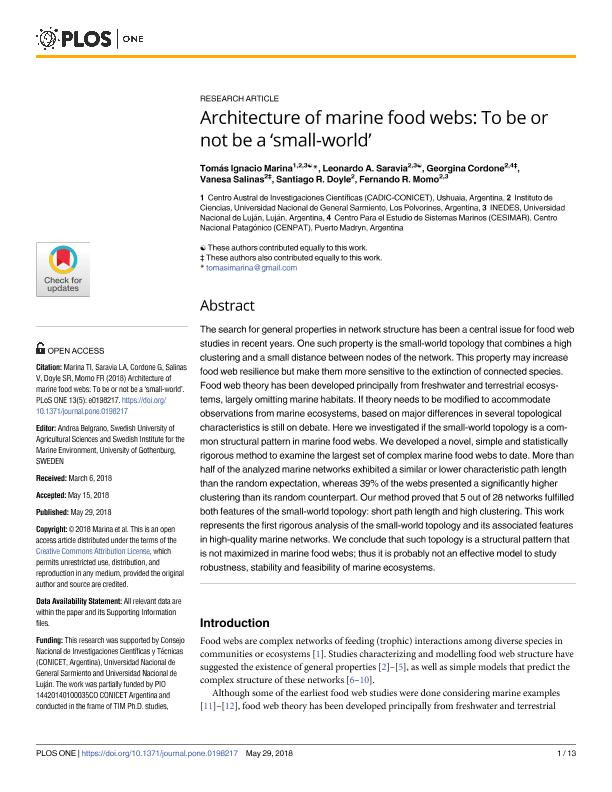
The search for general properties in network structure has been a central issue for food web studies in recent years. One such property is the small-world topology that combines a high clustering and a small distance between nodes of the network. This property may increase food web resilience but make them more sensitive to the extinction of connected species. Food web theory has been developed principally from freshwater and terrestrial ecosystems, largely omitting marine habitats. If theory needs to be modified to accommodate observations from marine ecosystems, based on major differences in several topological characteristics is still on debate. Here we investigated if the small-world topology is a common structural pattern in marine food webs. We developed a novel, simple and statistically rigorous method to examine the largest set of complex marine food webs to date. More than half of the analyzed marine networks exhibited a similar or lower characteristic path length than the random expectation, whereas 39% of the webs presented a significantly higher clustering than its random counterpart. Our method proved that 5 out of 28 networks fulfilled both features of the small-world topology: short path length and high clustering. This work represents the first rigorous analysis of the small-world topology and its associated features in high-quality marine networks. We conclude that such topology is a structural pattern that is not maximized in marine food webs; thus it is probably not an effective model to study robustness, stability and feasibility of marine ecosystems.
dc.format
application/pdf
dc.language.iso
eng
dc.publisher
Public Library of Science
dc.rights
info:eu-repo/semantics/openAccess
dc.rights.uri
https://creativecommons.org/licenses/by-nc-sa/2.5/ar/
dc.subject
Food web
dc.subject
Architecture
dc.subject
Small word
dc.subject.classification
Ecología
dc.subject.classification
Ciencias Biológicas
dc.subject.classification
CIENCIAS NATURALES Y EXACTAS
dc.title
Architecture of marine food webs: To be or not be a ‘small-world’
dc.type
info:eu-repo/semantics/article
dc.type
info:ar-repo/semantics/artículo
dc.type
info:eu-repo/semantics/publishedVersion
dc.date.updated
2019-10-17T14:02:12Z
dc.identifier.eissn
1932-6203
dc.journal.volume
13
dc.journal.number
5
dc.journal.pagination
1-13; e0198217
dc.journal.pais
Estados Unidos
dc.description.fil
Fil: Marina, Tomas Ignacio. Consejo Nacional de Investigaciones Científicas y Técnicas. Centro Austral de Investigaciones Científicas; Argentina. Universidad Nacional de Luján. Instituto de Ecología y Desarrollo Sustentable. Consejo Nacional de Investigaciones Científicas y Técnicas. Oficina de Coordinación Administrativa Parque Centenario. Instituto de Ecología y Desarrollo Sustentable; Argentina. Universidad Nacional de General Sarmiento. Instituto de Ciencias; Argentina
dc.description.fil
Fil: Saravia, Leonardo Ariel. Universidad Nacional de Luján. Instituto de Ecología y Desarrollo Sustentable. Consejo Nacional de Investigaciones Científicas y Técnicas. Oficina de Coordinación Administrativa Parque Centenario. Instituto de Ecología y Desarrollo Sustentable; Argentina. Universidad Nacional de General Sarmiento. Instituto de Ciencias; Argentina
dc.description.fil
Fil: Cordone, Georgina Florencia. Consejo Nacional de Investigaciones Científicas y Técnicas. Centro Científico Tecnológico Conicet - Centro Nacional Patagónico. Centro para el Estudio de Sistemas Marinos; Argentina. Universidad Nacional de General Sarmiento. Instituto de Ciencias; Argentina
dc.description.fil
Fil: Salinas, Vanesa Anabella. Universidad Nacional de General Sarmiento. Instituto de Ciencias; Argentina. Consejo Nacional de Investigaciones Científicas y Técnicas; Argentina
dc.description.fil
Fil: Doyle, Santiago Raúl. Universidad Nacional de General Sarmiento. Instituto de Ciencias; Argentina. Consejo Nacional de Investigaciones Científicas y Técnicas; Argentina
dc.description.fil
Fil: Momo, Fernando Roberto. Universidad Nacional de General Sarmiento. Instituto de Ciencias; Argentina. Universidad Nacional de Luján. Instituto de Ecología y Desarrollo Sustentable. Consejo Nacional de Investigaciones Científicas y Técnicas. Oficina de Coordinación Administrativa Parque Centenario. Instituto de Ecología y Desarrollo Sustentable; Argentina
dc.journal.title
Plos One
dc.relation.alternativeid
info:eu-repo/semantics/altIdentifier/doi/https://journals.plos.org/plosone/article?id=10.1371/journal.pone.0198217
dc.relation.alternativeid
info:eu-repo/semantics/altIdentifier/doi/http://dx.doi.org/10.1371/journal.pone.0198217
Archivos asociados

Tamaño:
1.096Mb
Formato:
PDF