Artículo
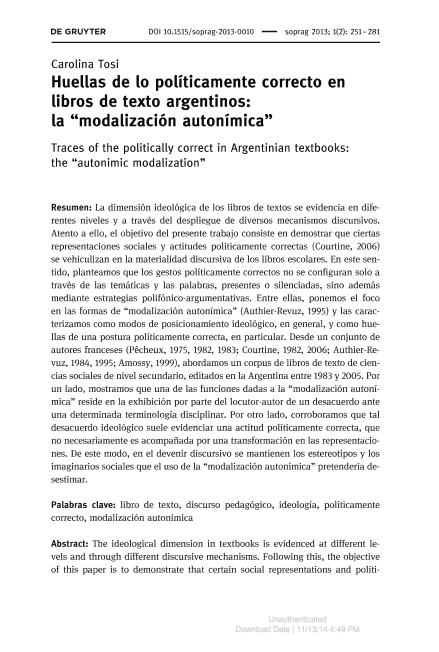
La dimensión ideológica de los libros de textos se evidencia en diferentes niveles y a través del despliegue de diversos mecanismos discursivos. Atento a ello, el objetivo del presente trabajo consiste en demostrar que ciertas representaciones sociales y actitudes políticamente correctas (Courtine, 2006) se vehiculizan en la materialidad discursiva de los libros escolares. En este sentido, planteamos que los gestos políticamente correctos no se configuran solo a través de las temáticas y las palabras, presentes o silenciadas, sino además mediante estrategias polifónico-argumentativas. Entre ellas, ponemos el foco en las formas de modalización autonímica (Authier-Revuz, 1995) y las caracterizamos como modos de posicionamiento ideológico, en general, y como huellas de una postura políticamente correcta, en particular. Desde un conjunto de autores franceses (Pêcheux, 1975, 1982, 1983; Courtine, 1982, 2006; Authier-Revuz, 1984, 1995; Amossy, 1999), abordamos un corpus de libros de texto de ciencias sociales de nivel secundario, editados en la Argentina entre 1983 y 2005. Por un lado, mostramos que una de las funciones dadas a la modalización autonímica reside en la exhibición por parte del locutor-autor de un desacuerdo ante una determinada terminología disciplinar. Por otro lado, corroboramos que tal desacuerdo ideológico suele evidenciar una actitud políticamente correcta, que no necesariamente es acompañada por una transformación en las representaciones. De este modo, en el devenir discursivo se mantienen los estereotipos y los imaginarios sociales que el uso de la modalización autonímica pretendería desestimar. The ideological dimension in textbooks is evidenced at different levels and through different discursive mechanisms. Following this, the objective of this paper is to demonstrate that certain social representations and politically correct attitudes (Courtine, 2006) are evidenced on the discursive materiality of textbooks. In this sense, we propose that politically correct gestures are not only configured through themes and words, present or silenced ones, but also through polyphonic and argumentative strategies. Among them, we focus on the forms identified as “autominic modalization” (Authier-Revuz, 1995) and we characterize them as modes of ideological positioning, in general, and as traces of a politically correct poses, in particular. Having a group of French authors as the theoretical framework for this study (Pêcheux, 1975, 1982, 1983; Courtine, 1982, 2006; Authier-Revuz, 1984, 1995; Amossy, 1999), we analyze a corpus of social science textbooks for secondary education, edited in Argentina between 1983 and 2005. On one hand, we show that one of the functions related to the “autonimic modalization” is based on having the locutor-author exhibiting disagreement when using a given disciplinary terminology. On the other hand, we corroborate that such ideological disagreement often evidences a politically correct attitude that is not necessarily accompanied with a transformation of the representations. In this way, stereotypes and social imagings are maintained through time and discourse, something that the “autonimic modalization” tried to avoid.
Huellas de lo políticamente correcto en libros de texto argentinos: la “modalización autonímica”
Título:
Traces of the politically correct in Argentinian textbooks: the “autonimic modalization”

Fecha de publicación:
11/2013
Editorial:
De Gruyter
Revista:
Pragmática Sociocultural / Sociocultural Pragmatics
ISSN:
2194-8313
Idioma:
Español
Tipo de recurso:
Artículo publicado
Clasificación temática:
Resumen
Palabras clave:
LIBRO DE TEXTO
,
DISCURSO PEDAGÓGICO
,
IDEOLOGÍA
Archivos asociados

Tamaño:
236.9Kb
Formato:
PDF
Licencia
 Excepto donde se diga explícitamente, este item se publica bajo la siguiente descripción:
Creative Commons Attribution-NonCommercial-ShareAlike 2.5 Unported (CC BY-NC-SA 2.5)
Excepto donde se diga explícitamente, este item se publica bajo la siguiente descripción:
Creative Commons Attribution-NonCommercial-ShareAlike 2.5 Unported (CC BY-NC-SA 2.5)
Identificadores
Colecciones
Articulos(SEDE CENTRAL)
Articulos de SEDE CENTRAL
Articulos de SEDE CENTRAL
Citación
Tosi, Carolina Luciana; Huellas de lo políticamente correcto en libros de texto argentinos: la “modalización autonímica”; De Gruyter; Pragmática Sociocultural / Sociocultural Pragmatics; 1; 2; 11-2013; 251-281
Compartir


Altmétricas