Artículo
Molybdenum incorporation on AB 2 alloys-Part II. On the synergetic effects of Laves and non-Laves phases

Fecha de publicación:
15/03/2018
Editorial:
Elsevier Science Sa
Revista:
Journal of Alloys and Compounds
ISSN:
0925-8388
Idioma:
Inglés
Tipo de recurso:
Artículo publicado
Clasificación temática:
Resumen
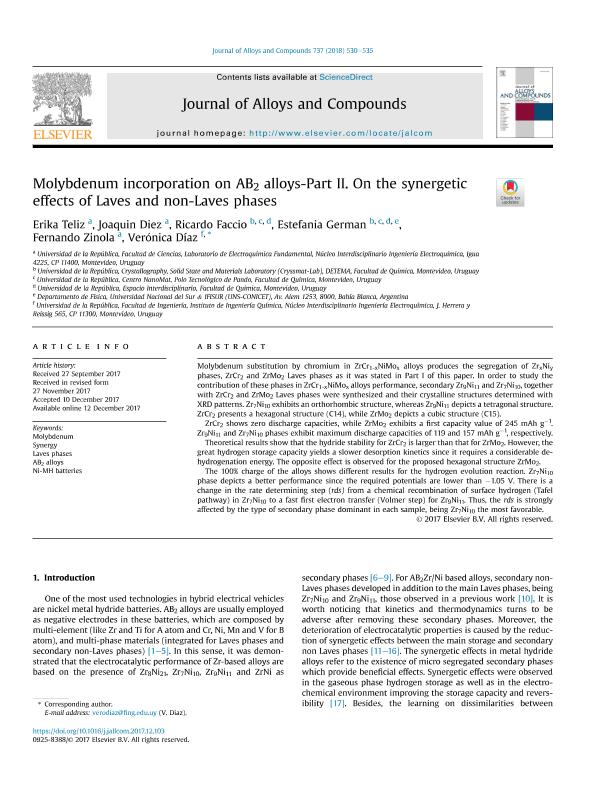
Molybdenum substitution by chromium in ZrCr1-xNiMox alloys produces the segregation of ZrxNiy phases, ZrCr2 and ZrMo2 Laves phases as it was stated in Part I of this paper. In order to study the contribution of these phases in ZrCr1-xNiMox alloys performance, secondary Zr9Ni11 and Zr7Ni10, together with ZrCr2 and ZrMo2 Laves phases were synthesized and their crystalline structures determined with XRD patterns. Zr7Ni10 exhibits an orthorhombic structure, whereas Zr9Ni11 depicts a tetragonal structure. ZrCr2 presents a hexagonal structure (C14), while ZrMo2 depicts a cubic structure (C15). ZrCr2 shows zero discharge capacities, while ZrMo2 exhibits a first capacity value of 245 mAh g−1. Zr9Ni11 and Zr7Ni10 phases exhibit maximum discharge capacities of 119 and 157 mAh g−1, respectively. Theoretical results show that the hydride stability for ZrCr2 is larger than that for ZrMo2. However, the great hydrogen storage capacity yields a slower desorption kinetics since it requires a considerable de-hydrogenation energy. The opposite effect is observed for the proposed hexagonal structure ZrMo2. The 100% charge of the alloys shows different results for the hydrogen evolution reaction. Zr7Ni10 phase depicts a better performance since the required potentials are lower than −1.05 V. There is a change in the rate determining step (rds) from a chemical recombination of surface hydrogen (Tafel pathway) in Zr7Ni10 to a fast first electron transfer (Volmer step) for Zr9Ni11. Thus, the rds is strongly affected by the type of secondary phase dominant in each sample, being Zr7Ni10 the most favorable.
Palabras clave:
AB2 ALLOYS
,
LAVES PHASES
,
MOLYBDENUM
,
NI-MH BATTERIES
,
SYNERGY
Archivos asociados

Tamaño:
640.1Kb
Formato:
PDF
Licencia
 Excepto donde se diga explícitamente, este item se publica bajo la siguiente descripción:
Creative Commons Attribution-NonCommercial-ShareAlike 2.5 Unported (CC BY-NC-SA 2.5)
Excepto donde se diga explícitamente, este item se publica bajo la siguiente descripción:
Creative Commons Attribution-NonCommercial-ShareAlike 2.5 Unported (CC BY-NC-SA 2.5)
Identificadores
Colecciones
Articulos(CCT - PATAGONIA NORTE)
Articulos de CTRO.CIENTIFICO TECNOL.CONICET - PATAGONIA NORTE
Articulos de CTRO.CIENTIFICO TECNOL.CONICET - PATAGONIA NORTE
Articulos(IFISUR)
Articulos de INSTITUTO DE FISICA DEL SUR
Articulos de INSTITUTO DE FISICA DEL SUR
Citación
Teliz, Erika; Diez, Joaquín; Faccio, Ricardo; German, Estefania; Zinola, Fernando; et al.; Molybdenum incorporation on AB 2 alloys-Part II. On the synergetic effects of Laves and non-Laves phases; Elsevier Science Sa; Journal of Alloys and Compounds; 737; 15-3-2018; 530-535
Compartir


Altmétricas