Artículo
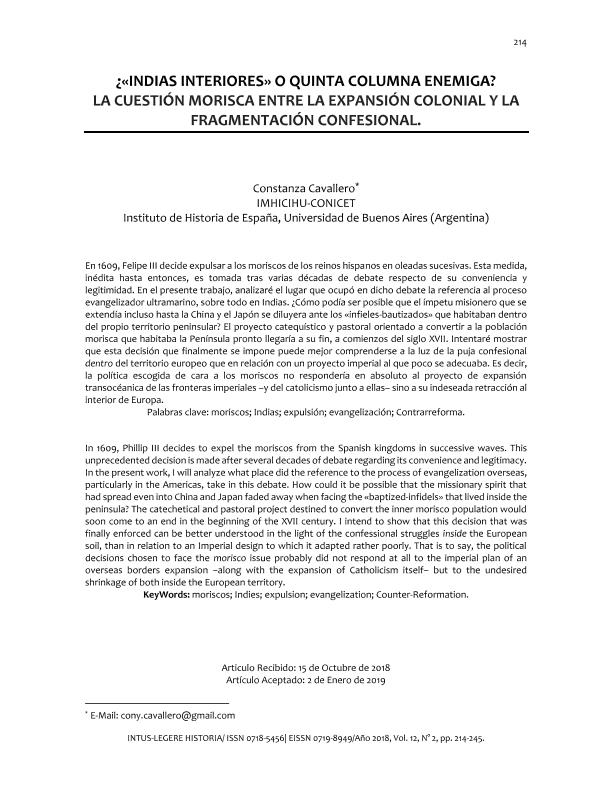
En 1609, Felipe III decide expulsar a los moriscos de los reinos hispanos en oleadas sucesivas. Esta medida, inédita hasta entonces, es tomada tras varias décadas de debate res-pecto de su conveniencia y legitimidad. En el presente trabajo, analizaré el lugar que ocupó en dicho debate la referencia al proceso evangelizador ultramarino, sobre todo en Indias. ¿Cómo podía ser posible que el ímpetu misionero que se extendía incluso hasta la China y el Japón se diluyera ante los 'infieles-bautizados' que habitaban dentro del propio territorio peninsular? El proyecto catequístico y pastoral orientado a convertir a la población morisca que habitaba la Península pronto llegaría a su fin, a comienzos del siglo XVII. Intentaré mostrar que esta decisión que finalmente se impone puede mejor comprenderse a la luz de la puja confesional dentro del territorio europeo que en relación con un proyecto imperial al que poco se adecuaba. Es decir, la política escogida de cara a los moriscos no respondería en absoluto al proyecto de expansión transocéanica de las fronteras imperiales ?y del catolicismo junto a ellas? sino a su indeseada retracción al interior de Europa. In 1609, Phillip III decides to expel the moriscos from the Spanish kingdoms in successive waves. This unprecedented decision is made after several decades of debate regarding its convenience and legitimacy. In the present work, I will analyze what place did the reference to the process of evangelization overseas, particularly in the Americas, take in this debate. How could it be possible that the missionary spirit that had spread even into China and Japan faded away when facing the «baptized-infidels» that lived inside the peninsula? The catechetical and pastoral project destined to convert the inner morisco population would soon come to an end in the beginning of the XVII century. I intend to show that this decision that was finally enforced can be better understood in the light of the confessional struggles inside the European soil, than in relation to an Imperial design to which it adapted rather poorly. That is to say, the political decisions chosen to face the morisco issue probably did not respond at all to the imperial plan of an overseas borders expansion –along with the expansion of Catholicism itself– but to then desired shrinkage of both inside the European territory.
¿"Indias interiores" o quinta columna enemiga?: La cuestión morisca entre la expansión colonial y la fragmentación confesional

Fecha de publicación:
12/2018
Editorial:
Universidad Adolfo Ibáñez
Revista:
Intus-Legere Historia
ISSN:
0718-5456
e-ISSN:
0719-8949
Idioma:
Español
Tipo de recurso:
Artículo publicado
Clasificación temática:
Resumen
Palabras clave:
MORISCOS
,
INDIAS
,
EXPULSIÓN
,
EVANGELIZACIÓN
Archivos asociados

Tamaño:
474.9Kb
Formato:
PDF
Licencia
 Excepto donde se diga explícitamente, este item se publica bajo la siguiente descripción:
Creative Commons Attribution-ShareAlike 2.5 Unported (CC BY-SA 2.5)
Excepto donde se diga explícitamente, este item se publica bajo la siguiente descripción:
Creative Commons Attribution-ShareAlike 2.5 Unported (CC BY-SA 2.5)
Identificadores
Colecciones
Articulos(IMHICIHU)
Articulos de INST.MULTIDISCIP.DE HISTORIA Y CS.HUMANAS
Articulos de INST.MULTIDISCIP.DE HISTORIA Y CS.HUMANAS
Citación
Cavallero, Constanza Edith; ¿"Indias interiores" o quinta columna enemiga?: La cuestión morisca entre la expansión colonial y la fragmentación confesional; Universidad Adolfo Ibáñez; Intus-Legere Historia; 12; 2; 12-2018; 214-245
Compartir

