Artículo
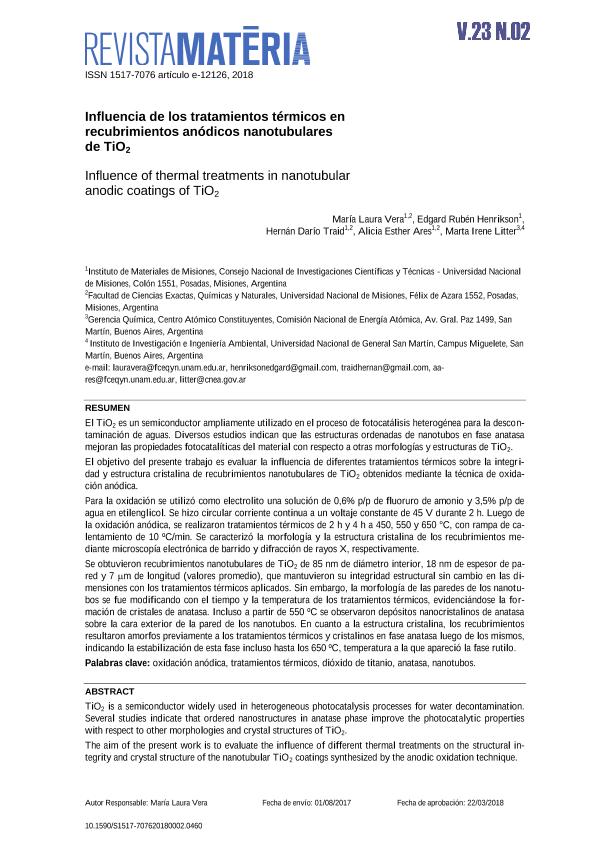
El TiO2 es un semiconductor ampliamente utilizado en el proceso de fotocatálisis heterogénea para la des-contaminación de aguas. Diversos estudios indican que las estructuras ordenadas de nanotubos en fase ana-tasa mejoran las propiedades fotocatalíticas del material con respecto a otras morfologías y estructuras de TiO2. El objetivo del presente trabajo es evaluar la influencia de diferentes tratamientos térmicos sobre la integri-dad y estructura cristalina de recubrimientos nanotubulares de TiO2 obtenidos mediante la técnica de oxida-ción anódica. Para la oxidación se utilizó como electrolito una solución de 0,6% p/p de fluoruro de amonio y 3,5% p/p de agua en etilenglicol. Se hizo circular corriente continua a un voltaje constante de 45 V durante 2 h. Luego de la oxidación anódica, se realizaron tratamientos térmicos de 2 h y 4 h a 450, 550 y 650 °C, con rampa de calentamiento de 10 ºC/min. Se caracterizó la morfología y la estructura cristalina de los recubrimientos mediante microscopía electrónica de barrido y difracción de rayos X, respectivamente.Se obtuvieron recubrimientos nanotubulares de TiO2 de 85 nm de diámetro interior, 18 nm de espesor de pared y 7 m de longitud (valores promedio), que mantuvieron su integridad estructural sin cambio en las dimensiones con los tratamientos térmicos aplicados. Sin embargo, la morfología de las paredes de los nano-tubos se fue modificando con el tiempo y la temperatura de los tratamientos térmicos, evidenciándose la formación de cristales de anatasa. Incluso a partir de 550 ºC se observaron depósitos nanocristalinos de anatasa sobre la cara exterior de la pared de los nanotubos. En cuanto a la estructura cristalina, los recubri-mientos resultaron amorfos previamente a los tratamientos térmicos y cristalinos en fase anatasa luego de los mismos, indicando la estabilización de esta fase incluso hasta los 650 ºC, temperatura a la que apareció la fase rutilo. TiO2 is a semiconductor widely used in heterogeneous photocatalysis processes for water decontamination. Several studies indicate that ordered nanostructures in anatase phase improve the photocatalytic properties with respect to other morphologies and crystal structures of TiO2. The aim of the present work is to evaluate the influence of different thermal treatments on the structural integrity and crystal structure of the nanotubular TiO2 coatings synthesized by the anodic oxidation technique. A solution of 0.6% w/w ammonium fluoride and 3.5% w/w water in ethylene glycol was used as the electrolyte for the oxidation. A direct current was used at a constant voltage of 45 V during 2 h. After the anodic oxidation, thermal treatments of 2 h and 4 h at 450, 550 and 650 °C with a heating ramp of 10 ºC/min were performed. Morphology and crystalline structure of the coatings were characterized by scanning electron microscopy and X-ray diffraction, respectively. TiO2 coatings of nanotubes about 85 nm inner diameter, 18 nm wall thick and 7 m in length (mean value) were obtained. The nanotubes maintained their structural integrity without changes in the dimensions with the applied thermal treatments. However, the morphology of the walls of the nanotubes was modified with the time and temperature of the thermal treatments, evidencing the formation of anatase crystals. Even on the coatings thermally treated at 550 °C, nanocrystalline anatase deposits on the outside wall of the nanotubes were observed. Regarding the crystal structure, the coatings were amorphous previously to the thermal treatments and were crystalline in anatase phase after thereof, indicating the anatase stabilization even up to 650 °C, temperature at which the rutile phase appeared.
Influencia de los tratamientos térmicos en recubrimientos anódicos nanotubulares de TiO
Título:
Influence of thermal treatments in nanotubular anodic coatings of TiO
Vera, Maria Laura ; Henrikson, Edgard Rubén; Traid, Hernán Darío
; Ares, Alicia Esther
; Litter, Marta Irene
; Henrikson, Edgard Rubén; Traid, Hernán Darío
; Ares, Alicia Esther
; Litter, Marta Irene
; Henrikson, Edgard Rubén; Traid, Hernán Darío
; Ares, Alicia Esther
; Litter, Marta Irene
Fecha de publicación:
07/2018
Editorial:
Universidade Federal do Rio de Janeiro
Revista:
Matéria
ISSN:
1517-7076
e-ISSN:
1517-7076
Idioma:
Español
Tipo de recurso:
Artículo publicado
Clasificación temática:
Resumen
Palabras clave:
OXIDACIÓN ANÓDICA
,
TRATAMIENTOS TÉRMICOS
,
DIÓXIDO DE TITANIO
,
ANATASA
,
NANOTUBOS
Archivos asociados

Tamaño:
644.8Kb
Formato:
PDF
Licencia
 Excepto donde se diga explícitamente, este item se publica bajo la siguiente descripción:
Creative Commons Attribution 2.5 Unported (CC BY 2.5)
Excepto donde se diga explícitamente, este item se publica bajo la siguiente descripción:
Creative Commons Attribution 2.5 Unported (CC BY 2.5)
Identificadores
Colecciones
Articulos(IMAM)
Articulos de INST.DE MATERIALES DE MISIONES
Articulos de INST.DE MATERIALES DE MISIONES
Citación
Vera, Maria Laura; Henrikson, Edgard Rubén; Traid, Hernán Darío; Ares, Alicia Esther; Litter, Marta Irene; Influencia de los tratamientos térmicos en recubrimientos anódicos nanotubulares de TiO; Universidade Federal do Rio de Janeiro; Matéria; 23; 2; 7-2018; 1-8
Compartir


Altmétricas