Artículo
Synthesis and characterization of lithiated nanostructures

Fecha de publicación:
07/2018
Editorial:
Universidade Federal do Rio de Janeiro
Revista:
Matéria
ISSN:
1517-7076
e-ISSN:
1517-7076
Idioma:
Inglés
Tipo de recurso:
Artículo publicado
Clasificación temática:
Resumen
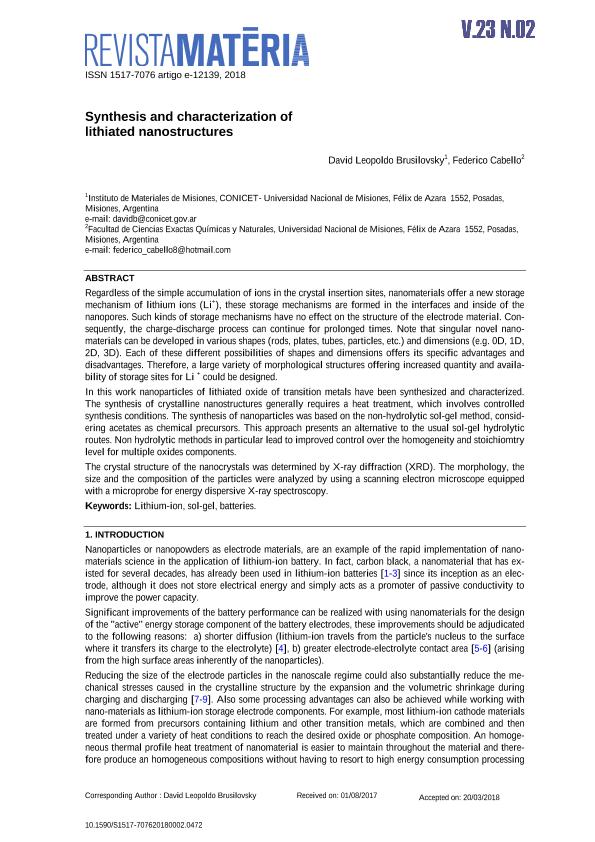
Regardless of the simple accumulation of ions in the crystal insertion sites, nanomaterials offer a new storage mechanism of lithium ions (Li+), these storage mechanisms are formed in the interfaces and inside of the nanopores. Such kinds of storage mechanisms have no effect on the structure of the electrode material. Consequently, the charge-discharge process can continue for prolonged times. Note that singular novel nanomaterials can be developed in various shapes (rods, plates, tubes, particles, etc.) and dimensions (e.g. 0D, 1D, 2D, 3D). Each of these different possibilities of shapes and dimensions offers its specific advantages and disadvantages. Therefore, a large variety of morphological structures offering increased quantity and availability of storage sites for Li+ could be designed. In this work nanoparticles of lithiated oxide of transition metals have been synthesized and characterized. The synthesis of crystalline nanostructures generally requires a heat treatment, which involves controlled synthesis conditions. The synthesis of nanoparticles was based on the non-hydrolytic sol-gel method, considering acetates as chemical precursors. This approach presents an alternative to the usual sol-gel hydrolytic routes. Non hydrolytic methods in particular lead to improved control over the homogeneity and stoichiomtry level for multiple oxides components. The crystal structure of the nanocrystals was determined by X-ray diffraction (XRD). The morphology, the size and the composition of the particles were analyzed by using a scanning electron microscope equipped with a microprobe for energy dispersive X-ray spectroscopy.
Palabras clave:
BATTERIES
,
LITHIUM-ION
,
SOL-GEL
Archivos asociados

Tamaño:
500.3Kb
Formato:
PDF
Licencia
 Excepto donde se diga explícitamente, este item se publica bajo la siguiente descripción:
Creative Commons Attribution 2.5 Unported (CC BY 2.5)
Excepto donde se diga explícitamente, este item se publica bajo la siguiente descripción:
Creative Commons Attribution 2.5 Unported (CC BY 2.5)
Identificadores
Colecciones
Articulos(IMAM)
Articulos de INST.DE MATERIALES DE MISIONES
Articulos de INST.DE MATERIALES DE MISIONES
Citación
Brusilovsky, David Leopoldo; Cabello, Federico; Synthesis and characterization of lithiated nanostructures; Universidade Federal do Rio de Janeiro; Matéria; 23; 2; 7-2018; 1-4
Compartir


Altmétricas