Artículo
Whole genome analysis of codon usage in Echinococcus
Maldonado, Lucas Luciano ; Stegmayer, Georgina
; Milone, Diego Humberto
; Oliveira, Guilherme; Rosenzvit, Mara Cecilia
; Kamenetzky, Laura
; Stegmayer, Georgina
; Milone, Diego Humberto
; Oliveira, Guilherme; Rosenzvit, Mara Cecilia
; Kamenetzky, Laura
; Stegmayer, Georgina
; Milone, Diego Humberto
; Oliveira, Guilherme; Rosenzvit, Mara Cecilia
; Kamenetzky, Laura
Fecha de publicación:
10/2018
Editorial:
Elsevier Science
Revista:
Molecular and Biochemical Parasitology
ISSN:
0166-6851
Idioma:
Inglés
Tipo de recurso:
Artículo publicado
Clasificación temática:
Resumen
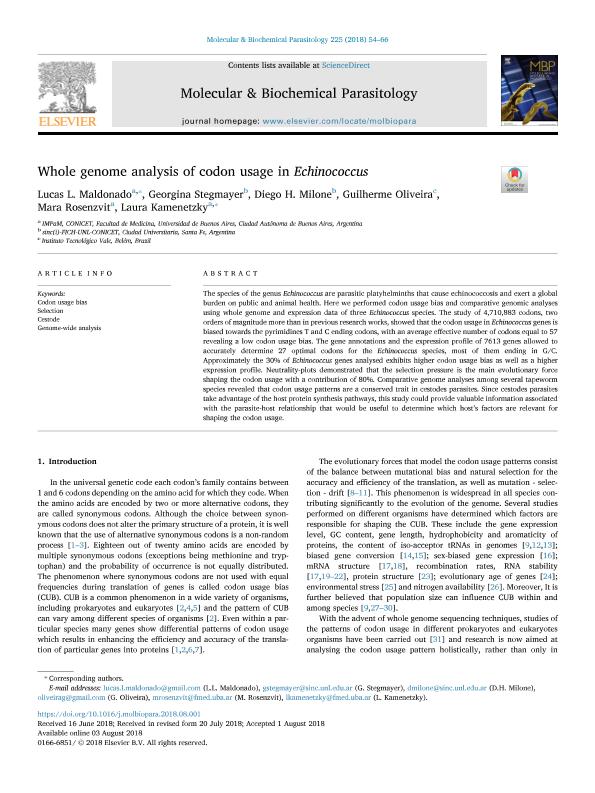
The species of the genus Echinococcus are parasitic platyhelminths that cause echinococcosis and exert a global burden on public and animal health. Here we performed codon usage bias and comparative genomic analyses using whole genome and expression data of three Echinococcus species. The study of 4,710,883 codons, two orders of magnitude more than in previous research works, showed that the codon usage in Echinococcus genes is biased towards the pyrimidines T and C ending codons, with an average effective number of codons equal to 57 revealing a low codon usage bias. The gene annotations and the expression profile of 7613 genes allowed to accurately determine 27 optimal codons for the Echinococcus species, most of them ending in G/C. Approximately the 30% of Echinococcus genes analysed exhibits higher codon usage bias as well as a higher expression profile. Neutrality-plots demonstrated that the selection pressure is the main evolutionary force shaping the codon usage with a contribution of 80%. Comparative genome analyses among several tapeworm species revealed that codon usage patterns are a conserved trait in cestodes parasites. Since cestodes parasites take advantage of the host protein synthesis pathways, this study could provide valuable information associated with the parasite-host relationship that would be useful to determine which host's factors are relevant for shaping the codon usage.
Palabras clave:
CESTODE
,
CODON USAGE BIAS
,
GENOME-WIDE ANALYSIS
,
SELECTION
Archivos asociados

Tamaño:
2.634Mb
Formato:
PDF
Licencia
 Excepto donde se diga explícitamente, este item se publica bajo la siguiente descripción:
Creative Commons Attribution-NonCommercial-ShareAlike 2.5 Unported (CC BY-NC-SA 2.5)
Excepto donde se diga explícitamente, este item se publica bajo la siguiente descripción:
Creative Commons Attribution-NonCommercial-ShareAlike 2.5 Unported (CC BY-NC-SA 2.5)
Identificadores
Colecciones
Articulos(IMPAM)
Articulos de INSTITUTO DE INVESTIGACIONES EN MICROBIOLOGIA Y PARASITOLOGIA MEDICA
Articulos de INSTITUTO DE INVESTIGACIONES EN MICROBIOLOGIA Y PARASITOLOGIA MEDICA
Citación
Maldonado, Lucas Luciano; Stegmayer, Georgina; Milone, Diego Humberto; Oliveira, Guilherme; Rosenzvit, Mara Cecilia; et al.; Whole genome analysis of codon usage in Echinococcus; Elsevier Science; Molecular and Biochemical Parasitology; 225; 10-2018; 54-66
Compartir


Altmétricas