Artículo
The role of regulatory T Cells in autoimmune orchitis

Fecha de publicación:
12/2018
Editorial:
Wiley Blackwell Publishing, Inc
Revista:
Andrologia
ISSN:
0303-4569
e-ISSN:
1439-0272
Idioma:
Inglés
Tipo de recurso:
Artículo publicado
Clasificación temática:
Resumen
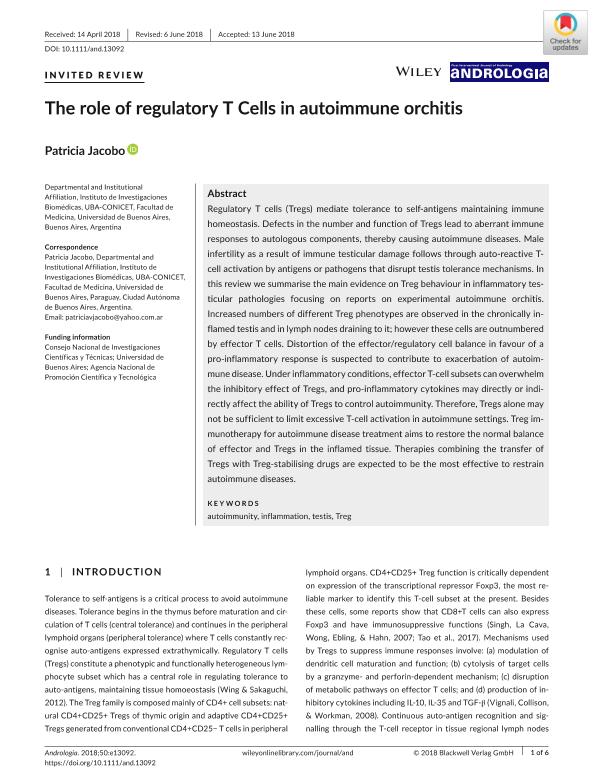
Regulatory T cells (Tregs) mediate tolerance to self-antigens maintaining immune homeostasis. Defects in the number and function of Tregs lead to aberrant immune responses to autologous components, thereby causing autoimmune diseases. Male infertility as a result of immune testicular damage follows through auto-reactive T-cell activation by antigens or pathogens that disrupt testis tolerance mechanisms. In this review we summarise the main evidence on Treg behaviour in inflammatory testicular pathologies focusing on reports on experimental autoimmune orchitis. Increased numbers of different Treg phenotypes are observed in the chronically inflamed testis and in lymph nodes draining to it; however these cells are outnumbered by effector T cells. Distortion of the effector/regulatory cell balance in favour of a pro-inflammatory response is suspected to contribute to exacerbation of autoimmune disease. Under inflammatory conditions, effector T-cell subsets can overwhelm the inhibitory effect of Tregs, and pro-inflammatory cytokines may directly or indirectly affect the ability of Tregs to control autoimmunity. Therefore, Tregs alone may not be sufficient to limit excessive T-cell activation in autoimmune settings. Treg immunotherapy for autoimmune disease treatment aims to restore the normal balance of effector and Tregs in the inflamed tissue. Therapies combining the transfer of Tregs with Treg-stabilising drugs are expected to be the most effective to restrain autoimmune diseases.
Palabras clave:
AUTOIMMUNITY
,
INFLAMMATION
,
TESTIS
,
TREG
Archivos asociados

Tamaño:
449.4Kb
Formato:
PDF
Licencia
 Excepto donde se diga explícitamente, este item se publica bajo la siguiente descripción:
Creative Commons Attribution-NonCommercial-ShareAlike 2.5 Unported (CC BY-NC-SA 2.5)
Excepto donde se diga explícitamente, este item se publica bajo la siguiente descripción:
Creative Commons Attribution-NonCommercial-ShareAlike 2.5 Unported (CC BY-NC-SA 2.5)
Identificadores
Colecciones
Articulos(BIOMED)
Articulos de INSTITUTO DE INVESTIGACIONES BIOMEDICAS
Articulos de INSTITUTO DE INVESTIGACIONES BIOMEDICAS
Articulos(INBIOMED)
Articulos de INSTITUTO DE INVESTIGACIONES BIOMEDICAS
Articulos de INSTITUTO DE INVESTIGACIONES BIOMEDICAS
Citación
Jacobo, Patricia Verónica; The role of regulatory T Cells in autoimmune orchitis; Wiley Blackwell Publishing, Inc; Andrologia; 50; 11; 12-2018; 1-6
Compartir


Altmétricas