Artículo
Pseudoexons provide a mechanism for allele-specific expression of APC in familial adenomatous polyposis
Nieminen, Taina T.; Pavicic, Walter Hernan ; Porkka, Noora; Kankainen, Matti; Järvinen, Heikki J.; Lepistö, Anna; Peltomäki, Päivi
; Porkka, Noora; Kankainen, Matti; Järvinen, Heikki J.; Lepistö, Anna; Peltomäki, Päivi
Fecha de publicación:
09/2016
Editorial:
Impact Journals
Revista:
Oncotarget
ISSN:
1949-2553
Idioma:
Inglés
Tipo de recurso:
Artículo publicado
Clasificación temática:
Resumen
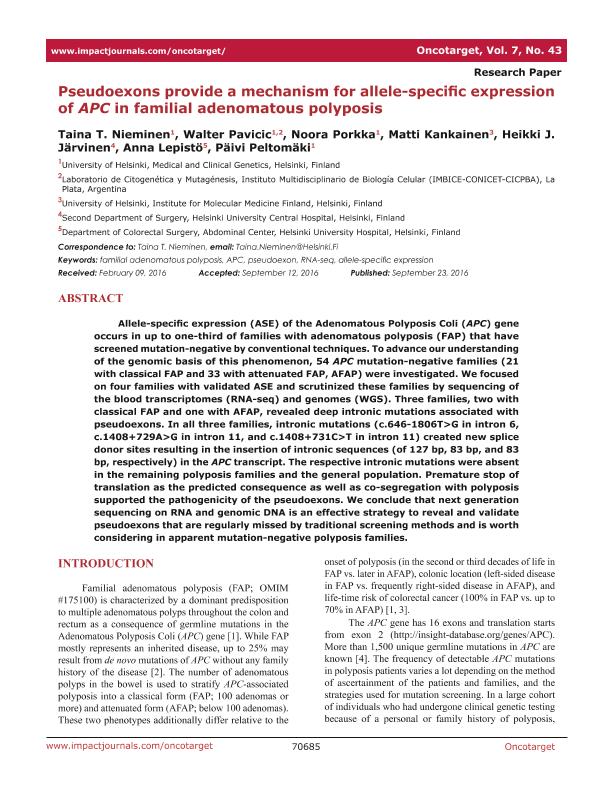
Allele-specific expression (ASE) of the Adenomatous Polyposis Coli (APC) gene occurs in up to one-third of families with adenomatous polyposis (FAP) that have screened mutation-negative by conventional techniques. To advance our understanding of the genomic basis of this phenomenon, 54 APC mutation-negative families (21 with classical FAP and 33 with attenuated FAP, AFAP) were investigated. We focused on four families with validated ASE and scrutinized these families by sequencing of the blood transcriptomes (RNA-seq) and genomes (WGS). Three families, two with classical FAP and one with AFAP, revealed deep intronic mutations associated with pseudoexons. In all three families, intronic mutations (c.646-1806T > G in intron 6, c.1408+729A > G in intron 11, and c.1408+731C > T in intron 11) created new splice donor sites resulting in the insertion of intronic sequences (of 127 bp, 83 bp, and 83 bp, respectively) in the APC transcript. The respective intronic mutations were absent in the remaining polyposis families and the general population. Premature stop of translation as the predicted consequence as well as co-segregation with polyposis supported the pathogenicity of the pseudoexons. We conclude that next generation sequencing on RNA and genomic DNA is an effective strategy to reveal and validate pseudoexons that are regularly missed by traditional screening methods and is worth considering in apparent mutation-negative polyposis families.
Archivos asociados

Tamaño:
3.590Mb
Formato:
PDF
Licencia
 Excepto donde se diga explícitamente, este item se publica bajo la siguiente descripción:
Creative Commons Attribution 2.5 Unported (CC BY 2.5)
Excepto donde se diga explícitamente, este item se publica bajo la siguiente descripción:
Creative Commons Attribution 2.5 Unported (CC BY 2.5)
Identificadores
Colecciones
Articulos(IMBICE)
Articulos de INST.MULTIDISCIPL.DE BIOLOGIA CELULAR (I)
Articulos de INST.MULTIDISCIPL.DE BIOLOGIA CELULAR (I)
Citación
Nieminen, Taina T.; Pavicic, Walter Hernan; Porkka, Noora; Kankainen, Matti; Järvinen, Heikki J.; et al.; Pseudoexons provide a mechanism for allele-specific expression of APC in familial adenomatous polyposis; Impact Journals; Oncotarget; 7; 43; 9-2016; 70685-70698
Compartir


Altmétricas