Artículo
An efficient and cyclic hydrogen evolution reaction mechanism on [Ni(P H 2NH 2)2]2+ catalysts: A theoretical and multiscale simulation study
Senthilnathan, Dhurairajan; Giunta, Pablo Daniel ; Vetere, Valentina; Kachmar, Ali; Maldivi, Pascale; Franco, Alejandro A.
; Vetere, Valentina; Kachmar, Ali; Maldivi, Pascale; Franco, Alejandro A.
Fecha de publicación:
10/2014
Editorial:
Royal Society of Chemistry
Revista:
RSC Advances
ISSN:
2046-2069
Idioma:
Inglés
Tipo de recurso:
Artículo publicado
Clasificación temática:
Resumen
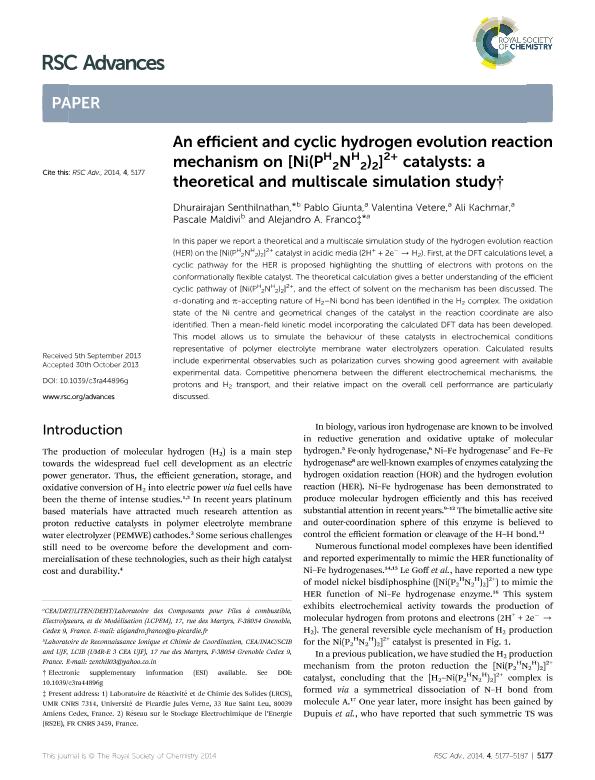
In this paper we report a theoretical and a multiscale simulation study of the hydrogen evolution reaction (HER) on the [Ni(PH 2N H 2)2]2+ catalyst in acidic media (2H+ + 2e- → H2). First, at the DFT calculations level, a cyclic pathway for the HER is proposed highlighting the shuttling of electrons with protons on the conformationally flexible catalyst. The theoretical calculation gives a better understanding of the efficient cyclic pathway of [Ni(PH 2NH 2) 2]2+, and the effect of solvent on the mechanism has been discussed. The σ-donating and π-accepting nature of H2-Ni bond has been identified in the H2 complex. The oxidation state of the Ni centre and geometrical changes of the catalyst in the reaction coordinate are also identified. Then a mean-field kinetic model incorporating the calculated DFT data has been developed. This model allows us to simulate the behaviour of these catalysts in electrochemical conditions representative of polymer electrolyte membrane water electrolyzers operation. Calculated results include experimental observables such as polarization curves showing good agreement with available experimental data. Competitive phenomena between the different electrochemical mechanisms, the protons and H2 transport, and their relative impact on the overall cell performance are particularly discussed.
Palabras clave:
HYDROGEN
,
MULTISCALE
,
SIMULATION
Archivos asociados

Tamaño:
1.035Mb
Formato:
PDF
Licencia
 Excepto donde se diga explícitamente, este item se publica bajo la siguiente descripción:
Creative Commons Attribution-NonCommercial-ShareAlike 2.5 Unported (CC BY-NC-SA 2.5)
Excepto donde se diga explícitamente, este item se publica bajo la siguiente descripción:
Creative Commons Attribution-NonCommercial-ShareAlike 2.5 Unported (CC BY-NC-SA 2.5)
Identificadores
Colecciones
Articulos(ITHES)
Articulos de INST. DE TECNOLOGIAS DEL HIDROGENO Y ENERGIAS SOSTENIBLES
Articulos de INST. DE TECNOLOGIAS DEL HIDROGENO Y ENERGIAS SOSTENIBLES
Citación
Senthilnathan, Dhurairajan; Giunta, Pablo Daniel; Vetere, Valentina; Kachmar, Ali; Maldivi, Pascale; et al.; An efficient and cyclic hydrogen evolution reaction mechanism on [Ni(P H 2NH 2)2]2+ catalysts: A theoretical and multiscale simulation study; Royal Society of Chemistry; RSC Advances; 4; 10; 10-2014; 5177-5187
Compartir


Altmétricas