Mostrar el registro sencillo del ítem
dc.contributor.author
Ghiberto, Pablo Javier
dc.contributor.author
Pilatti, Miguel Angel
dc.contributor.author
Imhoff, Silvia del Carmen
dc.contributor.author
ORELLANA, JORGE ALBERTO de
dc.date.available
2019-09-29T22:40:49Z
dc.date.issued
2007-03
dc.identifier.citation
Ghiberto, Pablo Javier; Pilatti, Miguel Angel; Imhoff, Silvia del Carmen; ORELLANA, JORGE ALBERTO de; Hydraulic conductivity of Molisolls irrigated with sodic-bicarbonated waters in Santa Fe (Argentine); Elsevier Science; Agricultural Water Management; 88; 1-3; 3-2007; 192-200
dc.identifier.issn
0378-3774
dc.identifier.uri
http://hdl.handle.net/11336/84802
dc.description.abstract
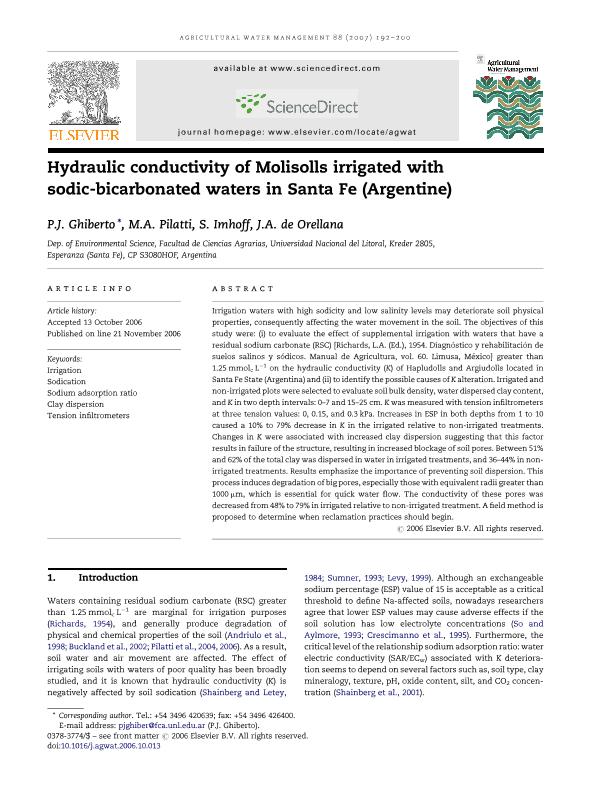
Irrigation waters with high sodicity and low salinity levels may deteriorate soil physical properties, consequently affecting the water movement in the soil. The objectives of this study were: (i) to evaluate the effect of supplemental irrigation with waters that have a residual sodium carbonate (RSC) [Richards, L.A. (Ed.), 1954. Diagnóstico y rehabilitación de suelos salinos y sódicos. Manual de Agricultura, vol. 60. Limusa, México] greater than 1.25 mmolc L-1 on the hydraulic conductivity (K) of Hapludolls and Argiudolls located in Santa Fe State (Argentina) and (ii) to identify the possible causes of K alteration. Irrigated and non-irrigated plots were selected to evaluate soil bulk density, water dispersed clay content, and K in two depth intervals: 0-7 and 15-25 cm. K was measured with tension infiltrometers at three tension values: 0, 0.15, and 0.3 kPa. Increases in ESP in both depths from 1 to 10 caused a 10% to 79% decrease in K in the irrigated relative to non-irrigated treatments. Changes in K were associated with increased clay dispersion suggesting that this factor results in failure of the structure, resulting in increased blockage of soil pores. Between 51% and 62% of the total clay was dispersed in water in irrigated treatments, and 36-44% in non-irrigated treatments. Results emphasize the importance of preventing soil dispersion. This process induces degradation of big pores, especially those with equivalent radii greater than 1000 μm, which is essential for quick water flow. The conductivity of these pores was decreased from 48% to 79% in irrigated relative to non-irrigated treatment. A field method is proposed to determine when reclamation practices should begin.
dc.format
application/pdf
dc.language.iso
eng
dc.publisher
Elsevier Science
dc.rights
info:eu-repo/semantics/openAccess
dc.rights.uri
https://creativecommons.org/licenses/by-nc-sa/2.5/ar/
dc.subject
CLAY DISPERSION
dc.subject
IRRIGATION
dc.subject
SODICATION
dc.subject
SODIUM ADSORPTION RATIO
dc.subject
TENSION INFILTROMETERS
dc.subject.classification
Ciencias del Suelo
dc.subject.classification
Agricultura, Silvicultura y Pesca
dc.subject.classification
CIENCIAS AGRÍCOLAS
dc.title
Hydraulic conductivity of Molisolls irrigated with sodic-bicarbonated waters in Santa Fe (Argentine)
dc.type
info:eu-repo/semantics/article
dc.type
info:ar-repo/semantics/artículo
dc.type
info:eu-repo/semantics/publishedVersion
dc.date.updated
2019-09-27T14:17:16Z
dc.journal.volume
88
dc.journal.number
1-3
dc.journal.pagination
192-200
dc.journal.pais
Países Bajos
dc.journal.ciudad
Amsterdam
dc.description.fil
Fil: Ghiberto, Pablo Javier. Universidad Nacional del Litoral; Argentina
dc.description.fil
Fil: Pilatti, Miguel Angel. Universidad Nacional del Litoral; Argentina
dc.description.fil
Fil: Imhoff, Silvia del Carmen. Consejo Nacional de Investigaciones Científicas y Técnicas. Centro Científico Tecnológico Conicet - Santa Fe. Instituto de Agrobiotecnología del Litoral. Universidad Nacional del Litoral. Instituto de Agrobiotecnología del Litoral; Argentina
dc.description.fil
Fil: ORELLANA, JORGE ALBERTO de. Universidad Nacional del Litoral; Argentina
dc.journal.title
Agricultural Water Management
dc.relation.alternativeid
info:eu-repo/semantics/altIdentifier/doi/http://dx.doi.org/10.1016/j.agwat.2006.10.013
Archivos asociados

Tamaño:
469.4Kb
Formato:
PDF