Mostrar el registro sencillo del ítem
dc.contributor.author
Alvarez, Luis Ignacio
dc.contributor.author
Suárez, G.
dc.contributor.author
Ceballos, Laura
dc.contributor.author
Moreno Torrejon, Laura
dc.contributor.author
Lanusse, Carlos Edmundo
dc.date.available
2019-09-18T20:04:23Z
dc.date.issued
2012-08
dc.identifier.citation
Alvarez, Luis Ignacio; Suárez, G.; Ceballos, Laura; Moreno Torrejon, Laura; Lanusse, Carlos Edmundo; Dose-dependent systemic exposure of albendazole metabolites in lambs; Wiley Blackwell Publishing, Inc; Journal of Veterinary Pharmacology and Therapeutics; 35; 4; 8-2012; 365-372
dc.identifier.issn
0140-7783
dc.identifier.uri
http://hdl.handle.net/11336/83878
dc.description.abstract
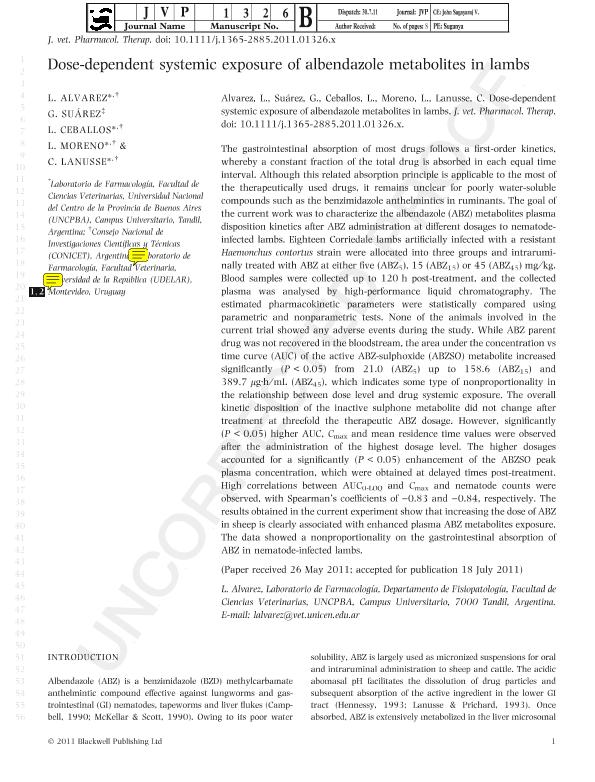
The gastrointestinal absorption of most drugs follows a first-order kinetics, whereby a constant fraction of the total drug is absorbed in each equal time interval. Although this related absorption principle is applicable to the most of the therapeutically used drugs, it remains unclear for poorly water-soluble compounds such as the benzimidazole anthelmintics in ruminants. The goal of the current work was to characterize the albendazole (ABZ) metabolites plasma disposition kinetics after ABZ administration at different dosages to nematode-infected lambs. Eighteen Corriedale lambs artificially infected with a resistant Haemonchus contortus strain were allocated into three groups and intraruminally treated with ABZ at either 5 (ABZ5), 15 (ABZ15) or 45 (ABZ45) mg/kg. Blood samples were collected up to 120h post-treatment, and the collected plasma was analysed by high-performance liquid chromatography. The estimated pharmacokinetic parameters were statistically compared using parametric and nonparametric tests. None of the animals involved in the current trial showed any adverse events during the study. While ABZ parent drug was not recovered in the bloodstream, the area under the concentration vs time curve (AUC) of the active ABZ-sulphoxide (ABZSO) metabolite increased significantly (P<0.05) from 21.0 (ABZ5) up to 158.6 (ABZ15) and 389.7μg·h/mL (ABZ45), which indicates some type of nonproportionality in the relationship between dose level and drug systemic exposure. The overall kinetic disposition of the inactive sulphone metabolite did not change after treatment at threefold the therapeutic ABZ dosage. However, significantly (P<0.05) higher AUC, Cmax and mean residence time values were observed after the administration of the highest dosage level. The higher dosages accounted for a significantly (P<0.05) enhancement of the ABZSO peak plasma concentration, which were obtained at delayed times post-treatment. High correlations between AUC0-LOQ and Cmax and nematode counts were observed, with Spearman's coefficients of -0.83 and -0.84, respectively. The results obtained in the current experiment show that increasing the dose of ABZ in sheep is clearly associated with enhanced plasma ABZ metabolites exposure. The data showed a nonproportionality on the gastrointestinal absorption of ABZ in nematode-infected lambs.
dc.format
application/pdf
dc.language.iso
eng
dc.publisher
Wiley Blackwell Publishing, Inc
dc.rights
info:eu-repo/semantics/openAccess
dc.rights.uri
https://creativecommons.org/licenses/by-nc-sa/2.5/ar/
dc.subject
Level Dose
dc.subject
Albendazole
dc.subject
Plasma
dc.subject
Lamb
dc.subject.classification
Otras Ciencias Veterinarias
dc.subject.classification
Ciencias Veterinarias
dc.subject.classification
CIENCIAS AGRÍCOLAS
dc.title
Dose-dependent systemic exposure of albendazole metabolites in lambs
dc.type
info:eu-repo/semantics/article
dc.type
info:ar-repo/semantics/artículo
dc.type
info:eu-repo/semantics/publishedVersion
dc.date.updated
2019-07-24T17:40:48Z
dc.journal.volume
35
dc.journal.number
4
dc.journal.pagination
365-372
dc.journal.pais
Reino Unido
dc.journal.ciudad
Londres
dc.description.fil
Fil: Alvarez, Luis Ignacio. Consejo Nacional de Investigaciones Científicas y Técnicas. Centro Científico Tecnológico Conicet - Tandil. Centro de Investigación Veterinaria de Tandil. Universidad Nacional del Centro de la Provincia de Buenos Aires. Centro de Investigación Veterinaria de Tandil. Provincia de Buenos Aires. Gobernación. Comision de Investigaciones Científicas. Centro de Investigación Veterinaria de Tandil; Argentina
dc.description.fil
Fil: Suárez, G.. Universidad de la República; Uruguay
dc.description.fil
Fil: Ceballos, Laura. Consejo Nacional de Investigaciones Científicas y Técnicas; Argentina. Universidad Nacional del Centro de la Provincia de Buenos Aires. Facultad de Ciencias Veterinarias. Departamento de Fisiopatología. Laboratorio de Farmacología; Argentina
dc.description.fil
Fil: Moreno Torrejon, Laura. Consejo Nacional de Investigaciones Científicas y Técnicas. Centro Científico Tecnológico Conicet - Tandil. Centro de Investigación Veterinaria de Tandil. Universidad Nacional del Centro de la Provincia de Buenos Aires. Centro de Investigación Veterinaria de Tandil. Provincia de Buenos Aires. Gobernación. Comision de Investigaciones Científicas. Centro de Investigación Veterinaria de Tandil; Argentina
dc.description.fil
Fil: Lanusse, Carlos Edmundo. Consejo Nacional de Investigaciones Científicas y Técnicas. Centro Científico Tecnológico Conicet - Tandil. Centro de Investigación Veterinaria de Tandil. Universidad Nacional del Centro de la Provincia de Buenos Aires. Centro de Investigación Veterinaria de Tandil. Provincia de Buenos Aires. Gobernación. Comision de Investigaciones Científicas. Centro de Investigación Veterinaria de Tandil; Argentina
dc.journal.title
Journal of Veterinary Pharmacology and Therapeutics
dc.relation.alternativeid
info:eu-repo/semantics/altIdentifier/doi/http://dx.doi.org/10.1111/j.1365-2885.2011.01326.x
dc.relation.alternativeid
info:eu-repo/semantics/altIdentifier/url/https://onlinelibrary.wiley.com/doi/abs/10.1111/j.1365-2885.2011.01326.x
Archivos asociados

Tamaño:
753.5Kb
Formato:
PDF