Artículo
Element homology and the evolution of dental formulae in Megachiropteran bats (mammalia: chiroptera: pteropodidae)

Fecha de publicación:
12/2007
Editorial:
American Museum of Natural History
Revista:
American Museum Novitates
ISSN:
0003-0082
Idioma:
Inglés
Tipo de recurso:
Artículo publicado
Clasificación temática:
Resumen
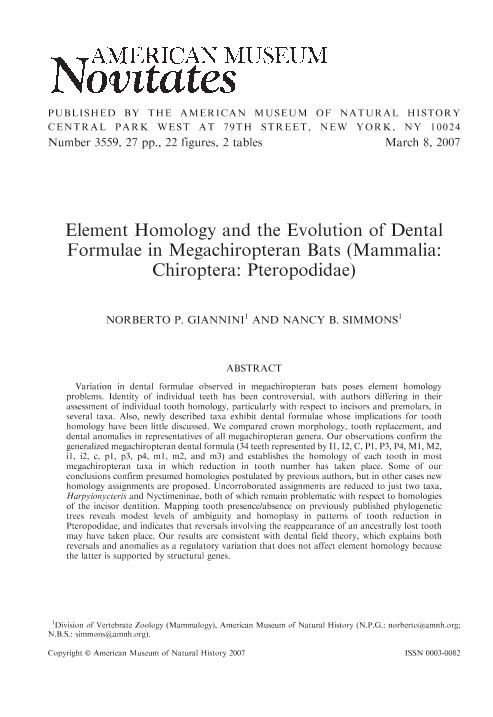
Variation in dental formulae observed in megachiropteran bats poses element homology problems. Identity of individual teeth has been controversial, with authors differing in their assessment of individual tooth homology, particularly with respect to incisors and premolars, in<br />several taxa. Also, newly described taxa exhibit dental formulae whose implications for tooth<br />homology have been little discussed. We compared crown morphology, tooth replacement, and<br />dental anomalies in representatives of all megachiropteran genera. Our observations confirm the<br />generalized megachiropteran dental formula (34 teeth represented by I1, I2, C, P1, P3, P4, M1, M2, i1, i2, c, p1, p3, p4, m1, m2, and m3) and establishes the homology of each tooth in most<br />megachiropteran taxa in which reduction in tooth number has taken place. Some of our conclusions confirm presumed homologies postulated by previous authors, but in other cases new homology assignments are proposed. Uncorroborated assignments are reduced to just two taxa, Harpyionycteris and Nyctimeninae, both of which remain problematic with respect to homologies of the incisor dentition. Mapping tooth presence/absence on previously published phylogenetic trees reveals modest levels of ambiguity and homoplasy in patterns of tooth reduction in Pteropodidae, and indicates that reversals involving the reappearance of an ancestrally lost tooth may have taken place. Our results are consistent with dental field theory, which explains both reversals and anomalies as a regulatory variation that does not affect element homology because the latter is supported by structural genes.
Palabras clave:
Skull Osteology
,
Chiroptera
Archivos asociados

Tamaño:
4.639Mb
Formato:
PDF
Licencia
 Excepto donde se diga explícitamente, este item se publica bajo la siguiente descripción:
Creative Commons Attribution-NonCommercial-ShareAlike 2.5 Unported (CC BY-NC-SA 2.5)
Excepto donde se diga explícitamente, este item se publica bajo la siguiente descripción:
Creative Commons Attribution-NonCommercial-ShareAlike 2.5 Unported (CC BY-NC-SA 2.5)
Identificadores
Colecciones
Articulos(CCT - NOA SUR)
Articulos de CTRO.CIENTIFICO TECNOL.CONICET - NOA SUR
Articulos de CTRO.CIENTIFICO TECNOL.CONICET - NOA SUR
Citación
Giannini, Norberto Pedro; Simmons, Nancy B.; Element homology and the evolution of dental formulae in Megachiropteran bats (mammalia: chiroptera: pteropodidae); American Museum of Natural History; American Museum Novitates; 3559; 12-2007; 1-27
Compartir

