Artículo
Metabolic stress and shell thinning in Pomacea canaliculata (Caenogastropoda, Ampullaridae) in rice agroecosystems of Argentina
Attademo, Andres Maximiliano ; Tamburi, Nicolas Eduardo
; Peltzer, Paola
; Lajmanovich, Rafael Carlos
; Martinuzzi, Candela Soledad
; Tamburi, Nicolas Eduardo
; Peltzer, Paola
; Lajmanovich, Rafael Carlos
; Martinuzzi, Candela Soledad
; Tamburi, Nicolas Eduardo
; Peltzer, Paola
; Lajmanovich, Rafael Carlos
; Martinuzzi, Candela Soledad
Fecha de publicación:
11/2018
Editorial:
Research Trends
Revista:
Current Topics in Toxicology
ISSN:
0972-8228
Idioma:
Inglés
Tipo de recurso:
Artículo publicado
Clasificación temática:
Resumen
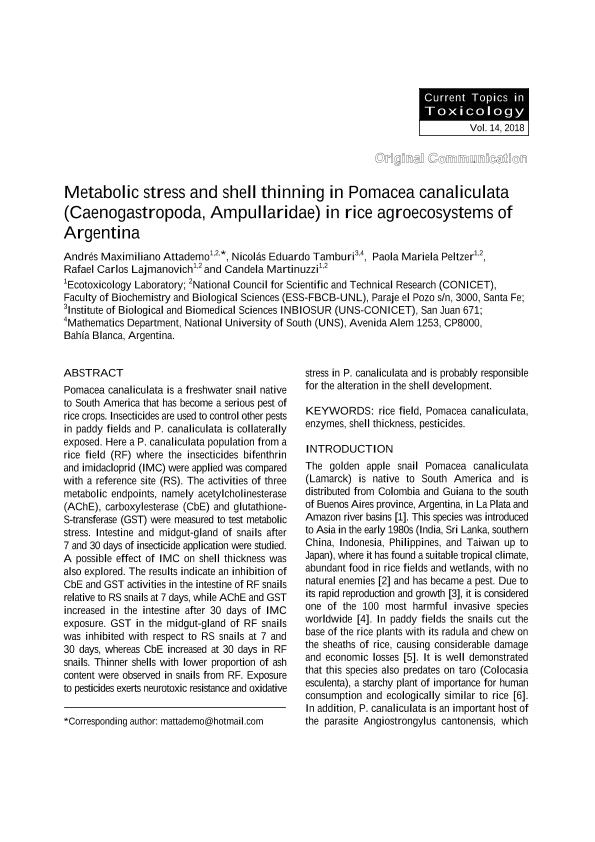
Pomacea canaliculata is a freshwater snail native to South America that has become a serious pest of rice crops. Insecticides are used to control other pests in paddy fields and P. canaliculata is collaterally exposed. Here a P. canaliculata population from a rice field (RF) where the insecticides bifenthrin and imidacloprid (IMC) were applied was compared with a reference site (RS). The activities of three metabolic endpoints, namely acetylcholinesterase (AChE), carboxylesterase (CbE) and glutathione-S-transferase (GST) were measured to test metabolic stress. Intestine and midgut-gland of snails after 7 and 30 days of insecticide application were studied. A possible effect of IMC on shell thickness was also explored. The results indicate an inhibition of CbE and GST activities in the intestine of RF snails relative to RS snails at 7 days, while AChE and GST increased in the intestine after 30 days of IMC exposure. GST in the midgut-gland of RF snails was inhibited with respect to RS snails at 7 and 30 days, whereas CbE increased at 30 days in RF snails. Thinner shells with lower proportion of ash content were observed in snails from RF. Exposure to pesticides exerts neurotoxic resistance and oxidative stress in P. canaliculata and is probably responsible for the alteration in the shell development.
Palabras clave:
Shell Tickness
,
Rice Field
,
Pomacea Canaliculata
,
Enzymes
,
Pesticides
Archivos asociados

Tamaño:
381.8Kb
Formato:
PDF
Licencia
 Excepto donde se diga explícitamente, este item se publica bajo la siguiente descripción:
Creative Commons Attribution-NonCommercial-ShareAlike 2.5 Unported (CC BY-NC-SA 2.5)
Excepto donde se diga explícitamente, este item se publica bajo la siguiente descripción:
Creative Commons Attribution-NonCommercial-ShareAlike 2.5 Unported (CC BY-NC-SA 2.5)
Identificadores
Colecciones
Articulos(CCT - SANTA FE)
Articulos de CTRO.CIENTIFICO TECNOL.CONICET - SANTA FE
Articulos de CTRO.CIENTIFICO TECNOL.CONICET - SANTA FE
Articulos(INBIOSUR)
Articulos de INSTITUTO DE CIENCIAS BIOLOGICAS Y BIOMEDICAS DEL SUR
Articulos de INSTITUTO DE CIENCIAS BIOLOGICAS Y BIOMEDICAS DEL SUR
Citación
Attademo, Andres Maximiliano; Tamburi, Nicolas Eduardo; Peltzer, Paola; Lajmanovich, Rafael Carlos; Martinuzzi, Candela Soledad; Metabolic stress and shell thinning in Pomacea canaliculata (Caenogastropoda, Ampullaridae) in rice agroecosystems of Argentina; Research Trends; Current Topics in Toxicology; 14; 11-2018; 53-65
Compartir

