Artículo
Scaling properties of a ferromagnetic thin film model at the depinning transition

Fecha de publicación:
10/2015
Editorial:
Iop Publishing
Revista:
Journal Of Statistical Mechanics: Theory And Experiment
ISSN:
1742-5468
Idioma:
Inglés
Tipo de recurso:
Artículo publicado
Clasificación temática:
Resumen
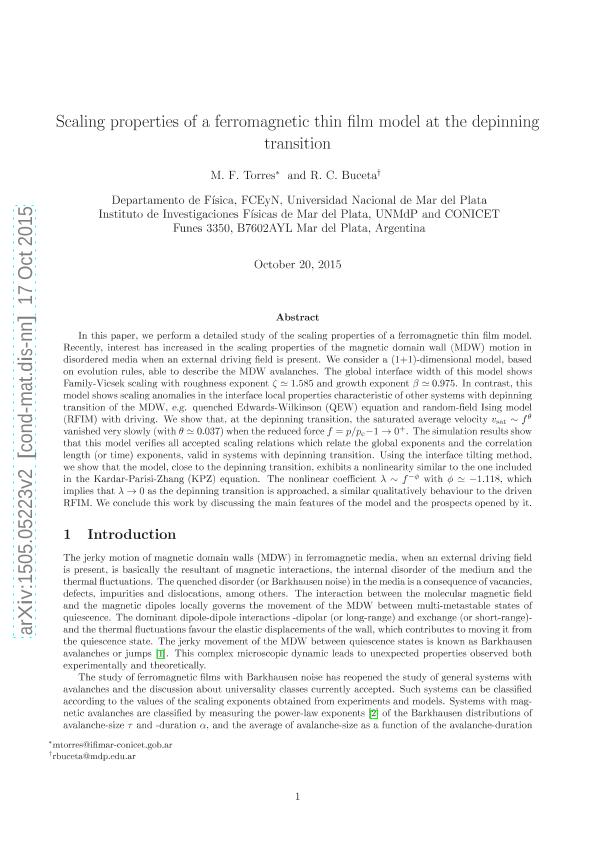
In this paper, we perform a detailed study of the scaling properties of a ferromagnetic thin film model. Recently, interest has increased in the scaling properties of the magnetic domain wall (MDW) motion in disordered media when an external driving field is present. We consider a (1+1)-dimensional model, based on evolution rules, able to describe the MDW avalanches. The global interface width of this model shows Family-Vicsek scaling with roughness exponent ζ ≃ 1.585 and growth exponent β ≃ 0.975. In contrast, this model shows scaling anomalies in the interface local properties characteristic of other systems with depinning transition of the MDW, e.g. the quenched Edwards-Wilkinson (QEW) equation and random-field Ising model (RFIM) with driving. We show that, at the depinning transition, the saturated average velocity vsat ∼ f^θ vanishes very slowly (with θ ≃ 0.037) when the reduced force f = p/p_c−1 → 0^+. The simulation results show that this model verifies all accepted scaling relations which relate the global exponents and the correlation length (or time) exponents, valid in systems with a depinning transition. Using the interface tilting method, we show that the model, close to the depinning transition, exhibits a nonlinearity similar to the one included in the Kardar-Parisi-Zhang (KPZ) equation. The nonlinear coefficient λ ∼ f^(−φ) with φ ≃ −1.118, which implies that λ → 0 as the depinning transition is approached, a similar qualitative behaviour to the driven RFIM. We conclude this work by discussing the main features of the model and the prospects opened by it.
Archivos asociados

Tamaño:
193.2Kb
Formato:
PDF
Licencia
 Excepto donde se diga explícitamente, este item se publica bajo la siguiente descripción:
Creative Commons Attribution-NonCommercial-ShareAlike 2.5 Unported (CC BY-NC-SA 2.5)
Excepto donde se diga explícitamente, este item se publica bajo la siguiente descripción:
Creative Commons Attribution-NonCommercial-ShareAlike 2.5 Unported (CC BY-NC-SA 2.5)
Identificadores
Colecciones
Articulos(IFIMAR)
Articulos de INST.DE INVESTIGACIONES FISICAS DE MAR DEL PLATA
Articulos de INST.DE INVESTIGACIONES FISICAS DE MAR DEL PLATA
Citación
Torres Rasmussen, Marcos Fernando; Buceta, Ruben Carlos; Scaling properties of a ferromagnetic thin film model at the depinning transition; Iop Publishing; Journal Of Statistical Mechanics: Theory And Experiment; 2015; 10; 10-2015; 1-13
Compartir


Altmétricas