Artículo
Signal transduction pathways involved in non-genomic action of estrone on vascular tissue
Massheimer, Virginia Laura ; Polini, Nélida Nora; Alvarez, Cristina; Benozzi, Silvia; Rauschemberger, María Belén
; Sellés, Juana
; Polini, Nélida Nora; Alvarez, Cristina; Benozzi, Silvia; Rauschemberger, María Belén
; Sellés, Juana
; Polini, Nélida Nora; Alvarez, Cristina; Benozzi, Silvia; Rauschemberger, María Belén
; Sellés, Juana
Fecha de publicación:
10/2006
Editorial:
Elsevier Science Inc
Revista:
Steroids
ISSN:
0039-128X
Idioma:
Inglés
Tipo de recurso:
Artículo publicado
Clasificación temática:
Resumen
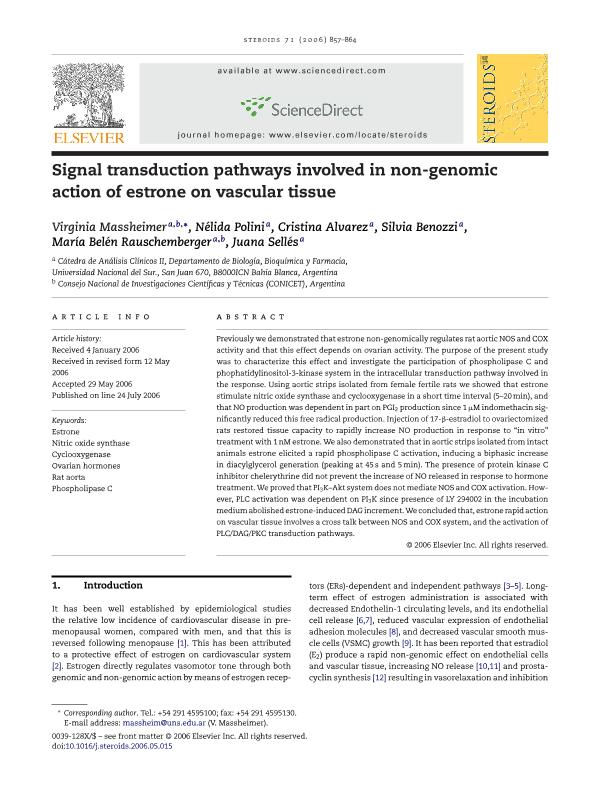
Previously we demonstrated that estrone non-genomically regulates rat aortic NOS and COX activity and that this effect depends on ovarian activity. The purpose of the present study was to characterize this effect and investigate the participation of phospholipase C and phophatidylinositol-3-kinase system in the intracellular transduction pathway involved in the response. Using aortic strips isolated from female fertile rats we showed that estrone stimulate nitric oxide synthase and cyclooxygenase in a short time interval (5-20 min), and that NO production was dependent in part on PGI2 production since 1 μM indomethacin significantly reduced this free radical production. Injection of 17-β-estradiol to ovariectomized rats restored tissue capacity to rapidly increase NO production in response to "in vitro" treatment with 1 nM estrone. We also demonstrated that in aortic strips isolated from intact animals estrone elicited a rapid phospholipase C activation, inducing a biphasic increase in diacylglycerol generation (peaking at 45 s and 5 min). The presence of protein kinase C inhibitor chelerythrine did not prevent the increase of NO released in response to hormone treatment. We proved that PI3K-Akt system does not mediate NOS and COX activation. However, PLC activation was dependent on PI3K since presence of LY 294002 in the incubation medium abolished estrone-induced DAG increment. We concluded that, estrone rapid action on vascular tissue involves a cross talk between NOS and COX system, and the activation of PLC/DAG/PKC transduction pathways.
Archivos asociados

Tamaño:
367.5Kb
Formato:
PDF
Licencia
 Excepto donde se diga explícitamente, este item se publica bajo la siguiente descripción:
Creative Commons Attribution-NonCommercial-ShareAlike 2.5 Unported (CC BY-NC-SA 2.5)
Excepto donde se diga explícitamente, este item se publica bajo la siguiente descripción:
Creative Commons Attribution-NonCommercial-ShareAlike 2.5 Unported (CC BY-NC-SA 2.5)
Identificadores
Colecciones
Articulos(CCT - BAHIA BLANCA)
Articulos de CTRO.CIENTIFICO TECNOL.CONICET - BAHIA BLANCA
Articulos de CTRO.CIENTIFICO TECNOL.CONICET - BAHIA BLANCA
Citación
Massheimer, Virginia Laura; Polini, Nélida Nora; Alvarez, Cristina; Benozzi, Silvia; Rauschemberger, María Belén; et al.; Signal transduction pathways involved in non-genomic action of estrone on vascular tissue; Elsevier Science Inc; Steroids; 71; 10; 10-2006; 857-864
Compartir


Altmétricas