Artículo
Toxicity of non-pyrethroid insecticides against Triatoma infestans (Hemiptera: Reduviidae)

Fecha de publicación:
08/2012
Editorial:
Fundação Oswaldo Cruz
Revista:
Memórias do Instituto Oswaldo Cruz
ISSN:
0074-0276
e-ISSN:
1678-8060
Idioma:
Inglés
Tipo de recurso:
Artículo publicado
Clasificación temática:
Resumen
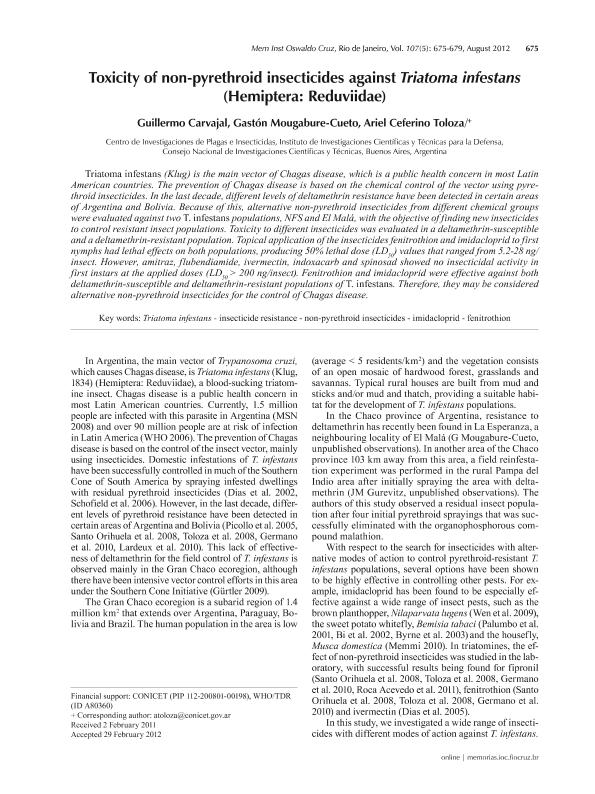
Triatoma infestans (Klug) is the main vector of Chagas disease, which is a public health concern in most Latin American countries. The prevention of Chagas disease is based on the chemical control of the vector using pyrethroid insecticides. In the last decade, different levels of deltamethrin resistance have been detected in certain areas of Argentina and Bolivia. Because of this, alternative non-pyrethroid insecticides from different chemical groups were evaluated against two T. infestans populations, NFS and El Malá, with the objective of finding new insecticides to control resistant insect populations. Toxicity to different insecticides was evaluated in a deltamethrin-susceptible and a deltamethrin-resistant population. Topical application of the insecticides fenitrothion and imidacloprid to first nymphs had lethal effects on both populations, producing 50% lethal dose (LD50) values that ranged from 5.2-28 ng/insect. However, amitraz, flubendiamide, ivermectin, indoxacarb and spinosad showed no insecticidal activity in first instars at the applied doses (LD50 > 200 ng/insect). Fenitrothion and imidacloprid were effective against both deltamethrin-susceptible and deltamethrin-resistant populations of T. infestans. Therefore, they may be considered alternative non-pyrethroid insecticides for the control of Chagas disease.
Archivos asociados

Tamaño:
340.6Kb
Formato:
PDF
Licencia
 Excepto donde se diga explícitamente, este item se publica bajo la siguiente descripción:
Creative Commons Attribution-NonCommercial-ShareAlike 2.5 Unported (CC BY-NC-SA 2.5)
Excepto donde se diga explícitamente, este item se publica bajo la siguiente descripción:
Creative Commons Attribution-NonCommercial-ShareAlike 2.5 Unported (CC BY-NC-SA 2.5)
Identificadores
Colecciones
Articulos(UNIDEF)
Articulos de UNIDAD DE INVESTIGACION Y DESARROLLO ESTRATEGICOS PARA LA DEFENSA
Articulos de UNIDAD DE INVESTIGACION Y DESARROLLO ESTRATEGICOS PARA LA DEFENSA
Citación
Carvajal, Guillermo; Mougabure Cueto, Gastón Adolfo; Toloza, Ariel Ceferino; Toxicity of non-pyrethroid insecticides against Triatoma infestans (Hemiptera: Reduviidae); Fundação Oswaldo Cruz; Memórias do Instituto Oswaldo Cruz; 107; 5; 8-2012; 675-679
Compartir


Altmétricas