Artículo
Circadian system responses to nocturnal and diurnal hosts in the kissing bug, Triatoma infestans
Lopez, Pablo Martin ; Abrahan, Luciana Beatriz
; Ralph, Martin Roland; Valentinuzzi, Verónica Sandra
; Abrahan, Luciana Beatriz
; Ralph, Martin Roland; Valentinuzzi, Verónica Sandra
; Abrahan, Luciana Beatriz
; Ralph, Martin Roland; Valentinuzzi, Verónica Sandra
Fecha de publicación:
10/2018
Editorial:
Taylor & Francis
Revista:
Chronobiology International
ISSN:
0742-0528
Idioma:
Inglés
Tipo de recurso:
Artículo publicado
Clasificación temática:
Resumen
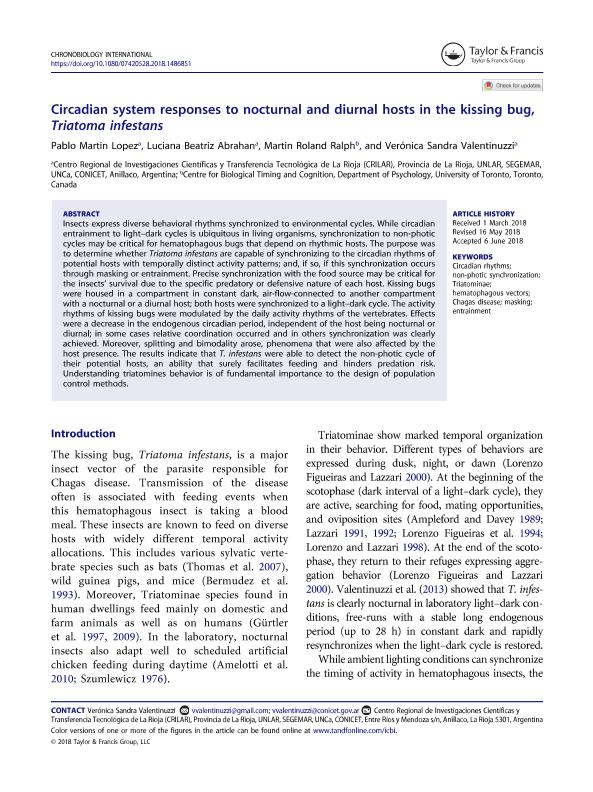
Insects express diverse behavioral rhythms synchronized to environmental cycles. While circadian entrainment to light–dark cycles is ubiquitous in living organisms, synchronization to non-photic cycles may be critical for hematophagous bugs that depend on rhythmic hosts. The purpose was to determine whether Triatoma infestans are capable of synchronizing to the circadian rhythms of potential hosts with temporally distinct activity patterns; and, if so, if this synchronization occurs through masking or entrainment. Precise synchronization with the food source may be critical for the insects’ survival due to the specific predatory or defensive nature of each host. Kissing bugs were housed in a compartment in constant dark, air-flow-connected to another compartment with a nocturnal or a diurnal host; both hosts were synchronized to a light–dark cycle. The activity rhythms of kissing bugs were modulated by the daily activity rhythms of the vertebrates. Effects were a decrease in the endogenous circadian period, independent of the host being nocturnal or diurnal; in some cases relative coordination occurred and in others synchronization was clearly achieved. Moreover, splitting and bimodality arose, phenomena that were also affected by the host presence. The results indicate that T. infestans were able to detect the non-photic cycle of their potential hosts, an ability that surely facilitates feeding and hinders predation risk. Understanding triatomines behavior is of fundamental importance to the design of population control methods.
Archivos asociados

Tamaño:
1.669Mb
Formato:
PDF
Licencia
 Excepto donde se diga explícitamente, este item se publica bajo la siguiente descripción:
Creative Commons Attribution-NonCommercial-ShareAlike 2.5 Unported (CC BY-NC-SA 2.5)
Excepto donde se diga explícitamente, este item se publica bajo la siguiente descripción:
Creative Commons Attribution-NonCommercial-ShareAlike 2.5 Unported (CC BY-NC-SA 2.5)
Identificadores
Colecciones
Articulos(CRILAR)
Articulos de CENTRO REGIONAL DE INV. CIENTIFICAS Y TRANSFERENCIA TECNOLOGICA DE ANILLACO
Articulos de CENTRO REGIONAL DE INV. CIENTIFICAS Y TRANSFERENCIA TECNOLOGICA DE ANILLACO
Citación
Lopez, Pablo Martin; Abrahan, Luciana Beatriz; Ralph, Martin Roland; Valentinuzzi, Verónica Sandra; Circadian system responses to nocturnal and diurnal hosts in the kissing bug, Triatoma infestans; Taylor & Francis; Chronobiology International; 35; 10; 10-2018; 1402-1412
Compartir


Altmétricas