Artículo
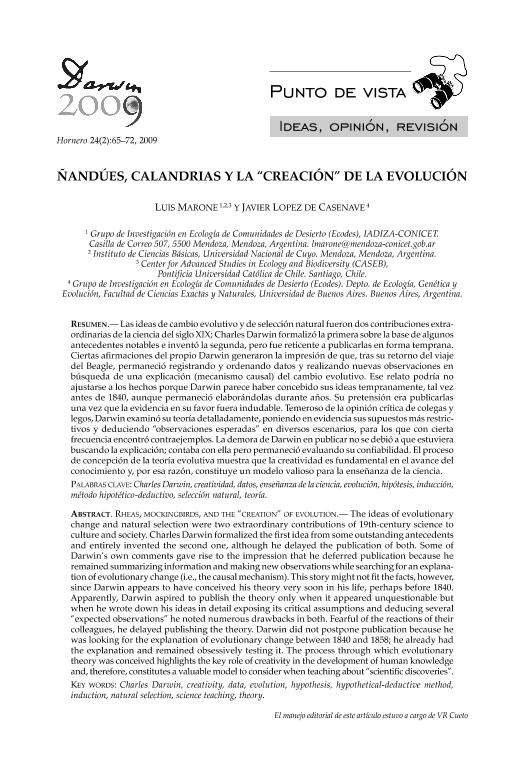
Las ideas de cambio evolutivo y de selección natural fueron dos contribuciones extraordinarias de la ciencia del siglo XIX; Charles Darwin formalizó la primera sobre la base de algunos antecedentes notables e inventó la segunda, pero fue reticente a publicarlas en forma temprana. Ciertas afirmaciones del propio Darwin generaron la impresión de que, tras su retorno del viaje del Beagle, permaneció registrando y ordenando datos y realizando nuevas observaciones en búsqueda de una explicación (mecanismo causal) del cambio evolutivo. Ese relato podría no ajustarse a los hechos porque Darwin parece haber concebido sus ideas tempranamente, tal vez antes de 1840, aunque permaneció elaborándolas durante años. Su pretensión era publicarlas una vez que la evidencia en su favor fuera indudable. Temeroso de la opinión crítica de colegas y legos, Darwin examinó su teoría detalladamente, poniendo en evidencia sus supuestos más restrictivos y deduciendo “observaciones esperadas” en diversos escenarios, para los que con cierta frecuencia encontró contraejemplos. La demora de Darwin en publicar no se debió a que estuviera buscando la explicación; contaba con ella pero permaneció evaluando su confiabilidad. El proceso de concepción de la teoría evolutiva muestra que la creatividad es fundamental en el avance del conocimiento y, por esa razón, constituye un modelo valioso para la enseñanza de la ciencia. The ideas of evolutionary change and natural selection were two extraordinary contributions of 19th-century science to culture and society. Charles Darwin formalized the first idea from some outstanding antecedents and entirely invented the second one, although he delayed the publication of both. Some of Darwin’s own comments gave rise to the impression that he deferred publication because he remained summarizing information and making new observations while searching for an explanation of evolutionary change (i.e., the causal mechanism). This story might not fit the facts, however, since Darwin appears to have conceived his theory very soon in his life, perhaps before 1840. Apparently, Darwin aspired to publish the theory only when it appeared unquestionable but when he wrote down his ideas in detail exposing its critical assumptions and deducing several “expected observations” he noted numerous drawbacks in both. Fearful of the reactions of their colleagues, he delayed publishing the theory. Darwin did not postpone publication because he was looking for the explanation of evolutionary change between 1840 and 1858; he already had the explanation and remained obsessively testing it. The process through which evolutionary theory was conceived highlights the key role of creativity in the development of human knowledge and, therefore, constitutes a valuable model to consider when teaching about “scientific discoveries”.
Ñandúes, calandrias y la "creación" de la evolución
Título:
Rheas, mockinbirds and the "creation" of evolution

Fecha de publicación:
12/2009
Editorial:
Asociación Ornitológica del Plata
Revista:
El Hornero
ISSN:
0073-3407
Idioma:
Español
Tipo de recurso:
Artículo publicado
Clasificación temática:
Resumen
Palabras clave:
Charles Darwin
,
Creatividad
,
Enseñanza de La Ciencia
,
Hipótesis
Archivos asociados

Tamaño:
753.3Kb
Formato:
PDF
Licencia
 Excepto donde se diga explícitamente, este item se publica bajo la siguiente descripción:
Creative Commons Attribution-NonCommercial-ShareAlike 2.5 Unported (CC BY-NC-SA 2.5)
Excepto donde se diga explícitamente, este item se publica bajo la siguiente descripción:
Creative Commons Attribution-NonCommercial-ShareAlike 2.5 Unported (CC BY-NC-SA 2.5)
Identificadores
Colecciones
Articulos(IADIZA)
Articulos de INST. ARG DE INVEST. DE LAS ZONAS ARIDAS
Articulos de INST. ARG DE INVEST. DE LAS ZONAS ARIDAS
Citación
Marone, Luis; Lopez de Casenave, Javier Nestor; Ñandúes, calandrias y la "creación" de la evolución; Asociación Ornitológica del Plata; El Hornero; 24; 2; 12-2009; 65-72
Compartir

