Artículo
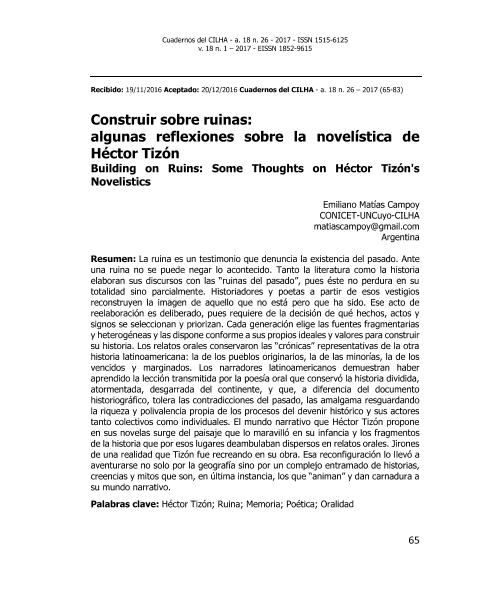
La ruina es un testimonio que denuncia la existencia del pasado. Ante una ruina no se puede negar lo acontecido. Tanto la literatura como la historia elaboran sus discursos con las “ruinas del pasado”, pues éste no perdura en su totalidad sino parcialmente. Historiadores y poetas a partir de esos vestigios reconstruyen la imagen de aquello que no está pero que ha sido. Ese acto de reelaboración es deliberado, pues requiere de la decisión de qué hechos, actos y signos se seleccionan y priorizan. Cada generación elige las fuentes fragmentarias y heterogéneas y las dispone conforme a sus propios ideales y valores para construir su historia. Los relatos orales conservaron las “crónicas” representativas de la otra historia latinoamericana: la de los pueblos originarios, la de las minorías, la de los vencidos y marginados. Los narradores latinoamericanos demuestran haber aprendido la lección transmitida por la poesía oral que conservó la historia dividida, atormentada, desgarrada del continente, y que, a diferencia del documento historiográfico, tolera las contradicciones del pasado, las amalgama resguardando la riqueza y polivalencia propia de los procesos del devenir histórico y sus actores tanto colectivos como individuales. El mundo narrativo que Héctor Tizón propone en sus novelas surge del paisaje que lo maravilló en su infancia y los fragmentos de la historia que por esos lugares deambulaban dispersos en relatos orales. Jirones de una realidad que Tizón fue recreando en su obra. Esa reconfiguración lo llevó a aventurarse no solo por la geografía sino por un complejo entramado de historias, creencias y mitos que son, en última instancia, los que “animan” y dan carnadura a su mundo narrativo. Ruin is a testimony that denounces the existence of the past. Before a ruin cannot deny what happened. Both literature and history elaborate their speeches with the "ruins of the past," for it does not last in its entirety but only partially. Historians and poets from these vestiges reconstruct the image of that which is not but has been. That act of re-elaboration is deliberate, since it requires the decision of which facts, acts and signs are selected and prioritized. Each generation chooses the fragmented and heterogeneous sources and disposes them according to their own ideals and values to build their history. The oral histories retained the "chronicles" representative of the other Latin American history: that of the original peoples, that of the minorities, that of the vanquished and the marginalized. Latin American narrators show that they have learned the lesson transmitted by oral poetry that preserved the divided, tormented, torn history of the continent, and which, unlike the historiographical document, tolerates the contradictions of the past, amalgamating them with the wealth and versatility of the processes of the historical becoming and its actors both collective and individual. The narrative world that Héctor Tizón proposes in his novels arises from the landscape that marveled him in his childhood and the fragments of history that by these places wandered scattered in oral stories. Shreds of a reality that Tizón was recreating in his work. This reconfiguration led him to venture not only for geography but for a complex web of stories, beliefs and myths that are ultimately those who "encourage" and give way to his narrative world.
Construir sobre ruinas: algunas reflexiones sobre la novelística de Héctor Tizón

Fecha de publicación:
09/2017
Editorial:
Universidad Nacional de Cuyo. Facultad de Filosofía y Letras
Revista:
Cuadernos del CILHA
ISSN:
1515-6125
Idioma:
Español
Tipo de recurso:
Artículo publicado
Clasificación temática:
Resumen
Archivos asociados

Tamaño:
401.5Kb
Formato:
PDF
Licencia
 Excepto donde se diga explícitamente, este item se publica bajo la siguiente descripción:
Creative Commons Attribution-NonCommercial-ShareAlike 2.5 Unported (CC BY-NC-SA 2.5)
Excepto donde se diga explícitamente, este item se publica bajo la siguiente descripción:
Creative Commons Attribution-NonCommercial-ShareAlike 2.5 Unported (CC BY-NC-SA 2.5)
Identificadores
Colecciones
Articulos(CCT - MENDOZA)
Articulos de CTRO.CIENTIFICO TECNOL.CONICET - MENDOZA
Articulos de CTRO.CIENTIFICO TECNOL.CONICET - MENDOZA
Citación
Campoy, Emiliano Matías; Construir sobre ruinas: algunas reflexiones sobre la novelística de Héctor Tizón; Universidad Nacional de Cuyo. Facultad de Filosofía y Letras; Cuadernos del CILHA; 18; 1; 9-2017; 65-83
Compartir

