Mostrar el registro sencillo del ítem
dc.contributor.author
Sala-Newby, Graciela B.
dc.contributor.author
Freeman, Nicola V. E.
dc.contributor.author
Curto, Maria de Los Angeles
dc.contributor.author
Newby, Andrew C.
dc.date.available
2019-07-18T20:12:27Z
dc.date.issued
2003-09
dc.identifier.citation
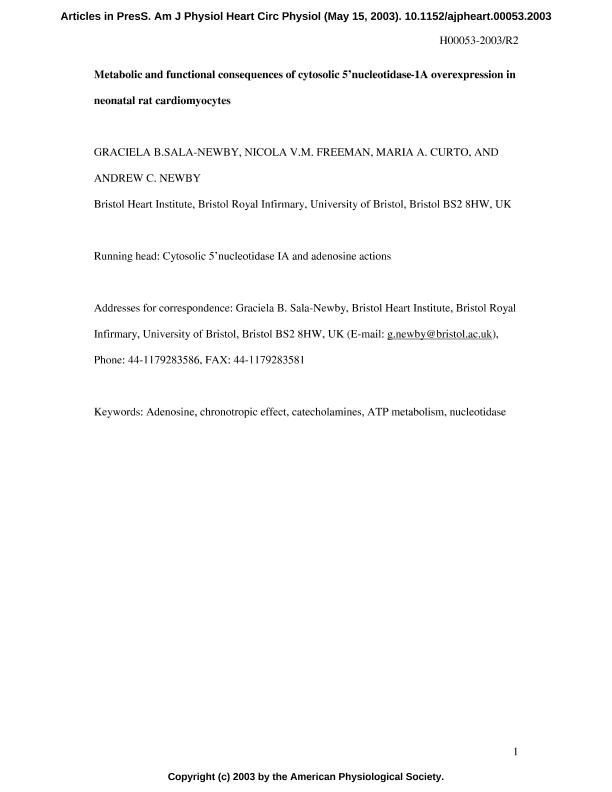
Sala-Newby, Graciela B.; Freeman, Nicola V. E.; Curto, Maria de Los Angeles; Newby, Andrew C.; Metabolic and functional consequences of cytosolic 5′-nucleotidase-IA overexpression in neonatal rat cardiomyocytes; American Physiological Society; American Journal of Physiology - Heart and Circulatory Physiology; 285; 3; 9-2003; H991-H998
dc.identifier.issn
0363-6135
dc.identifier.uri
http://hdl.handle.net/11336/79845
dc.description.abstract
Adenosine exerts a spectrum of energy-preserving actions on the heart negative chronotropic effects. The pathways leading to adenosine formation have remained controversial. In particular, although cytosolic 5′-nucleotidases can catalyze adenosine formation in cardiomyocytes, their contribution to the actions of adenosine has not been documented previously. We recently cloned two closely related AMP-preferring cytosolic 5′-nucleotidases (cN-IA and -IB); the A form predominates in the heart. In this study, we overexpressed pigeon cN-IA in neonatal rat cardiomyocytes using an adenovirus. cN-IA overexpression increased adenosine formation and release into the medium caused by simulated hypoxia and by isoproterenol in the absence and presence of inhibitors of adenosine metabolism. Adenosine release was not affected by an ecto-5′-nucleotidase inhibitor, α,β-methylene-ADP, but was affected by a nucleoside transporter, dipyridamole. The positive chronotropic effect of isoproterenol (130 ±3 vs. 100 ±4 beats/min) was inhibited (107 ±3 vs. 94 ±3 beats/min) in cells overexpressing cN-IA, and this was reversed by the addition of the adenosine receptor antagonist 8-(p-sulfophenyl)theophilline (120 ± 3 vs. 90 ± 4 beats/min). Our results demonstrate that overexpressed cN-IA can be sufficiently active in cardiomyocytes to generate physiologically effective concentrations of adenosine at its receptors.
dc.format
application/pdf
dc.language.iso
eng
dc.publisher
American Physiological Society
dc.rights
info:eu-repo/semantics/openAccess
dc.rights.uri
https://creativecommons.org/licenses/by-nc-sa/2.5/ar/
dc.subject
Adenosine
dc.subject
Chronotropic Effect
dc.subject
Catecholamines
dc.subject
Atp Metabolism
dc.subject.classification
Bioquímica y Biología Molecular
dc.subject.classification
Ciencias Biológicas
dc.subject.classification
CIENCIAS NATURALES Y EXACTAS
dc.title
Metabolic and functional consequences of cytosolic 5′-nucleotidase-IA overexpression in neonatal rat cardiomyocytes
dc.type
info:eu-repo/semantics/article
dc.type
info:ar-repo/semantics/artículo
dc.type
info:eu-repo/semantics/publishedVersion
dc.date.updated
2019-07-16T14:12:23Z
dc.journal.volume
285
dc.journal.number
3
dc.journal.pagination
H991-H998
dc.journal.pais
Estados Unidos
dc.journal.ciudad
Bethesda
dc.description.fil
Fil: Sala-Newby, Graciela B.. University of Bristol; Reino Unido
dc.description.fil
Fil: Freeman, Nicola V. E.. University of Bristol; Reino Unido
dc.description.fil
Fil: Curto, Maria de Los Angeles. University of Bristol; Reino Unido. Consejo Nacional de Investigaciones Científicas y Técnicas. Instituto de Investigaciones en Ingeniería Genética y Biología Molecular "Dr. Héctor N. Torres"; Argentina
dc.description.fil
Fil: Newby, Andrew C.. University of Bristol; Reino Unido
dc.journal.title
American Journal of Physiology - Heart and Circulatory Physiology
dc.relation.alternativeid
info:eu-repo/semantics/altIdentifier/doi/http://dx.doi.org/10.1152/ajpheart.00053.2003
dc.relation.alternativeid
info:eu-repo/semantics/altIdentifier/url/https://www.physiology.org/doi/full/10.1152/ajpheart.00053.2003
dc.relation.alternativeid
info:eu-repo/semantics/altIdentifier/url/https://www.ncbi.nlm.nih.gov/pubmed/12750059
Archivos asociados

Tamaño:
480.4Kb
Formato:
PDF