Mostrar el registro sencillo del ítem
dc.contributor.author
Ponzinibbio, Maria Virginia
dc.contributor.author
Crudeli, Cintia
dc.contributor.author
Peral Garcia, Pilar
dc.contributor.author
Seoane, Analia Isabel
dc.date.available
2019-07-15T23:15:12Z
dc.date.issued
2010-11
dc.identifier.citation
Ponzinibbio, Maria Virginia; Crudeli, Cintia; Peral Garcia, Pilar; Seoane, Analia Isabel; Low-dose radiation employed in diagnostic imaging causes genetic effects in cultured cells; Taylor & Francis Ltd; Acta Radiologica; 51; 9; 11-2010; 1028-1033
dc.identifier.issn
0284-1851
dc.identifier.uri
http://hdl.handle.net/11336/79611
dc.description.abstract
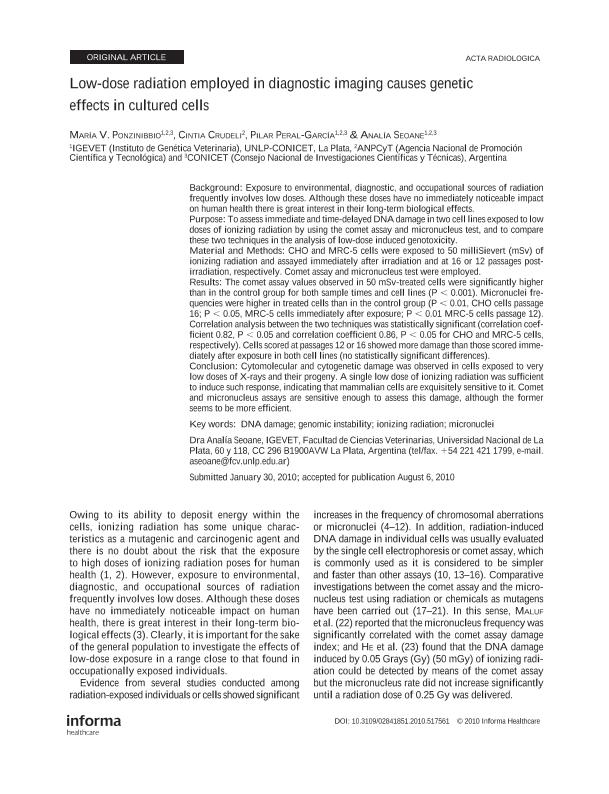
Background: Exposure to environmental, diagnostic, and occupational sources of radiation frequently involves low doses. Although these doses have no immediately noticeable impact on human health there is great interest in their long-term biological effects. Purpose: To assess immediate and time-delayed DNA damage in two cell lines exposed to low doses of ionizing radiation by using the comet assay and micronucleus test, and to compare these two techniques in the analysis of low-dose induced genotoxicity. Material and Methods: CHO and MRC-5 cells were exposed to 50 milliSievert (mSv) of ionizing radiation and assayed immediately after irradiation and at 16 or 12 passages post-irradiation, respectively. Comet assay and micronucleus test were employed. Results: The comet assay values observed in 50 mSv-treated cells were significantly higher than in the control group for both sample times and cell lines (P < 0.001). Micronuclei frequencies were higher in treated cells than in the control group (P < 0.01, CHO cells passage 16; P < 0.05, MRC-5 cells immediately after exposure; P < 0.01 MRC-5 cells passage 12). Correlation analysis between the two techniques was statistically significant (correlation coefficient 0.82, P < 0.05 and correlation coefficient 0.86, P < 0.05 for CHO and MRC-5 cells, respectively). Cells scored at passages 12 or 16 showed more damage than those scored immediately after exposure in both cell lines (no statistically significant differences). Conclusion: Cytomolecular and cytogenetic damage was observed in cells exposed to very low doses of X-rays and their progeny. A single low dose of ionizing radiation was sufficient to induce such response, indicating that mammalian cells are exquisitely sensitive to it. Comet and micronucleus assays are sensitive enough to assess this damage, although the former seems to be more efficient.
dc.format
application/pdf
dc.language.iso
eng
dc.publisher
Taylor & Francis Ltd
dc.rights
info:eu-repo/semantics/openAccess
dc.rights.uri
https://creativecommons.org/licenses/by-nc-sa/2.5/ar/
dc.subject
Dna Damage
dc.subject
Genomic Instability
dc.subject
Ionizing Radiation
dc.subject
Micronuclei
dc.subject.classification
Salud Ocupacional
dc.subject.classification
Ciencias de la Salud
dc.subject.classification
CIENCIAS MÉDICAS Y DE LA SALUD
dc.subject.classification
Salud Ocupacional
dc.subject.classification
Ciencias de la Salud
dc.subject.classification
CIENCIAS MÉDICAS Y DE LA SALUD
dc.title
Low-dose radiation employed in diagnostic imaging causes genetic effects in cultured cells
dc.type
info:eu-repo/semantics/article
dc.type
info:ar-repo/semantics/artículo
dc.type
info:eu-repo/semantics/publishedVersion
dc.date.updated
2019-07-03T15:04:50Z
dc.journal.volume
51
dc.journal.number
9
dc.journal.pagination
1028-1033
dc.journal.pais
Reino Unido
dc.journal.ciudad
Londres
dc.description.fil
Fil: Ponzinibbio, Maria Virginia. Consejo Nacional de Investigaciones Científicas y Técnicas. Centro Científico Tecnológico CONICET- La Plata. Instituto de Genética Veterinaria "Ing. Fernando Noel Dulout". Universidad Nacional de La Plata. Facultad de Ciencias Veterinarias. Instituto de Genética Veterinaria; Argentina. Ministerio de Ciencia. Tecnología e Innovación Productiva. Agencia Nacional de Promoción Científica y Tecnológica; Argentina
dc.description.fil
Fil: Crudeli, Cintia. Consejo Nacional de Investigaciones Científicas y Técnicas; Argentina. Ministerio de Ciencia. Tecnología e Innovación Productiva. Agencia Nacional de Promoción Científica y Tecnológica; Argentina
dc.description.fil
Fil: Peral Garcia, Pilar. Consejo Nacional de Investigaciones Científicas y Técnicas. Centro Científico Tecnológico CONICET- La Plata. Instituto de Genética Veterinaria "Ing. Fernando Noel Dulout". Universidad Nacional de La Plata. Facultad de Ciencias Veterinarias. Instituto de Genética Veterinaria; Argentina. Ministerio de Ciencia. Tecnología e Innovación Productiva. Agencia Nacional de Promoción Científica y Tecnológica; Argentina
dc.description.fil
Fil: Seoane, Analia Isabel. Consejo Nacional de Investigaciones Científicas y Técnicas. Centro Científico Tecnológico CONICET- La Plata. Instituto de Genética Veterinaria "Ing. Fernando Noel Dulout". Universidad Nacional de La Plata. Facultad de Ciencias Veterinarias. Instituto de Genética Veterinaria; Argentina. Ministerio de Ciencia. Tecnología e Innovación Productiva. Agencia Nacional de Promoción Científica y Tecnológica; Argentina
dc.journal.title
Acta Radiologica
dc.relation.alternativeid
info:eu-repo/semantics/altIdentifier/doi/http://dx.doi.org/10.3109/02841851.2010.517561
dc.relation.alternativeid
info:eu-repo/semantics/altIdentifier/url/https://journals.sagepub.com/doi/10.3109/02841851.2010.517561
Archivos asociados

Tamaño:
75.91Kb
Formato:
PDF