Artículo
Allosterically linked noncompetitive antagonist binding sites in the resting nicotinic acetylcholine receptor ion channel

Fecha de publicación:
01/07/2002
Editorial:
Elsevier Science Inc
Revista:
Archives of Biochemistry and Biophysics
ISSN:
0003-9861
Idioma:
Inglés
Tipo de recurso:
Artículo publicado
Clasificación temática:
Resumen
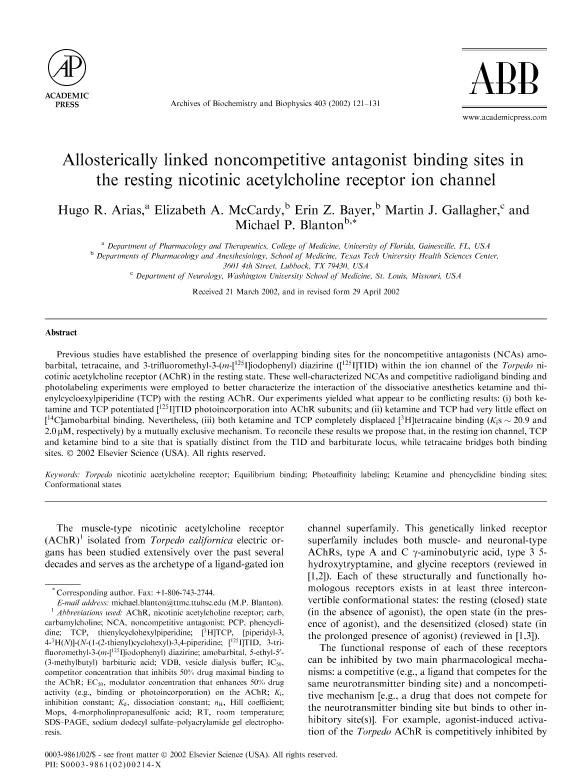
Previous studies have established the presence of overlapping binding sites for the noncompetitive antagonists (NCAs) amobarbital, tetracaine, and 3-trifluoromethyl-3-(m-[ 125 I]iodophenyl) diazirine ([ 125 I]TID) within the ion channel of the Torpedo nicotinic acetylcholine receptor (AChR) in the resting state. These well-characterized NCAs and competitive radioligand binding and photolabeling experiments were employed to better characterize the interaction of the dissociative anesthetics ketamine and thienylcycloexylpiperidine (TCP) with the resting AChR. Our experiments yielded what appear to be conflicting results: (i) both ketamine and TCP potentiated [ 125 I]TID photoincorporation into AChR subunits; and (ii) ketamine and TCP had very little effect on [ 14 C]amobarbital binding. Nevertheless, (iii) both ketamine and TCP completely displaced [ 3 H]tetracaine binding (K i s ∼ 20.9 and 2.0 μM, respectively) by a mutually exclusive mechanism. To reconcile these results we propose that, in the resting ion channel, TCP and ketamine bind to a site that is spatially distinct from the TID and barbiturate locus, while tetracaine bridges both binding sites.
Archivos asociados

Tamaño:
279.5Kb
Formato:
PDF
Licencia
 Excepto donde se diga explícitamente, este item se publica bajo la siguiente descripción:
Creative Commons Attribution-NonCommercial-ShareAlike 2.5 Unported (CC BY-NC-SA 2.5)
Excepto donde se diga explícitamente, este item se publica bajo la siguiente descripción:
Creative Commons Attribution-NonCommercial-ShareAlike 2.5 Unported (CC BY-NC-SA 2.5)
Identificadores
Colecciones
Articulos(INMABB)
Articulos de INST.DE MATEMATICA BAHIA BLANCA (I)
Articulos de INST.DE MATEMATICA BAHIA BLANCA (I)
Citación
Arias, Hugo Rubén; McCardy, Elizabeth A; Bayer, Erin Z.; Gallagher, Martin J.; Blanton, Michael P.; Allosterically linked noncompetitive antagonist binding sites in the resting nicotinic acetylcholine receptor ion channel; Elsevier Science Inc; Archives of Biochemistry and Biophysics; 403; 1; 1-7-2002; 121-131
Compartir


Altmétricas