Artículo
PdCuAu ternary alloy membranes: Hydrogen permeation properties in the presence of H2S
Tarditi, Ana Maria ; Imhoff, Carolina Guadalupe
; Braun, Fernando
; Miller, James B.; Gellman, Andrew J.; Cornaglia, Laura Maria
; Imhoff, Carolina Guadalupe
; Braun, Fernando
; Miller, James B.; Gellman, Andrew J.; Cornaglia, Laura Maria
; Imhoff, Carolina Guadalupe
; Braun, Fernando
; Miller, James B.; Gellman, Andrew J.; Cornaglia, Laura Maria
Fecha de publicación:
04/2015
Editorial:
Elsevier Science
Revista:
Journal of Membrane Science
ISSN:
0376-7388
Idioma:
Inglés
Tipo de recurso:
Artículo publicado
Clasificación temática:
Resumen
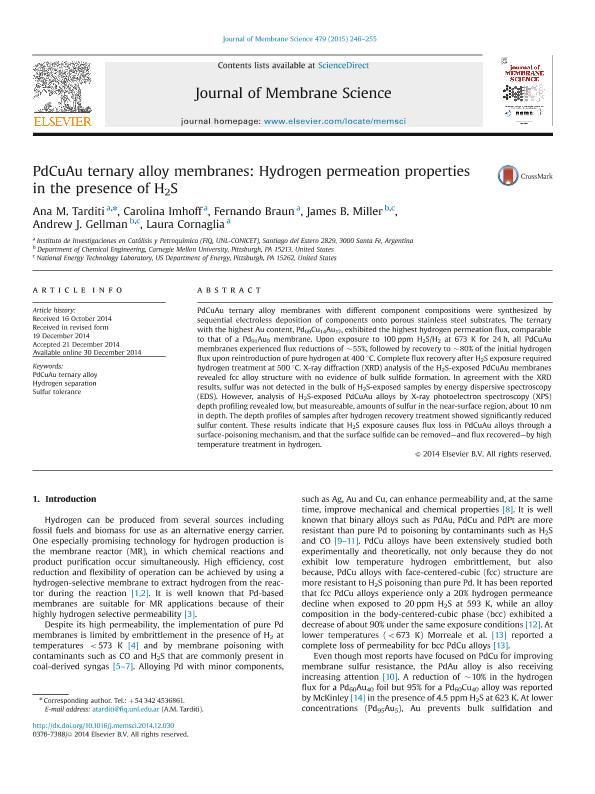
PdCuAu ternary alloy membranes with different component compositions were synthesized by sequential electroless deposition of components onto porous stainless steel substrates. The ternary with the highest Au content, Pd 69 Cu 14 Au 17 , exhibited the highest hydrogen permeation flux, comparable to that of a Pd 91 Au 9 membrane. Upon exposure to 100ppm H 2 S/H 2 at 673 K for 24h, all PdCuAu membranes experienced flux reductions of ~55%, followed by recovery to ~80% of the initial hydrogen flux upon reintroduction of pure hydrogen at 400°C. Complete flux recovery after H 2 S exposure required hydrogen treatment at 500°C. X-ray diffraction (XRD) analysis of the H 2 S-exposed PdCuAu membranes revealed fcc alloy structure with no evidence of bulk sulfide formation. In agreement with the XRD results, sulfur was not detected in the bulk of H 2 S-exposed samples by energy dispersive spectroscopy (EDS). However, analysis of H 2 S-exposed PdCuAu alloys by X-ray photoelectron spectroscopy (XPS) depth profiling revealed low, but measureable, amounts of sulfur in the near-surface region, about 10nm in depth. The depth profiles of samples after hydrogen recovery treatment showed significantly reduced sulfur content. These results indicate that H 2 S exposure causes flux loss in PdCuAu alloys through a surface-poisoning mechanism, and that the surface sulfide can be removed-and flux recovered-by high temperature treatment in hydrogen.
Palabras clave:
Hydrogen Separation
,
Pdcuau Ternary Alloy
,
Sulfur Tolerance
Archivos asociados

Tamaño:
2.185Mb
Formato:
PDF
Licencia
 Excepto donde se diga explícitamente, este item se publica bajo la siguiente descripción:
Creative Commons Attribution-NonCommercial-ShareAlike 2.5 Unported (CC BY-NC-SA 2.5)
Excepto donde se diga explícitamente, este item se publica bajo la siguiente descripción:
Creative Commons Attribution-NonCommercial-ShareAlike 2.5 Unported (CC BY-NC-SA 2.5)
Identificadores
Colecciones
Articulos(INCAPE)
Articulos de INST.DE INVEST.EN CATALISIS Y PETROQUIMICA "ING. JOSE MIGUEL PARERA"
Articulos de INST.DE INVEST.EN CATALISIS Y PETROQUIMICA "ING. JOSE MIGUEL PARERA"
Citación
Tarditi, Ana Maria; Imhoff, Carolina Guadalupe; Braun, Fernando; Miller, James B.; Gellman, Andrew J.; et al.; PdCuAu ternary alloy membranes: Hydrogen permeation properties in the presence of H2S; Elsevier Science; Journal of Membrane Science; 479; 4-2015; 246-255
Compartir


Altmétricas