Artículo
Transparent multiphasic polystyrene/epoxy blends
Hoppe, Cristina Elena ; Galante, Maria Jose
; Oyanguren, Patricia Angelica
; Williams, Roberto Juan Jose
; Girard Reydet, E.; Pascault, J.P.
; Galante, Maria Jose
; Oyanguren, Patricia Angelica
; Williams, Roberto Juan Jose
; Girard Reydet, E.; Pascault, J.P.
; Galante, Maria Jose
; Oyanguren, Patricia Angelica
; Williams, Roberto Juan Jose
; Girard Reydet, E.; Pascault, J.P.
Fecha de publicación:
12/2002
Editorial:
John Wiley & Sons Inc
Revista:
Polymer Engineering and Science
ISSN:
0032-3888
Idioma:
Inglés
Tipo de recurso:
Artículo publicado
Clasificación temática:
Resumen
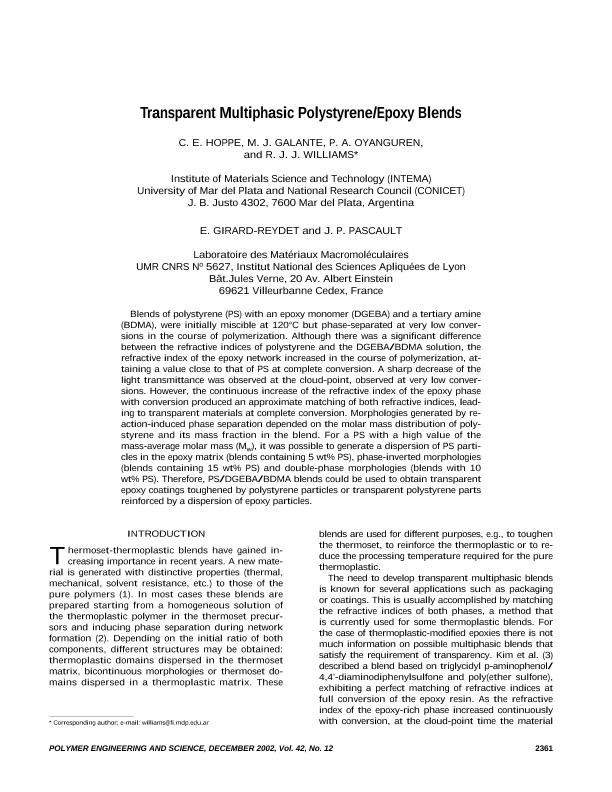
Blends of polystyrene (PS) with an epoxy monomer (DGEBA) and a tertiary amine (BDMA), were initially miscible at 120°C but phase‐separated at very low conversions in the course of polymerization. Although there was a significant difference between the refractive indices of polystyrene and the DGEBA/BDMA solution, the refractive index of the epoxy network increased in the course of polymerization, attaining a value close to that of PS at complete conversion. A sharp decrease of the light transmittance was observed at the cloud‐point, observed at very low conversions. However, the continuous increase of the refractive index of the epoxy phase with conversion produced an approximate matching of both refractive indices, leading to transparent materials at complete conversion. Morphologies generated by reaction‐induced phase separation depended on the molar mass distribution of polystyrene and its mass fraction in the blend. For a PS with a high value of the mass‐average molar mass (Mw), it was possible to generate a dispersion of PS particles in the epoxy matrix (blends containing 5 wt% PS), phase‐inverted morphologies (blends containing 15 wt% PS) and double‐phase morphologies (blends with 10 wt% PS). Therefore, PS/DGEBA/BDMA blends could be used to obtain transparent epoxy coatings toughened by polystyrene particles or transparent polystyrene parts reinforced by a dispersion of epoxy particles.
Palabras clave:
Epoxy
,
Polystyrene
,
Blends
Archivos asociados

Tamaño:
130.0Kb
Formato:
PDF
Licencia
 Excepto donde se diga explícitamente, este item se publica bajo la siguiente descripción:
Creative Commons Attribution-NonCommercial-ShareAlike 2.5 Unported (CC BY-NC-SA 2.5)
Excepto donde se diga explícitamente, este item se publica bajo la siguiente descripción:
Creative Commons Attribution-NonCommercial-ShareAlike 2.5 Unported (CC BY-NC-SA 2.5)
Identificadores
Colecciones
Articulos(INTEMA)
Articulos de INST.DE INV.EN CIENCIA Y TECNOL.MATERIALES (I)
Articulos de INST.DE INV.EN CIENCIA Y TECNOL.MATERIALES (I)
Citación
Hoppe, Cristina Elena; Galante, Maria Jose; Oyanguren, Patricia Angelica; Williams, Roberto Juan Jose; Girard Reydet, E.; et al.; Transparent multiphasic polystyrene/epoxy blends; John Wiley & Sons Inc; Polymer Engineering and Science; 42; 12; 12-2002; 2361-2368
Compartir


Altmétricas