Artículo
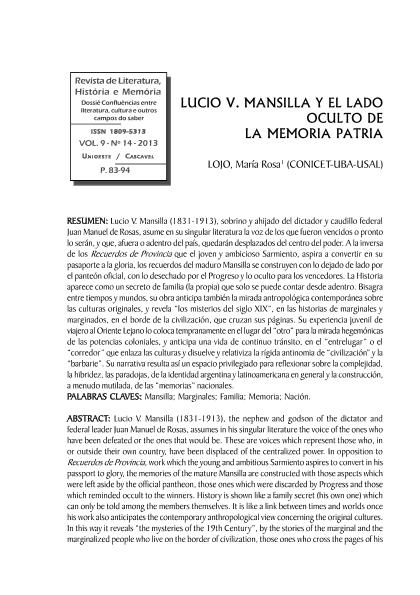
Lucio V. Mansilla (1831-1913), sobrino y ahijado del dictador y caudillo federal Juan Manuel de Rosas, asume en su singular literatura la voz de los que fueron vencidos o pronto lo serán, y que, afuera o adentro del país, quedarán desplazados del centro del poder. A la inversa de los Recuerdos de Provincia que el joven y ambicioso Sarmiento, aspira a convertir en su pasaporte a la gloria, los recuerdos del maduro Mansilla se construyen con lo dejado de lado por el panteón oficial, con lo desechado por el Progreso y lo oculto para los vencedores. La Historia aparece como un secreto de familia (la propia) que solo se puede contar desde adentro. Bisagra entre tiempos y mundos, su obra anticipa también la mirada antropológica contemporánea sobre las culturas originales, y revela “los misterios del siglo XIX”, en las historias de marginales y marginados, en el borde de la civilización, que cruzan sus páginas. Su experiencia juvenil de viajero al Oriente Lejano lo coloca tempranamente en el lugar del “otro” para la mirada hegemónicas de las potencias coloniales, y anticipa una vida de continuo tránsito, en el “entrelugar” o el “corredor” que enlaza las culturas y disuelve y relativiza la rígida antinomia de “civilización” y la “barbarie”. Su narrativa resulta así un espacio privilegiado para reflexionar sobre la complejidad, la hibridez, las paradojas, de la identidad argentina y latinoamericana en general y la construcción, a menudo mutilada, de las “memorias” nacionales Lucio V. Mansilla (1831-1913), the nephew and godson of the dictator and federal leader Juan Manuel de Rosas, assumes in his singular literature the voice of the ones who have been defeated or the ones that would be. These are voices which represent those who, in or outside their own country, have been displaced of the centralized power. In opposition to Recuerdos de Provincia, work which the young and ambitious Sarmiento aspires to convert in his passport to glory, the memories of the mature Mansilla are constructed with those aspects which were left aside by the official pantheon, those ones which were discarded by Progress and those which reminded occult to the winners. History is shown like a family secret (his own one) which can only be told among the members themselves. It is like a link between times and worlds once his work also anticipates the contemporary anthropological view concerning the original cultures. In this way it reveals “the mysteries of the 19th Century”, by the stories of the marginal and the marginalized people who live on the border of civilization, those ones who cross the pages of his work. His juvenile experience of traveling to the Far East enables him to be early put in the place of the “other” concerning a hegemonic view of the colonial powers. It also anticipates a life of continuous transit, in the “space in-between” and along the “corridor” that bonds the cultures dissolving and relativizing the rigid antinomy of “civilization” and “barbarism”. His narrative results being a privileged space to reflect upon the complexity, the hybridity, the paradoxes of the Argentinean and the general Latin-American identity overall and the construction, often mangled, of the national “memories”.
Lucio V. Mansilla y el lado oculto de la memoria patria

Fecha de publicación:
03/2013
Editorial:
Universidade Estadual do Oeste do Paraná
Revista:
Revista de Literatura, História e memória
ISSN:
1983-1498
Idioma:
Español
Tipo de recurso:
Artículo publicado
Clasificación temática:
Resumen
Palabras clave:
Mansilla
,
Marginales
,
Memoria
,
Nación
Archivos asociados

Tamaño:
155.2Kb
Formato:
PDF
Licencia
 Excepto donde se diga explícitamente, este item se publica bajo la siguiente descripción:
Creative Commons Attribution-NonCommercial-ShareAlike 2.5 Unported (CC BY-NC-SA 2.5)
Excepto donde se diga explícitamente, este item se publica bajo la siguiente descripción:
Creative Commons Attribution-NonCommercial-ShareAlike 2.5 Unported (CC BY-NC-SA 2.5)
Identificadores
Colecciones
Articulos(SEDE CENTRAL)
Articulos de SEDE CENTRAL
Articulos de SEDE CENTRAL
Citación
Lojo Calatrava, Maria Rosa; Lucio V. Mansilla y el lado oculto de la memoria patria; Universidade Estadual do Oeste do Paraná; Revista de Literatura, História e memória; 9; 14; 3-2013; 83-94
Compartir

