Artículo
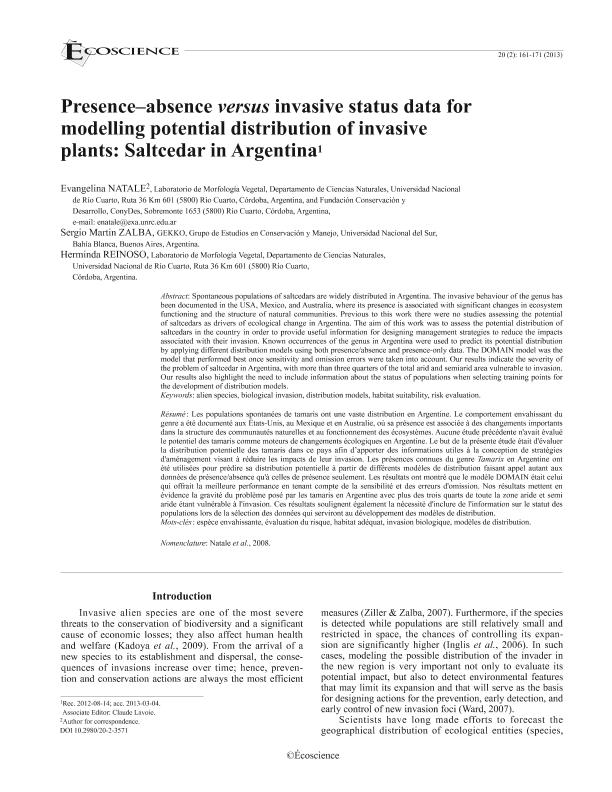
Spontaneous populations of saltcedars are widely distributed in Argentina. The invasive behaviour of the genus has been documented in the USA, Mexico, and Australia, where its presence is associated with significant changes in ecosystem functioning and the structure of natural communities. Previous to this work there were no studies assessing the potential of saltcedars as drivers of ecological change in Argentina. The aim of this work was to assess the potential distribution of saltcedars in the country in order to provide useful information for designing management strategies to reduce the impacts associated with their invasion. Known occurrences of the genus in Argentina were used to predict its potential distribution by applying different distribution models using both presence/absence and presence-only data. The DOMAIN model was the model that performed best once sensitivity and omission errors were taken into account. Our results indicate the severity of the problem of saltcedar in Argentina, with more than three quarters of the total arid and semiarid area vulnerable to invasion. Our results also highlight the need to include information about the status of populations when selecting training points for the development of distribution models. Les populations spontanées de tamaris ont une vaste distribution en Argentine. Le comportement envahissant du genre a été documenté aux États-Unis, au Mexique et en Australie, où sa présence est associée à des changements importants dans la structure des communautés naturelles et au fonctionnement des écosystèmes. Aucune étude précédente n'avait évalué le potentiel des tamaris comme moteurs de changements écologiques en Argentine. Le but de la présente étude était d'évaluer la distribution potentielle des tamaris dans ce pays afin d'apporter des informations utiles à la conception de stratégies d'aménagement visant à réduire les impacts de leur invasion. Les présences connues du genre Tamarix en Argentine ont été utilisées pour prédire sa distribution potentielle à partir de différents modèles de distribution faisant appel autant aux données de présence/absence qu'à celles de présence seulement. Les résultats ont montré que le modèle DOMAIN était celui qui offrait la meilleure performance en tenant compte de la sensibilité et des erreurs d'omission. Nos résultats mettent en évidence la gravité du problème posé par les tamaris en Argentine avec plus des trois quarts de toute la zone aride et semi aride étant vulnérable à l'invasion. Ces résultats soulignent également la nécessité d'inclure de l'information sur le statut des populations lors de la sélection des données qui serviront au développement des modèles de distribution.
Presence-absence versus invasive status data for modelling potential distribution of invasive plants: Saltcedar in Argentina

Fecha de publicación:
06/2013
Editorial:
Université Laval
Revista:
Ecoscience (sainte-foy)
ISSN:
1195-6860
e-ISSN:
2376-7626
Idioma:
Inglés
Tipo de recurso:
Artículo publicado
Clasificación temática:
Resumen
Archivos asociados

Tamaño:
1.257Mb
Formato:
PDF
Licencia
 Excepto donde se diga explícitamente, este item se publica bajo la siguiente descripción:
Creative Commons Attribution-NonCommercial-ShareAlike 2.5 Unported (CC BY-NC-SA 2.5)
Excepto donde se diga explícitamente, este item se publica bajo la siguiente descripción:
Creative Commons Attribution-NonCommercial-ShareAlike 2.5 Unported (CC BY-NC-SA 2.5)
Identificadores
Colecciones
Articulos(CCT - BAHIA BLANCA)
Articulos de CTRO.CIENTIFICO TECNOL.CONICET - BAHIA BLANCA
Articulos de CTRO.CIENTIFICO TECNOL.CONICET - BAHIA BLANCA
Citación
Natale, Evangelina Sandra; Zalba, Sergio Martín; Reinoso, Herminda Elmira; Presence-absence versus invasive status data for modelling potential distribution of invasive plants: Saltcedar in Argentina; Université Laval; Ecoscience (sainte-foy); 20; 2; 6-2013; 161-171
Compartir


Altmétricas