Mostrar el registro sencillo del ítem
dc.contributor.author
Lamoso, Adriana Amanda
dc.date.available
2019-05-31T14:46:25Z
dc.date.issued
2008-12
dc.identifier.citation
Lamoso, Adriana Amanda; El rostro en el espejo: Ezequiel Martínez Estrada y el símil de una (auto) figuración; Universidad Nacional de La Pampa. Facultad de Ciencias Humanas. Instituto de Investigaciones Literarias y Discursivas; Anclajes; 11; 12; 12-2008; 143-154
dc.identifier.issn
0329-3807
dc.identifier.uri
http://hdl.handle.net/11336/77448
dc.description.abstract
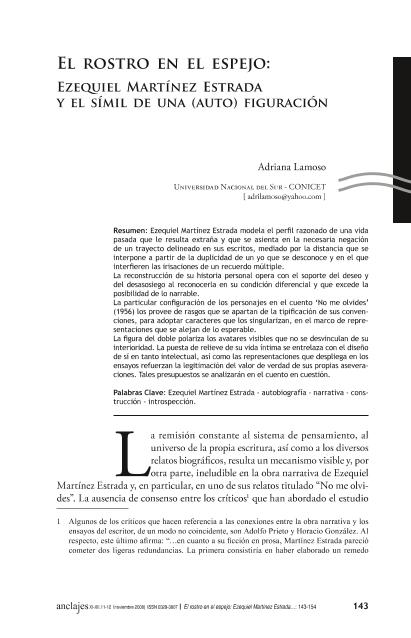
Ezequiel Martínez Estrada modela el perfil razonado de una vida pasada que le resulta extraña y que se asienta en la necesaria negación de un trayecto delineado en sus escritos, mediado por la distancia que se interpone a partir de la duplicidad de un yo que se desconoce y en el que interfieren las irisaciones de un recuerdo múltiple. La reconstrucción de su historia personal opera con el soporte del deseo y del desasosiego al reconocerla en su condición diferencial y que excede la posibilidad de lo narrable. La particular configuración de los personajes en el cuento 'No me olvides' (1956) los provee de rasgos que se apartan de la tipificación de sus convenciones, para adoptar caracteres que los singularizan, en el marco de representaciones que se alejan de lo esperable. La figura del doble polariza los avatares visibles que no se desvinculan de su interioridad. La puesta de relieve de su vida íntima se entrelaza con el diseño de sí en tanto intelectual, así como las representaciones que despliega en los ensayos refuerzan la legitimación del valor de verdad de sus propias aseveraciones. Tales presupuestos se analizarán en el cuento en cuestión.
dc.description.abstract
Ezequiel Martínez Estrada gives shape to the profile of a past life that seems strange to him, which consolidates in the necessary denial of a trajectory delineated in his writings, influenced by the distance that interposes from the duplicity of a self that is unknown and in which the manifestations of a multiple memory interfere. The reconstruction of his personal history operates with the convincing support of the opposite desire, and with the feeling of restlessness that pushes him to reflect on his personal history with the purpose of recognizing his distinctive condition, which exceeds the possibility of what he can narrate. The particular configuration of the characters in the story "No me olvides" (1956) provides them with particular features that separate them from the tipification of his conventions so as to adopt characters that single those peculiar traits out in the frame of representations that move away from what one expects. The figure of the double self polarizes the visible circumstances which are not detachable from his inwardness. The manifestation of his intimate life intwines tightly with his selfconfiguration as an intellectual; the representations he unfolds in his essays are projected in a piece of writing that reinforces the legitimization of the value of truth in his own assertions. Such assumptions will be analyzed in the story mentioned above.
dc.format
application/pdf
dc.language.iso
spa
dc.publisher
Universidad Nacional de La Pampa. Facultad de Ciencias Humanas. Instituto de Investigaciones Literarias y Discursivas
dc.rights
info:eu-repo/semantics/openAccess
dc.rights.uri
https://creativecommons.org/licenses/by-nc-sa/2.5/ar/
dc.subject
Autobiografía
dc.subject
Narrativa
dc.subject
Ezequiel Martínez Estrada
dc.subject
Desasosiego
dc.subject
Construcción
dc.subject
Introspección
dc.subject.classification
Estudios Generales del Lenguaje
dc.subject.classification
Lengua y Literatura
dc.subject.classification
HUMANIDADES
dc.title
El rostro en el espejo: Ezequiel Martínez Estrada y el símil de una (auto) figuración
dc.title
The Face in the Mirror: Ezequiel Martínez Estrada and the Resemblance of an (Auto) configuration
dc.type
info:eu-repo/semantics/article
dc.type
info:ar-repo/semantics/artículo
dc.type
info:eu-repo/semantics/publishedVersion
dc.date.updated
2019-03-27T13:30:55Z
dc.identifier.eissn
1851-4669
dc.journal.volume
11
dc.journal.number
12
dc.journal.pagination
143-154
dc.journal.pais
Argentina
dc.journal.ciudad
La Pampa
dc.description.fil
Fil: Lamoso, Adriana Amanda. Consejo Nacional de Investigaciones Científicas y Técnicas. Centro Científico Tecnológico Conicet - Bahía Blanca; Argentina. Universidad Nacional del Sur. Departamento de Humanidades; Argentina
dc.journal.title
Anclajes
dc.relation.alternativeid
info:eu-repo/semantics/altIdentifier/url/http://ref.scielo.org/zj8sgf
dc.relation.alternativeid
info:eu-repo/semantics/altIdentifier/url/https://www.redalyc.org/articulo.oa?id=22435822008
dc.relation.alternativeid
info:eu-repo/semantics/altIdentifier/url/https://dialnet.unirioja.es/servlet/articulo?codigo=4794251
dc.relation.alternativeid
info:eu-repo/semantics/altIdentifier/url/https://cerac.unlpam.edu.ar/index.php/anclajes/article/view/283
Archivos asociados

Tamaño:
519.0Kb
Formato:
PDF