Artículo
Origin of melt pockets in mantle xenoliths from southern Patagonia, Argentina

Fecha de publicación:
12/2009
Editorial:
Pergamon-Elsevier Science Ltd
Revista:
Journal of South American Earth Sciences
ISSN:
0895-9811
Idioma:
Inglés
Tipo de recurso:
Artículo publicado
Clasificación temática:
Resumen
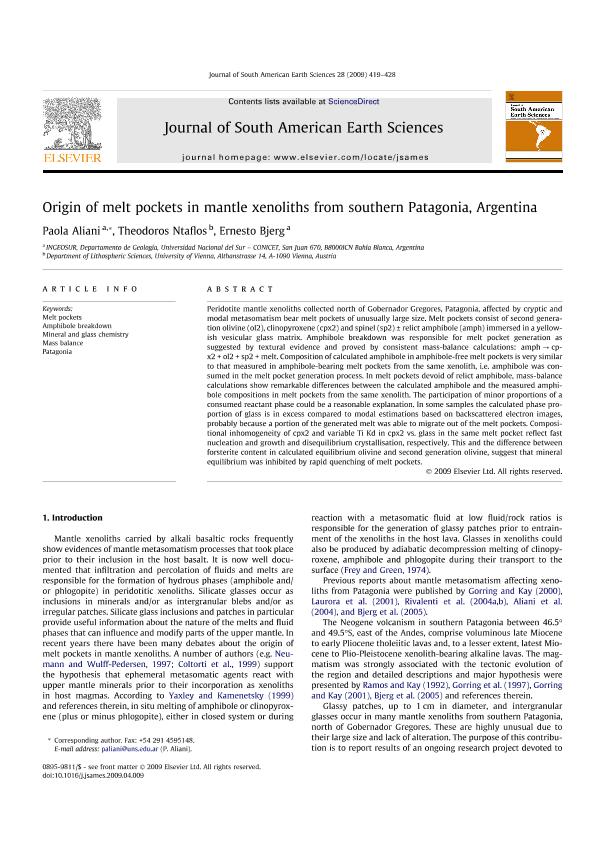
Peridotite mantle xenoliths collected north of Gobernador Gregores, Patagonia, affected by cryptic and modal metasomatism bear melt pockets of unusually large size. Melt pockets consist of second generation olivine (ol2), clinopyroxene (cpx2) and spinel (sp2) ± relict amphibole (amph) immersed in a yellowish vesicular glass matrix. Amphibole breakdown was responsible for melt pocket generation as suggested by textural evidence and proved by consistent mass-balance calculations: amph → cpx2 + ol2 + sp2 + melt. Composition of calculated amphibole in amphibole-free melt pockets is very similar to that measured in amphibole-bearing melt pockets from the same xenolith, i.e. amphibole was consumed in the melt pocket generation process. In melt pockets devoid of relict amphibole, mass-balance calculations show remarkable differences between the calculated amphibole and the measured amphibole compositions in melt pockets from the same xenolith. The participation of minor proportions of a consumed reactant phase could be a reasonable explanation. In some samples the calculated phase proportion of glass is in excess compared to modal estimations based on backscattered electron images, probably because a portion of the generated melt was able to migrate out of the melt pockets. Compositional inhomogeneity of cpx2 and variable Ti Kd in cpx2 vs. glass in the same melt pocket reflect fast nucleation and growth and disequilibrium crystallisation, respectively. This and the difference between forsterite content in calculated equilibrium olivine and second generation olivine, suggest that mineral equilibrium was inhibited by rapid quenching of melt pockets.
Archivos asociados

Tamaño:
327.4Kb
Formato:
PDF
Licencia
 Excepto donde se diga explícitamente, este item se publica bajo la siguiente descripción:
Creative Commons Attribution-NonCommercial-ShareAlike 2.5 Unported (CC BY-NC-SA 2.5)
Excepto donde se diga explícitamente, este item se publica bajo la siguiente descripción:
Creative Commons Attribution-NonCommercial-ShareAlike 2.5 Unported (CC BY-NC-SA 2.5)
Identificadores
Colecciones
Articulos(INGEOSUR)
Articulos de INST.GEOLOGICO DEL SUR
Articulos de INST.GEOLOGICO DEL SUR
Citación
Aliani, Paola; Ntaflos, Theodoros; Bjerg, Ernesto Alfredo; Origin of melt pockets in mantle xenoliths from southern Patagonia, Argentina; Pergamon-Elsevier Science Ltd; Journal of South American Earth Sciences; 28; 4; 12-2009; 419-428
Compartir


Altmétricas