Mostrar el registro sencillo del ítem
dc.contributor.author
Garcia Burgos, David
dc.contributor.author
Zamora, María Clara
dc.date.available
2019-05-23T19:55:34Z
dc.date.issued
2013-01
dc.identifier.citation
Garcia Burgos, David; Zamora, María Clara; Facial affective reactions to bitter-tasting foods and body mass index in adults; Academic Press Ltd - Elsevier Science Ltd; Appetite; 71; 1-2013; 178-186
dc.identifier.issn
0195-6663
dc.identifier.uri
http://hdl.handle.net/11336/76973
dc.description.abstract
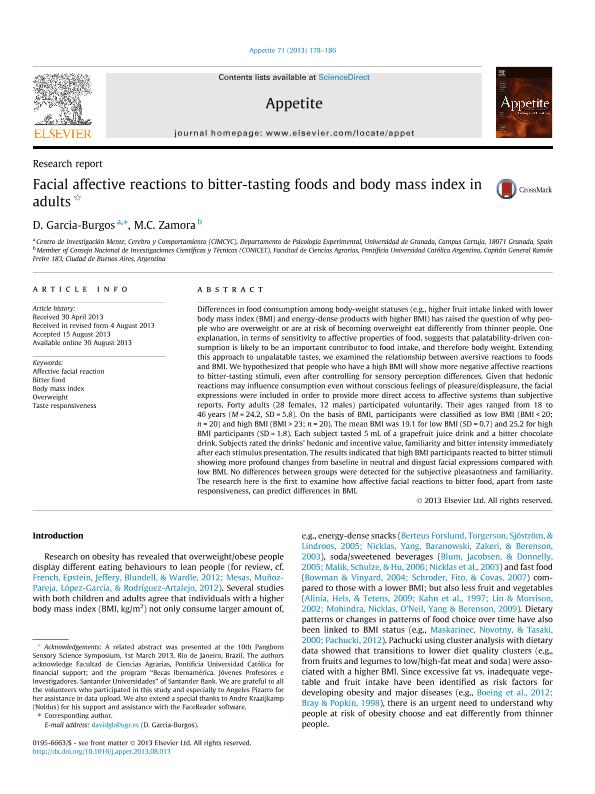
Differences in food consumption among body-weight statuses (e.g., higher fruit intake linked with lower body mass index (BMI) and energy-dense products with higher BMI) has raised the question of why people who are overweight or are at risk of becoming overweight eat differently from thinner peopl>e. One explanation, in terms of sensitivity to affective properties of food, suggests that palatability-driven consumption is likely to be an important contributor to food intake, and therefore body weight. Extending this approach to unpalatable tastes, we examined the relationship between aversive reactions to foods and BMI. We hypothesized that people who have a high BMI will show more negative affective reactions to bitter-tasting stimuli, even after controlling for sensory perception differences. Given that hedonic reactions may influence consumption even without conscious feelings of pleasure/displeasure, the facial expressions were included in order to provide more direct access to affective systems than subjective reports. Forty adults (28 females, 12 males) participated voluntarily. Their ages ranged from 18 to 46. years (M=24.2, SD=5.8). On the basis of BMI, participants were classified as low BMI (BMI. <. 20; n=20) and high BMI (BMI. >. 23; n=20). The mean BMI was 19.1 for low BMI (SD=0.7) and 25.2 for high BMI participants (SD=1.8). Each subject tasted 5. mL of a grapefruit juice drink and a bitter chocolate drink. Subjects rated the drinks' hedonic and incentive value, familiarity and bitter intensity immediately after each stimulus presentation. The results indicated that high BMI participants reacted to bitter stimuli showing more profound changes from baseline in neutral and disgust facial expressions compared with low BMI. No differences between groups were detected for the subjective pleasantness and familiarity. The research here is the first to examine how affective facial reactions to bitter food, apart from taste responsiveness, can predict differences in BMI. © 2013 Elsevier Ltd.
dc.format
application/pdf
dc.language.iso
eng
dc.publisher
Academic Press Ltd - Elsevier Science Ltd
dc.rights
info:eu-repo/semantics/openAccess
dc.rights.uri
https://creativecommons.org/licenses/by-nc-sa/2.5/ar/
dc.subject
Affective Facial Reaction
dc.subject
Bitter Food
dc.subject
Body Mass Index
dc.subject
Overweight
dc.subject
Taste Responsiveness
dc.subject.classification
Alimentos y Bebidas
dc.subject.classification
Otras Ingenierías y Tecnologías
dc.subject.classification
INGENIERÍAS Y TECNOLOGÍAS
dc.title
Facial affective reactions to bitter-tasting foods and body mass index in adults
dc.type
info:eu-repo/semantics/article
dc.type
info:ar-repo/semantics/artículo
dc.type
info:eu-repo/semantics/publishedVersion
dc.date.updated
2019-05-23T13:15:34Z
dc.journal.volume
71
dc.journal.pagination
178-186
dc.journal.pais
Países Bajos
dc.journal.ciudad
Amsterdam
dc.description.fil
Fil: Garcia Burgos, David. Universidad de Granada; España
dc.description.fil
Fil: Zamora, María Clara. Consejo Nacional de Investigaciones Científicas y Técnicas; Argentina. Pontificia Universidad Católica Argentina "Santa María de los Buenos Aires"; Argentina
dc.journal.title
Appetite
dc.relation.alternativeid
info:eu-repo/semantics/altIdentifier/doi/https://doi.org/10.1016/j.appet.2013.08.013
dc.relation.alternativeid
info:eu-repo/semantics/altIdentifier/url/https://linkinghub.elsevier.com/retrieve/pii/S0195666313003711
Archivos asociados

Tamaño:
917.5Kb
Formato:
PDF