Artículo
The KCNQ5 potassium channel mediates a component of the afterhyperpolarization current in mouse hippocampus
Tzingounis, Anastassios V.; Heidenreich, Matthias; Kharkovets,Tatjana; Spitzmaul, Guillermo Federico ; Jensen, Henrik S.; Roger, A. Nicoll; Jentsch, Thomas J.
; Jensen, Henrik S.; Roger, A. Nicoll; Jentsch, Thomas J.
Fecha de publicación:
01/06/2010
Editorial:
National Academy of Sciences
Revista:
Proceedings of the National Academy of Sciences of The United States of America
ISSN:
0027-8424
Idioma:
Inglés
Tipo de recurso:
Artículo publicado
Clasificación temática:
Resumen
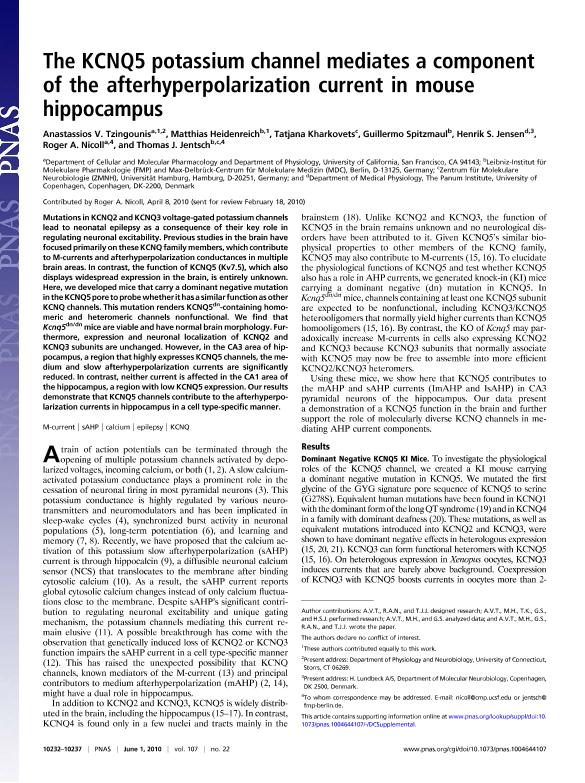
Mutations in KCNQ2 and KCNQ3 voltage-gated potassium channels lead to neonatal epilepsy as a consequence of their key role in regulating neuronal excitability. Previous studies in the brain have focused primarily on these KCNQ family members, which contribute to M-currents and afterhyperpolarization conductances in multiple brain areas. In contrast, the function of KCNQ5 (Kv7.5), which also displays widespread expression in the brain, is entirely unknown. Here, we developed mice that carry a dominant negative mutation in the KCNQ5 pore to probe whetherit has a similar function as other KCNQ channels. This mutation renders KCNQ5dn-containing homomeric and heteromeric channels nonfunctional. We find that Kcnq5dn/dn mice are viable and have normal brain morphology. Furthermore, expression and neuronal localization of KCNQ2 and KCNQ3 subunits are unchanged. However, in the CA3 area of hippocampus, a region that highly expresses KCNQ5 channels, the medium and slow afterhyperpolarization currents are significantly reduced. In contrast, neither current is affected in the CA1 area of the hippocampus, a region with low KCNQ5 expression. Our results demonstrate that KCNQ5 channels contribute to the afterhyperpolarization currents in hippocampus in a cell type-specific manner.
Palabras clave:
Calcium
,
Epilepsy
,
Kcnq
,
M-Current
,
Sahp
Archivos asociados

Tamaño:
799.3Kb
Formato:
PDF
Licencia
 Excepto donde se diga explícitamente, este item se publica bajo la siguiente descripción:
Creative Commons Attribution-NonCommercial-ShareAlike 2.5 Unported (CC BY-NC-SA 2.5)
Excepto donde se diga explícitamente, este item se publica bajo la siguiente descripción:
Creative Commons Attribution-NonCommercial-ShareAlike 2.5 Unported (CC BY-NC-SA 2.5)
Identificadores
Colecciones
Articulos(INIBIBB)
Articulos de INST.DE INVEST.BIOQUIMICAS BAHIA BLANCA (I)
Articulos de INST.DE INVEST.BIOQUIMICAS BAHIA BLANCA (I)
Citación
Tzingounis, Anastassios V.; Heidenreich, Matthias; Kharkovets,Tatjana; Spitzmaul, Guillermo Federico; Jensen, Henrik S.; et al.; The KCNQ5 potassium channel mediates a component of the afterhyperpolarization current in mouse hippocampus; National Academy of Sciences; Proceedings of the National Academy of Sciences of The United States of America; 107; 22; 1-6-2010; 10232-10237
Compartir


Altmétricas