Artículo
Involvement of KLF14 and egr-1 in the TGF-beta1 action on Leydig cell proliferation
Gonzalez, Candela Rocio ; Vallcaneras, Sandra
; Calandra, Ricardo Saul
; Gonzalez de Calvar, Silvia Ines
; Vallcaneras, Sandra
; Calandra, Ricardo Saul
; Gonzalez de Calvar, Silvia Ines
; Vallcaneras, Sandra
; Calandra, Ricardo Saul
; Gonzalez de Calvar, Silvia Ines
Fecha de publicación:
02/2013
Editorial:
Academic Press Ltd - Elsevier Science Ltd
Revista:
Cytokine
ISSN:
1043-4666
Idioma:
Inglés
Tipo de recurso:
Artículo publicado
Clasificación temática:
Resumen
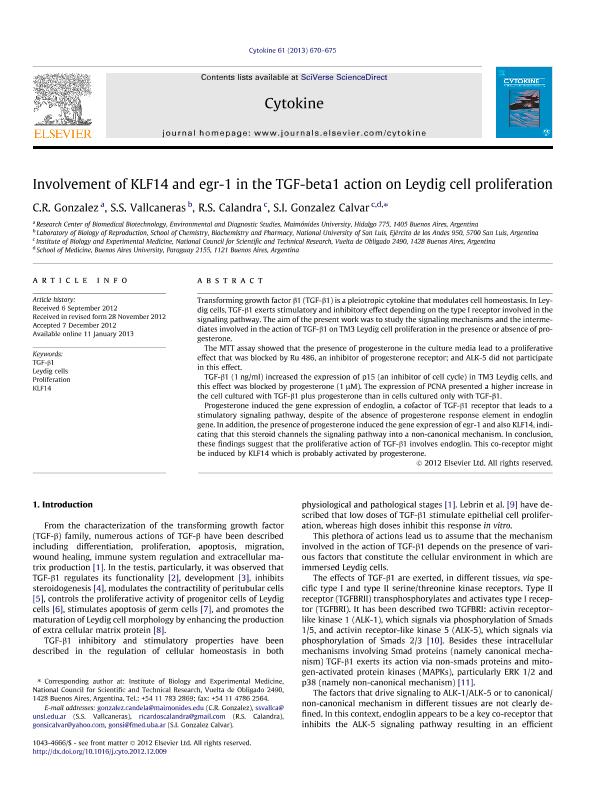
Transforming growth factor β1 (TGF-β1) is a pleiotropic cytokine that modulates cell homeostasis. In Leydig cells, TGF-β1 exerts stimulatory and inhibitory effect depending on the type I receptor involved in the signaling pathway. The aim of the present work was to study the signaling mechanisms and the intermediates involved in the action of TGF-β1 on TM3 Leydig cell proliferation in the presence or absence of progesterone. The MTT assay showed that the presence of progesterone in the culture media lead to a proliferative effect that was blocked by Ru 486, an inhibitor of progesterone receptor; and ALK-5 did not participate in this effect. TGF-β1 (1. ng/ml) increased the expression of p15 (an inhibitor of cell cycle) in TM3 Leydig cells, and this effect was blocked by progesterone (1 μM). The expression of PCNA presented a higher increase in the cell cultured with TGF-β1 plus progesterone than in cells cultured only with TGF-β1.Progesterone induced the gene expression of endoglin, a cofactor of TGF-β1 receptor that leads to a stimulatory signaling pathway, despite of the absence of progesterone response element in endoglin gene. In addition, the presence of progesterone induced the gene expression of egr-1 and also KLF14, indicating that this steroid channels the signaling pathway into a non-canonical mechanism. In conclusion, these findings suggest that the proliferative action of TGF-β1 involves endoglin. This co-receptor might be induced by KLF14 which is probably activated by progesterone.
Palabras clave:
Klf14
,
Leydig Cells
,
Proliferation
,
Tgf-Β1
Archivos asociados

Tamaño:
522.3Kb
Formato:
PDF
Licencia
 Excepto donde se diga explícitamente, este item se publica bajo la siguiente descripción:
Creative Commons Attribution-NonCommercial-ShareAlike 2.5 Unported (CC BY-NC-SA 2.5)
Excepto donde se diga explícitamente, este item se publica bajo la siguiente descripción:
Creative Commons Attribution-NonCommercial-ShareAlike 2.5 Unported (CC BY-NC-SA 2.5)
Identificadores
Colecciones
Articulos(IBYME)
Articulos de INST.DE BIOLOGIA Y MEDICINA EXPERIMENTAL (I)
Articulos de INST.DE BIOLOGIA Y MEDICINA EXPERIMENTAL (I)
Articulos(IMIBIO-SL)
Articulos de INST. MULTIDICIPLINARIO DE INV. BIO. DE SAN LUIS
Articulos de INST. MULTIDICIPLINARIO DE INV. BIO. DE SAN LUIS
Articulos(SEDE CENTRAL)
Articulos de SEDE CENTRAL
Articulos de SEDE CENTRAL
Citación
Gonzalez, Candela Rocio; Vallcaneras, Sandra; Calandra, Ricardo Saul; Gonzalez de Calvar, Silvia Ines; Involvement of KLF14 and egr-1 in the TGF-beta1 action on Leydig cell proliferation; Academic Press Ltd - Elsevier Science Ltd; Cytokine; 61; 2; 2-2013; 670-675
Compartir


Altmétricas