Mostrar el registro sencillo del ítem
dc.contributor.author
González, Ana Cecilia
dc.date.available
2019-05-10T20:54:19Z
dc.date.issued
2017-08
dc.identifier.citation
González, Ana Cecilia; Fundamentos filosóficos e implicancias subjetivas de la noción de cuerpo en las Técnicas de Reproducción Humana Asistida; L. Misseri; Prometeica; 15; 8-2017; 42-49
dc.identifier.issn
1852-9488
dc.identifier.uri
http://hdl.handle.net/11336/76118
dc.description.abstract
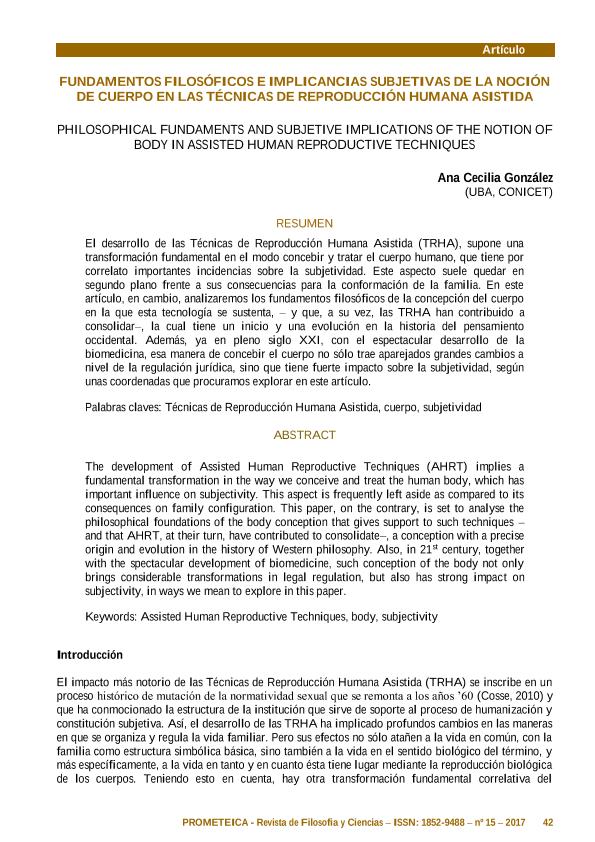
El desarrollo de las Técnicas de Reproducción Humana Asistida (TRHA), supone una transformación fundamental en el modo concebir y tratar el cuerpo humano, que tiene por correlato importantes incidencias sobre la subjetividad. Este aspecto suele quedar en segundo plano frente a sus consecuencias para la conformación de la familia. En este artículo, en cambio, analizaremos los fundamentos filosóficos de la concepción del cuerpo en la que esta tecnología se sustenta, – y que, a su vez, las TRHA han contribuido a consolidar–, la cual tiene un inicio y una evolución en la historia del pensamiento occidental. Además, ya en pleno siglo XXI, con el espectacular desarrollo de la biomedicina, esa manera de concebir el cuerpo no sólo trae aparejados grandes cambios a nivel de la regulación jurídica, sino que tiene fuerte impacto sobre la subjetividad, según unas coordenadas que procuramos explorar en este artículo.
dc.description.abstract
The development of Assisted Human Reproductive Techniques (AHRT) implies a fundamental transformation in the way we conceive and treat the human body, which has important influence on subjectivity. This aspect is frequently left aside as compared to its consequences on family configuration. This paper, on the contrary, is set to analyse the philosophical foundations of the body conception that gives support to such techniques – and that AHRT, at their turn, have contributed to consolidate–, a conception with a precise origin and evolution in the history of Western philosophy. Also, in 21st century, together with the spectacular development of biomedicine, such conception of the body not only brings considerable transformations in legal regulation, but also has strong impact on subjectivity, in ways we mean to explore in this paper.
dc.format
application/pdf
dc.language.iso
spa
dc.publisher
L. Misseri
dc.rights
info:eu-repo/semantics/openAccess
dc.rights.uri
https://creativecommons.org/licenses/by-nc-sa/2.5/ar/
dc.subject
Tecnicas de Reproducción Humana Asistida
dc.subject
Cuerpo
dc.subject
Subjetividad
dc.subject
Biopolitica
dc.subject.classification
Otras Filosofía, Étnica y Religión
dc.subject.classification
Filosofía, Ética y Religión
dc.subject.classification
HUMANIDADES
dc.title
Fundamentos filosóficos e implicancias subjetivas de la noción de cuerpo en las Técnicas de Reproducción Humana Asistida
dc.title
Philosophical fundaments and subjetive implications of the notion of body in assisted human reproductive techniques
dc.type
info:eu-repo/semantics/article
dc.type
info:ar-repo/semantics/artículo
dc.type
info:eu-repo/semantics/publishedVersion
dc.date.updated
2019-05-08T17:33:58Z
dc.journal.number
15
dc.journal.pagination
42-49
dc.journal.pais
Argentina
dc.journal.ciudad
Mar del Plata
dc.description.fil
Fil: González, Ana Cecilia. Universidad de Buenos Aires. Facultad de Psicología. Instituto de Investigaciones; Argentina. Consejo Nacional de Investigaciones Científicas y Técnicas; Argentina
dc.journal.title
Prometeica
dc.relation.alternativeid
info:eu-repo/semantics/altIdentifier/url/https://periodicos.unifesp.br/index.php/prometeica/article/view/1652
dc.relation.alternativeid
info:eu-repo/semantics/altIdentifier/doi/http://dx.doi.org/10.24316/prometeica.v0i15.193
Archivos asociados

Tamaño:
383.5Kb
Formato:
PDF