Mostrar el registro sencillo del ítem
dc.contributor.author
Lama, Amriti
dc.contributor.author
Pawarta, Sudesh
dc.contributor.author
Bidon Chanal, Axel
dc.contributor.author
Anand, Arvind
dc.contributor.author
Gelpi, José Luis
dc.contributor.author
Arya, Swati
dc.contributor.author
Marti, Marcelo Adrian
dc.contributor.author
Estrin, Dario Ariel
dc.contributor.author
Luque, F. Javier
dc.contributor.author
Dikshit, Kanak
dc.date.available
2019-05-06T00:09:50Z
dc.date.issued
2009
dc.identifier.citation
Lama, Amriti; Pawarta, Sudesh; Bidon Chanal, Axel; Anand, Arvind; Gelpi, José Luis; et al.; Role of the pre-A motif in nitric oxide scavenging by truncated hemoglobin HbN of Mycobacterium Tuberculosis; American Society for Biochemistry and Molecular Biology; Journal of Biological Chemistry (online); 284; 2009; 14457-14468
dc.identifier.issn
0021-9258
dc.identifier.uri
http://hdl.handle.net/11336/75572
dc.description.abstract
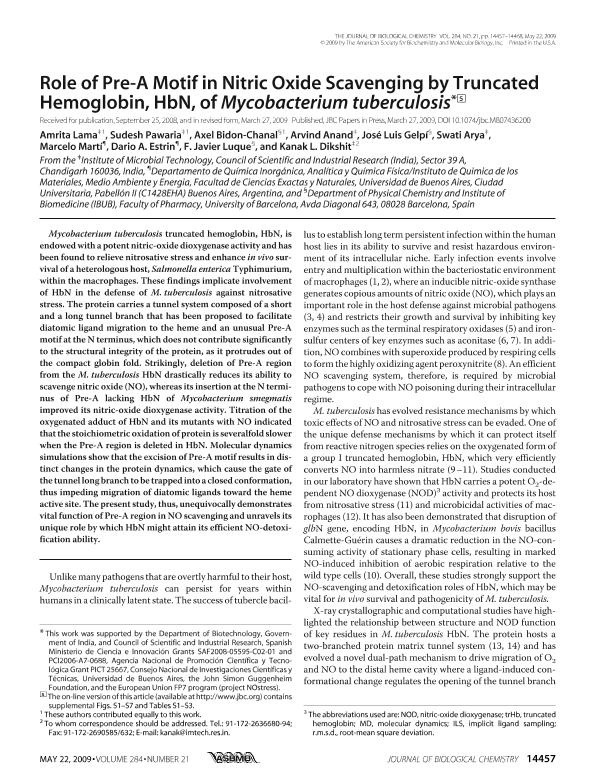
Mycobacterium tuberculosis truncated hemoglobin, HbN, is endowed with a potent nitric-oxide dioxygenase activity and has been found to relieve nitrosative stress and enhance in vivo survival of a heterologous host, Salmonella enterica Typhimurium, within the macrophages. These findings implicate involvement of HbN in the defense of M. tuberculosis against nitrosative stress. The protein carries a tunnel system composed of a short and a long tunnel branch that has been proposed to facilitate diatomic ligand migration to the heme and an unusual Pre-A motif at the N terminus, which does not contribute significantly to the structural integrity of the protein, as it protrudes out of the compact globin fold. Strikingly, deletion of Pre-A region from the M. tuberculosis HbN drastically reduces its ability to scavenge nitric oxide (NO), whereas its insertion at the N terminus of Pre-A lacking HbN of Mycobacterium smegmatis improved its nitric-oxide dioxygenase activity. Titration of the oxygenated adduct of HbN and its mutants with NO indicated that the stoichiometric oxidation of protein is severalfold slower when the Pre-A region is deleted in HbN. Molecular dynamics simulations show that the excision of Pre-A motif results in distinct changes in the protein dynamics, which cause the gate of the tunnel long branch to be trapped into a closed conformation, thus impeding migration of diatomic ligands toward the heme active site. The present study, thus, unequivocally demonstrates vital function of Pre-A region in NO scavenging and unravels its unique role by which HbN might attain its efficient NO-detoxification ability.
dc.format
application/pdf
dc.language.iso
eng
dc.publisher
American Society for Biochemistry and Molecular Biology
dc.rights
info:eu-repo/semantics/openAccess
dc.rights.uri
https://creativecommons.org/licenses/by-nc-sa/2.5/ar/
dc.subject
Truncated Hemoglobin
dc.subject
Molecular Dynamics
dc.subject.classification
Bioquímica y Biología Molecular
dc.subject.classification
Ciencias Biológicas
dc.subject.classification
CIENCIAS NATURALES Y EXACTAS
dc.title
Role of the pre-A motif in nitric oxide scavenging by truncated hemoglobin HbN of Mycobacterium Tuberculosis
dc.type
info:eu-repo/semantics/article
dc.type
info:ar-repo/semantics/artículo
dc.type
info:eu-repo/semantics/publishedVersion
dc.date.updated
2019-03-21T16:12:57Z
dc.journal.volume
284
dc.journal.pagination
14457-14468
dc.journal.pais
Estados Unidos
dc.description.fil
Fil: Lama, Amriti. Council of Scientific and Industrial Research; India
dc.description.fil
Fil: Pawarta, Sudesh. Council of Scientific and Industrial Research; India
dc.description.fil
Fil: Bidon Chanal, Axel. Universitat de Barcelona; España
dc.description.fil
Fil: Anand, Arvind. Council of Scientific and Industrial Research; India
dc.description.fil
Fil: Gelpi, José Luis. Universitat de Barcelona; España
dc.description.fil
Fil: Arya, Swati. Council of Scientific and Industrial Research; India
dc.description.fil
Fil: Marti, Marcelo Adrian. Consejo Nacional de Investigaciones Científicas y Técnicas. Oficina de Coordinación Administrativa Ciudad Universitaria. Instituto de Química, Física de los Materiales, Medioambiente y Energía. Universidad de Buenos Aires. Facultad de Ciencias Exactas y Naturales. Instituto de Química, Física de los Materiales, Medioambiente y Energía; Argentina
dc.description.fil
Fil: Estrin, Dario Ariel. Consejo Nacional de Investigaciones Científicas y Técnicas. Oficina de Coordinación Administrativa Ciudad Universitaria. Instituto de Química, Física de los Materiales, Medioambiente y Energía. Universidad de Buenos Aires. Facultad de Ciencias Exactas y Naturales. Instituto de Química, Física de los Materiales, Medioambiente y Energía; Argentina
dc.description.fil
Fil: Luque, F. Javier. Universitat de Barcelona; España
dc.description.fil
Fil: Dikshit, Kanak. Council of Scientific and Industrial Research; India
dc.journal.title
Journal of Biological Chemistry (online)
dc.relation.alternativeid
info:eu-repo/semantics/altIdentifier/url/http://www.jbc.org/content/284/21/14457.long
dc.relation.alternativeid
info:eu-repo/semantics/altIdentifier/doi/http://dx.doi.org/10.1074/jbc.M807436200
dc.relation.alternativeid
info:eu-repo/semantics/altIdentifier/pmid/19329431
Archivos asociados

Tamaño:
1.262Mb
Formato:
PDF