Artículo
The relative importance of genetic diversity and phenotypic plasticity in determining invasion success of a clonal weed in the USA and China
Geng, Yupeng; van Klinken, Rieks D.; Sosa, Alejandro Joaquín ; Li, Bo; Chen, Jiakuan; Xu, Cheng Yuan
; Li, Bo; Chen, Jiakuan; Xu, Cheng Yuan
Fecha de publicación:
02/2016
Editorial:
Frontiers Media S.A.
Revista:
Frontiers in Plant Science
ISSN:
1664-462X
Idioma:
Inglés
Tipo de recurso:
Artículo publicado
Clasificación temática:
Resumen
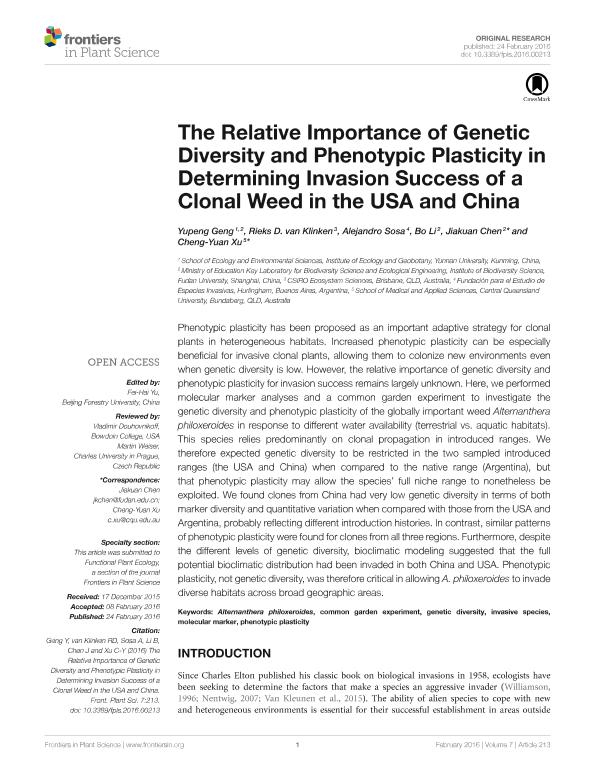
Phenotypic plasticity has been proposed as an important adaptive strategy for clonal plants in heterogeneous habitats. Increased phenotypic plasticity can be especially beneficial for invasive clonal plants, allowing them to colonize new environments even when genetic diversity is low. However, the relative importance of genetic diversity and phenotypic plasticity for invasion success remains largely unknown. Here, we performed molecular marker analyses and a common garden experiment to investigate the genetic diversity and phenotypic plasticity of the globally important weed Alternanthera philoxeroides in response to different water availability (terrestrial vs. aquatic habitats). This species relies predominantly on clonal propagation in introduced ranges. We therefore expected genetic diversity to be restricted in the two sampled introduced ranges (the USA and China) when compared to the native range (Argentina), but that phenotypic plasticity may allow the species' full niche range to nonetheless be exploited. We found clones from China had very low genetic diversity in terms of both marker diversity and quantitative variation when compared with those from the USA and Argentina, probably reflecting different introduction histories. In contrast, similar patterns of phenotypic plasticity were found for clones from all three regions. Furthermore, despite the different levels of genetic diversity, bioclimatic modeling suggested that the full potential bioclimatic distribution had been invaded in both China and USA. Phenotypic plasticity, not genetic diversity, was therefore critical in allowing A. philoxeroides to invade diverse habitats across broad geographic areas.
Archivos asociados

Tamaño:
2.876Mb
Formato:
PDF
Licencia
 Excepto donde se diga explícitamente, este item se publica bajo la siguiente descripción:
Creative Commons Attribution-NonCommercial-ShareAlike 2.5 Unported (CC BY-NC-SA 2.5)
Excepto donde se diga explícitamente, este item se publica bajo la siguiente descripción:
Creative Commons Attribution-NonCommercial-ShareAlike 2.5 Unported (CC BY-NC-SA 2.5)
Identificadores
Colecciones
Articulos(SEDE CENTRAL)
Articulos de SEDE CENTRAL
Articulos de SEDE CENTRAL
Citación
Geng, Yupeng; van Klinken, Rieks D.; Sosa, Alejandro Joaquín; Li, Bo; Chen, Jiakuan; et al.; The relative importance of genetic diversity and phenotypic plasticity in determining invasion success of a clonal weed in the USA and China; Frontiers Media S.A.; Frontiers in Plant Science; 7; 2-2016; 1-13
Compartir


Altmétricas