Artículo
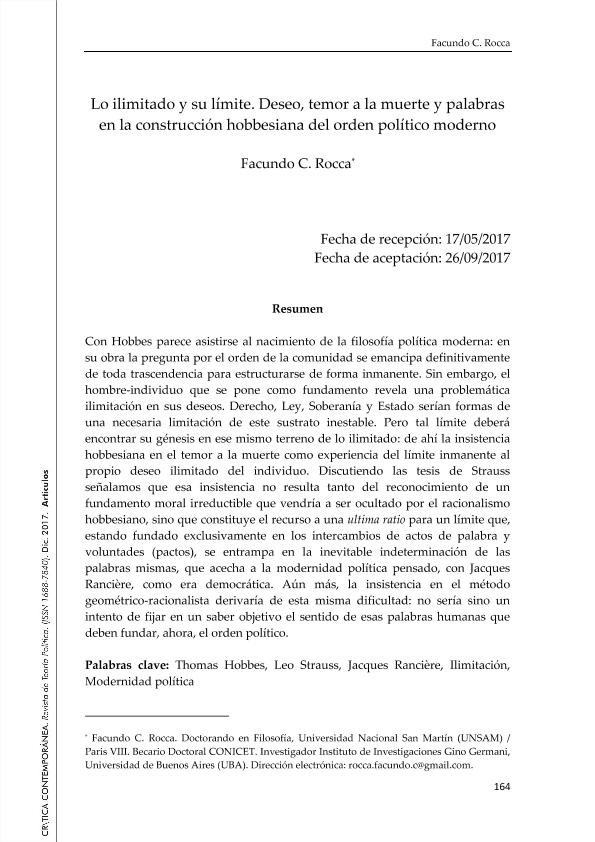
Con Hobbes parece asistirse al nacimiento de la filosofía política moderna: ensu obra la pregunta por el orden de la comunidad se emancipa definitivamentede toda trascendencia para estructurarse de forma inmanente. Sin embargo, elhombre-individuo que se pone como fundamento revela una problemáticailimitación en sus deseos. Derecho, Ley, Soberanía y Estado serían formas deuna necesaria limitación de este sustrato inestable. Pero tal límite deberáencontrar su génesis en ese mismo terreno de lo ilimitado: de ahí la insistenciahobbesiana en el temor a la muerte como experiencia del límite inmanente alpropio deseo ilimitado del individuo. Discutiendo las tesis de Straussseñalamos que esa insistencia no resulta tanto del reconocimiento de unfundamento moral irreductible que vendría a ser ocultado por el racionalismohobbesiano, sino que constituye el recurso a una ultima ratio para un límite que, estando fundado exclusivamente en los intercambios de actos de palabra yvoluntades (pactos), se entrampa en la inevitable indeterminación de laspalabras mismas, que acecha a la modernidad política pensado, con JacquesRancière, como era democrática. Aún más, la insistencia en el métodogeométrico-racionalista derivaría de esta misma dificultad: no sería sino unintento de fijar en un saber objetivo el sentido de esas palabras humanas quedeben fundar, ahora, el orden político. In Hobbes one seems to face the birth of modern political philosophy: in his work the question of the order of the community is emancipated from any transcendence in order to be immanently structured. However, the manindividual that is posited as its basis shows a problematic limitlessness of his desires. Right, Law, Sovereignty and State could be seen as necessary limitations of this unstable foundation. Nevertheless, such a limit ought to find its genesis in this same limitless ground. Hobbes’ insistence on the fear of death as an experience of limitation, internal to the unlimited desire of the individual, results from this necessity. Contesting Straus thesis, it would be pointed out that such insistence would be not the acknowledgment of an irreducible moral foundation later cloaked by Hobbes’ rationalism, but the use of an ultima ratio to secure a limit that, being founded exclusively on the exchange of words and wills (pact), is trapped in the inevitable indetermination of words themselves. It is this indetermination that, as shown by Jacques Rancière, haunts political modernity as a democratic age. Even more, Hobbes’s insistence on the geometric-rational method would derive from this same difficulty; it would be nothing but the attempt to fixate as an objective knowledge the human words that must manufacture, in modern times, the political order.
Lo ilimitado y su límite. Deseo, temor a la muerte y palabras en la construcción hobbesiana del orden político moderno

Fecha de publicación:
12/2017
Editorial:
Universidad de la República
Revista:
Crítica Contemporánea. Revista de Teoría Política
ISSN:
1688-7840
Idioma:
Español
Tipo de recurso:
Artículo publicado
Clasificación temática:
Resumen
Palabras clave:
Thomas Hobbes
,
Leo Strauss
,
Jacques Rancière
,
Modernidad Política
Archivos asociados

Tamaño:
970.5Kb
Formato:
PDF
Licencia
 Excepto donde se diga explícitamente, este item se publica bajo la siguiente descripción:
Creative Commons Attribution-NonCommercial-ShareAlike 2.5 Unported (CC BY-NC-SA 2.5)
Excepto donde se diga explícitamente, este item se publica bajo la siguiente descripción:
Creative Commons Attribution-NonCommercial-ShareAlike 2.5 Unported (CC BY-NC-SA 2.5)
Identificadores
Colecciones
Articulos(SEDE CENTRAL)
Articulos de SEDE CENTRAL
Articulos de SEDE CENTRAL
Citación
Rocca, Facundo Carlos; Lo ilimitado y su límite. Deseo, temor a la muerte y palabras en la construcción hobbesiana del orden político moderno; Universidad de la República; Crítica Contemporánea. Revista de Teoría Política; 7; 12-2017; 164-189
Compartir

