Artículo
Is medically assisted death a special obligation?

Fecha de publicación:
06/2017
Editorial:
B M J Publishing Group
Revista:
Journal Of Medical Ethics.
ISSN:
0306-6800
Idioma:
Inglés
Tipo de recurso:
Artículo publicado
Clasificación temática:
Resumen
Several distinct arguments conclude that terminally ill patients have a right to a medically assisted death; two are especially influential: the autonomy argument and the non-harm argument. Both have proven convincing to many, but not to those who view the duty not to kill as an (almost) absolute constraint. Some philosophers see the source of such a constraint in general (deontological) moral principles, other in the nature of the medical profession. My aim in this paper is not to add one further argument in favour of medically assisted death. Rather, I want to shed light on a kind of reason that, to my mind, has not been previously highlighted or defended, and that might shake the principled conviction that doctors are never allowed to actively assist their patients to die. Specifically, my purpose is to show that doctors (as members of the medical profession) have a special duty to provide medically assisted death to consenting terminally ill patients, because (and insofar as) they have been participants in the process leading to the situation in which a patient can reasonably ask to die. In some specific ways (to be explained), they are involved in the tragic fate of those patients and, therefore, are not morally allowed to straightforwardly refuse to assist them to die.
Palabras clave:
Medically Assisted Death
,
Euthanasia
,
Special Duties
Archivos asociados
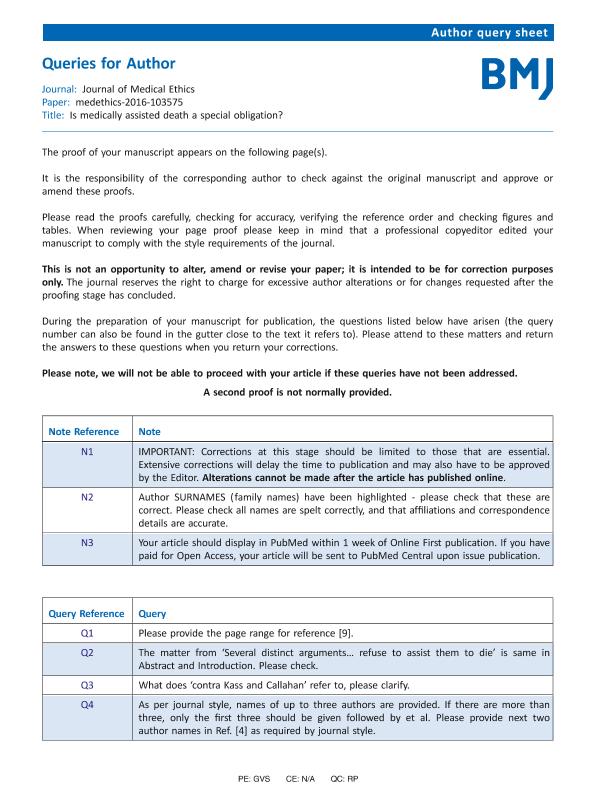

Tamaño:
344.7Kb
Formato:
PDF
Licencia
 Excepto donde se diga explícitamente, este item se publica bajo la siguiente descripción:
Creative Commons Attribution-NonCommercial-ShareAlike 2.5 Unported (CC BY-NC-SA 2.5)
Excepto donde se diga explícitamente, este item se publica bajo la siguiente descripción:
Creative Commons Attribution-NonCommercial-ShareAlike 2.5 Unported (CC BY-NC-SA 2.5)
Identificadores
Colecciones
Articulos(SEDE CENTRAL)
Articulos de SEDE CENTRAL
Articulos de SEDE CENTRAL
Citación
Rivera López, Eduardo Enrique; Is medically assisted death a special obligation?; B M J Publishing Group; Journal Of Medical Ethics.; 43; 6; 6-2017; 401-406
Compartir


Altmétricas