Artículo
How Do I Examine Postural Disorders in Parkinson's Disease?

Fecha de publicación:
11/2016
Editorial:
Wiley
Revista:
Movement Disorders Clinical Practice
ISSN:
2330-1619
Idioma:
Inglés
Tipo de recurso:
Artículo publicado
Clasificación temática:
Resumen
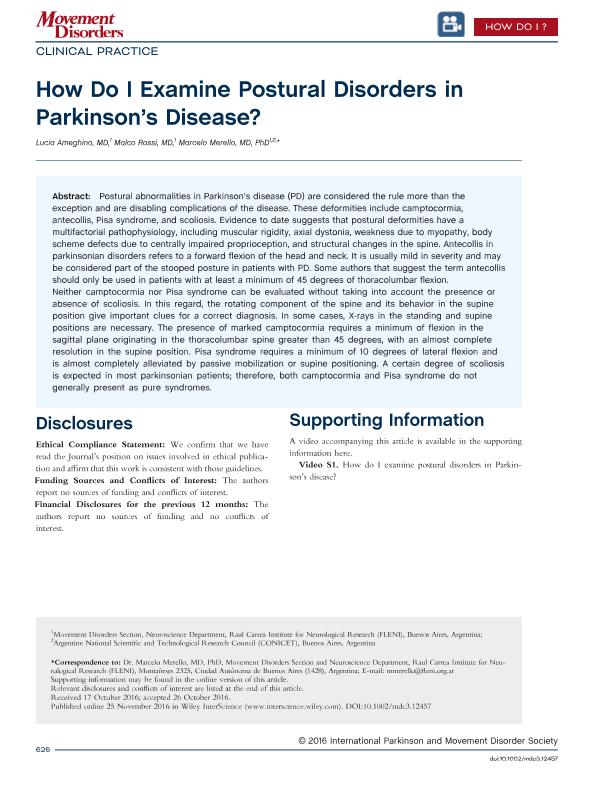
Postural abnormalities in Parkinson's disease (PD) are considered the rule more than the exception and are disabling complications of the disease. These deformities include camptocormia, antecollis, Pisa syndrome, and scoliosis. Evidence to date suggests that postural deformities have a multifactorial pathophysiology, including muscular rigidity, axial dystonia, weakness due to myopathy, body scheme defects due to centrally impaired proprioception, and structural changes in the spine. Antecollis in parkinsonian disorders refers to a forward flexion of the head and neck. It is usually mild in severity and may be considered part of the stooped posture in patients with PD. Some authors that suggest the term antecollis should only be used in patients with at least a minimum of 45 degrees of thoracolumbar flexion.Neither camptocormia nor Pisa syndrome can be evaluated without taking into account the presence or absence of scoliosis. In this regard, the rotating component of the spine and its behavior in the supine position give important clues for a correct diagnosis. In some cases, X‐rays in the standing and supine positions are necessary. The presence of marked camptocormia requires a minimum of flexion in the sagittal plane originating in the thoracolumbar spine greater than 45 degrees, with an almost complete resolution in the supine position. Pisa syndrome requires a minimum of 10 degrees of lateral flexion and is almost completely alleviated by passive mobilization or supine positioning. A certain degree of scoliosis is expected in most parkinsonian patients; therefore, both camptocormia and Pisa syndrome do not generally present as pure syndromes.
Palabras clave:
Postural
,
Posture
,
Disorder
,
Parkinson
Archivos asociados

Tamaño:
73.36Kb
Formato:
PDF
Licencia
 Excepto donde se diga explícitamente, este item se publica bajo la siguiente descripción:
Creative Commons Attribution-NonCommercial-ShareAlike 2.5 Unported (CC BY-NC-SA 2.5)
Excepto donde se diga explícitamente, este item se publica bajo la siguiente descripción:
Creative Commons Attribution-NonCommercial-ShareAlike 2.5 Unported (CC BY-NC-SA 2.5)
Identificadores
Colecciones
Articulos(SEDE CENTRAL)
Articulos de SEDE CENTRAL
Articulos de SEDE CENTRAL
Citación
Ameghino, Lucia; Rossi, Malco Damián; Merello, Marcelo Jorge; How Do I Examine Postural Disorders in Parkinson's Disease?; Wiley; Movement Disorders Clinical Practice; 3; 6; 11-2016; 626-626
Compartir


Altmétricas