Artículo
The interplay between the effectiveness of the grass-endophyte mutualism and the genetic variability of the host plant

Fecha de publicación:
09/2010
Editorial:
Wiley Blackwell Publishing, Inc
Revista:
Evolutionary Applications
ISSN:
1752-4571
Idioma:
Inglés
Tipo de recurso:
Artículo publicado
Clasificación temática:
Resumen
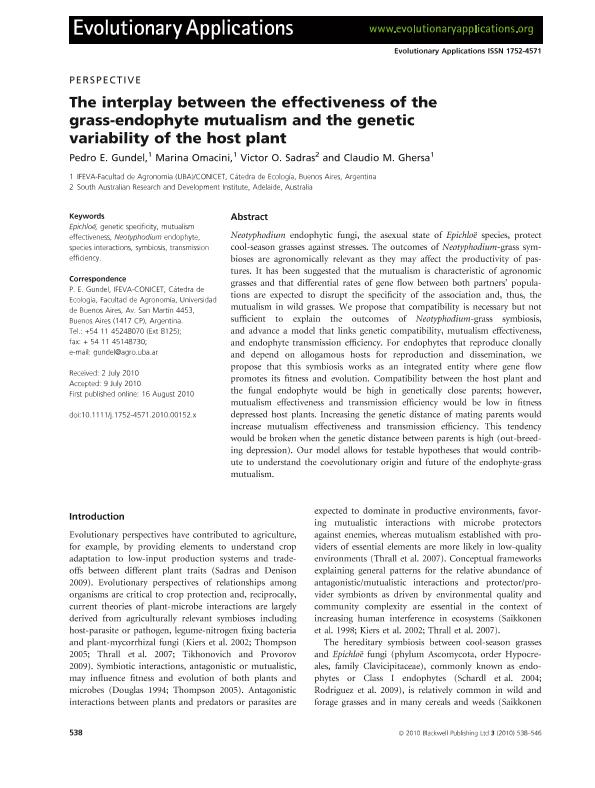
Neotyphodium endophytic fungi, the asexual state of Epichloë species, protect cool-season grasses against stresses. The outcomes of Neotyphodium-grass symbioses are agronomically relevant as they may affect the productivity of pastures. It has been suggested that the mutualism is characteristic of agronomic grasses and that differential rates of gene flow between both partners' populations are expected to disrupt the specificity of the association and, thus, the mutualism in wild grasses. We propose that compatibility is necessary but not sufficient to explain the outcomes of Neotyphodium-grass symbiosis, and advance a model that links genetic compatibility, mutualism effectiveness, and endophyte transmission efficiency. For endophytes that reproduce clonally and depend on allogamous hosts for reproduction and dissemination, we propose that this symbiosis works as an integrated entity where gene flow promotes its fitness and evolution. Compatibility between the host plant and the fungal endophyte would be high in genetically close parents; however, mutualism effectiveness and transmission efficiency would be low in fitness depressed host plants. Increasing the genetic distance of mating parents would increase mutualism effectiveness and transmission efficiency. This tendency would be broken when the genetic distance between parents is high (out-breeding depression). Our model allows for testable hypotheses that would contribute to understand the coevolutionary origin and future of the endophyte-grass mutualism. © 2010 Blackwell Publishing Ltd.
Archivos asociados

Tamaño:
408.6Kb
Formato:
PDF
Licencia
 Excepto donde se diga explícitamente, este item se publica bajo la siguiente descripción:
Creative Commons Attribution-NonCommercial-ShareAlike 2.5 Unported (CC BY-NC-SA 2.5)
Excepto donde se diga explícitamente, este item se publica bajo la siguiente descripción:
Creative Commons Attribution-NonCommercial-ShareAlike 2.5 Unported (CC BY-NC-SA 2.5)
Identificadores
Colecciones
Articulos(IFEVA)
Articulos de INST.D/INV.FISIOLOGICAS Y ECO.VINCULADAS A L/AGRIC
Articulos de INST.D/INV.FISIOLOGICAS Y ECO.VINCULADAS A L/AGRIC
Citación
Gundel, Pedro Emilio; Omacini, Marina; Sadras, Victor Oscar; Ghersa, Claudio Marco; The interplay between the effectiveness of the grass-endophyte mutualism and the genetic variability of the host plant; Wiley Blackwell Publishing, Inc; Evolutionary Applications; 3; 5-6; 9-2010; 538-546
Compartir


Altmétricas