Artículo
Ethanol-conditioned place preference is reduced in dopamine D2 receptor-deficient mice
Cunningham, Christopher L.; Howard, MacKenzie A.; Gill, Sylvia J.; Rubinstein, Marcelo ; Low, Malcolm J.; Grandy, David K.
; Low, Malcolm J.; Grandy, David K.
Fecha de publicación:
12/2000
Editorial:
Pergamon-Elsevier Science Ltd
Revista:
Pharmacology Biochemistry and Behavior
ISSN:
0091-3057
Idioma:
Inglés
Tipo de recurso:
Artículo publicado
Clasificación temática:
Resumen
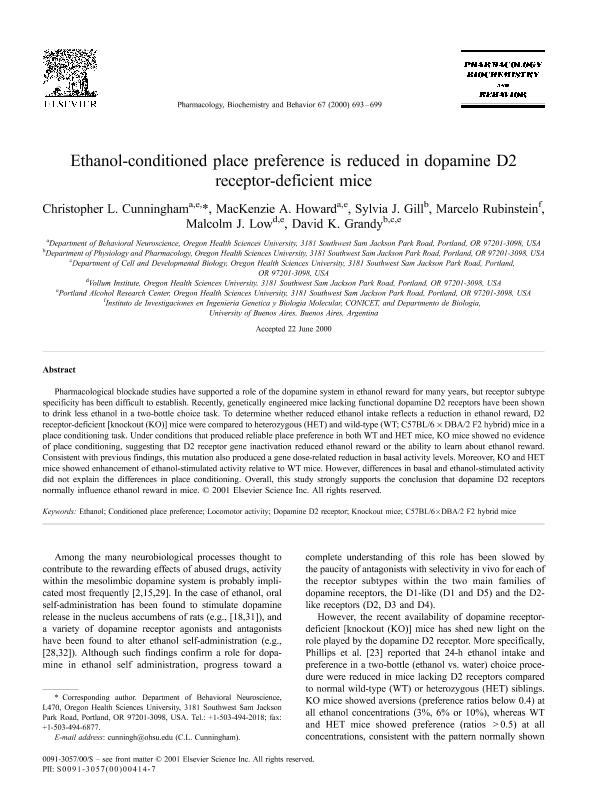
Pharmacological blockade studies have supported a role of the dopamine system in ethanol reward for many years, but receptor subtype specificity has been difficult to establish. Recently, genetically engineered mice lacking functional dopamine D2 receptors have been shown to drink less ethanol in a two-bottle choice task. To determine whether reduced ethanol intake reflects a reduction in ethanol reward, D2 receptor-deficient [knockout (KO)] mice were compared to heterozygous (HET) and wild-type (WT; C57BL/6 × DBA/2 F2 hybrid) mice in a place conditioning task. Under conditions that produced reliable place preference in both WT and HET mice, KO mice showed no evidence of place conditioning, suggesting that D2 receptor gene inactivation reduced ethanol reward or the ability to learn about ethanol reward. Consistent with previous findings, this mutation also produced a gene dose-related reduction in basal activity levels. Moreover, KO and HET mice showed enhancement of ethanol-stimulated activity relative to WT mice. However, differences in basal and ethanol-stimulated activity did not explain the differences in place conditioning. Overall, this study strongly supports the conclusion that dopamine D2 receptors normally influence ethanol reward in mice.
Archivos asociados

Tamaño:
149Kb
Formato:
PDF
Licencia
 Excepto donde se diga explícitamente, este item se publica bajo la siguiente descripción:
Creative Commons Attribution-NonCommercial-ShareAlike 2.5 Unported (CC BY-NC-SA 2.5)
Excepto donde se diga explícitamente, este item se publica bajo la siguiente descripción:
Creative Commons Attribution-NonCommercial-ShareAlike 2.5 Unported (CC BY-NC-SA 2.5)
Identificadores
Colecciones
Articulos(INGEBI)
Articulos de INST.DE INVEST.EN ING.GENETICA Y BIOL.MOLECULAR "DR. HECTOR N TORRES"
Articulos de INST.DE INVEST.EN ING.GENETICA Y BIOL.MOLECULAR "DR. HECTOR N TORRES"
Citación
Cunningham, Christopher L.; Howard, MacKenzie A.; Gill, Sylvia J.; Rubinstein, Marcelo; Low, Malcolm J.; et al.; Ethanol-conditioned place preference is reduced in dopamine D2 receptor-deficient mice; Pergamon-Elsevier Science Ltd; Pharmacology Biochemistry and Behavior; 67; 4; 12-2000; 693-699
Compartir


Altmétricas