Mostrar el registro sencillo del ítem
dc.contributor.author
Fernandez, Jimena Beatriz
dc.contributor.author
Ibarguengoytía, Nora
dc.date.available
2019-03-11T19:26:00Z
dc.date.issued
2012-12
dc.identifier.citation
Fernandez, Jimena Beatriz; Ibarguengoytía, Nora; Does acclimation at higher temperatures affect the locomotor performance of one of the southernmost reptiles in the world?; Firenze University Press; Acta Herpetologica; 7; 2; 12-2012; 281-296
dc.identifier.issn
1827-9635
dc.identifier.uri
http://hdl.handle.net/11336/71376
dc.description.abstract
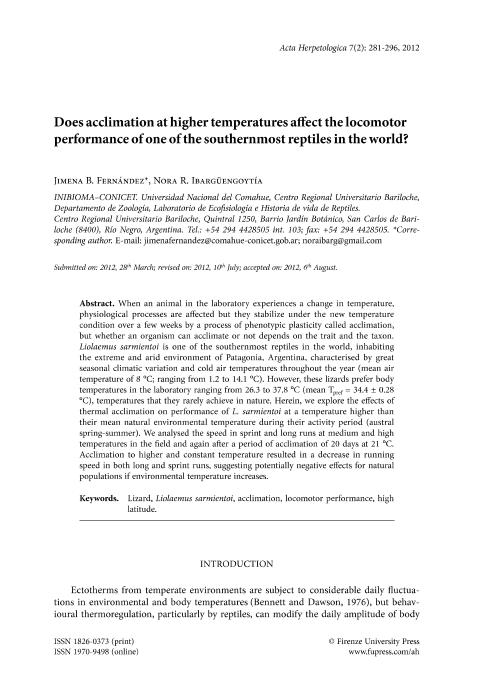
When an animal in the laboratory experiences a change in temperature, physiological processes are affected but they stabilize under the new temperature condition over a few weeks by a process of phenotypic plasticity called acclimation, but whether an organism can acclimate or not depends on the trait and the taxon. Liolaemus sarmientoi is one of the southernmost reptiles in the world, inhabiting the extreme and arid environment of Patagonia, Argentina, characterised by great seasonal climatic variation and cold air temperatures throughout the year (mean air temperature of 8 ºC; ranging from 1.2 to 14.1 ºC). However, these lizards prefer body temperatures in the laboratory ranging from 26.3 to 37.8 ºC (mean Tpref = 34.4 ºC ± 0.28), temperatures that they rarely achieve in nature. Herein, we explore the effects of thermal acclimation on performance of L. sarmientoi at a temperature higher than their mean natural environmental temperature during their activity period (austral spring-summer). We analysed the speed in sprint and long runs at medium and high temperatures in the field and again after a period of acclimation of 20 days at 21 ºC. Acclimation to higher and constant temperature resulted in a decrease in running speed in both long and sprint runs, suggesting potentially negative effects for natural populations if environmental temperature increases.
dc.format
application/pdf
dc.language.iso
eng
dc.publisher
Firenze University Press
dc.rights
info:eu-repo/semantics/openAccess
dc.rights.uri
https://creativecommons.org/licenses/by/2.5/ar/
dc.subject
Liolaemus Sarmientoi
dc.subject
Acclimation
dc.subject
Locomotor Performance
dc.subject
High Latitude
dc.subject.classification
Otras Ciencias Biológicas
dc.subject.classification
Ciencias Biológicas
dc.subject.classification
CIENCIAS NATURALES Y EXACTAS
dc.title
Does acclimation at higher temperatures affect the locomotor performance of one of the southernmost reptiles in the world?
dc.type
info:eu-repo/semantics/article
dc.type
info:ar-repo/semantics/artículo
dc.type
info:eu-repo/semantics/publishedVersion
dc.date.updated
2019-02-12T16:55:02Z
dc.identifier.eissn
1827-9643
dc.journal.volume
7
dc.journal.number
2
dc.journal.pagination
281-296
dc.journal.pais
Italia
dc.journal.ciudad
Florencia
dc.description.fil
Fil: Fernandez, Jimena Beatriz. Consejo Nacional de Investigaciones Científicas y Técnicas. Centro Científico Tecnológico Conicet - Patagonia Norte. Instituto de Investigaciones en Biodiversidad y Medioambiente. Universidad Nacional del Comahue. Centro Regional Universidad Bariloche. Instituto de Investigaciones en Biodiversidad y Medioambiente; Argentina
dc.description.fil
Fil: Ibarguengoytía, Nora. Consejo Nacional de Investigaciones Científicas y Técnicas. Centro Científico Tecnológico Conicet - Patagonia Norte. Instituto de Investigaciones en Biodiversidad y Medioambiente. Universidad Nacional del Comahue. Centro Regional Universidad Bariloche. Instituto de Investigaciones en Biodiversidad y Medioambiente; Argentina
dc.journal.title
Acta Herpetologica
dc.relation.alternativeid
info:eu-repo/semantics/altIdentifier/url/http://www.fupress.net/index.php/ah/article/view/10772
dc.relation.alternativeid
info:eu-repo/semantics/altIdentifier/doi/http://dx.doi.org/10.13128/Acta_Herpetol-10772
Archivos asociados

Tamaño:
247.2Kb
Formato:
PDF