Artículo
CDK2 activation in mouse epidermis induces keratinocyte proliferation but does not affect skin tumor development
Macias, Everardo; Miliani De Marval, Paula L.; de Siervi, Adriana ; Conti, Claudio J.; Senderowicz, Adrian M.; Rodriguez Puebla, Marcelo L.
; Conti, Claudio J.; Senderowicz, Adrian M.; Rodriguez Puebla, Marcelo L.
Fecha de publicación:
12/2008
Editorial:
American Society of Investigative Pathology
Revista:
American Journal Of Pathology
ISSN:
0002-9440
Idioma:
Inglés
Tipo de recurso:
Artículo publicado
Clasificación temática:
Resumen
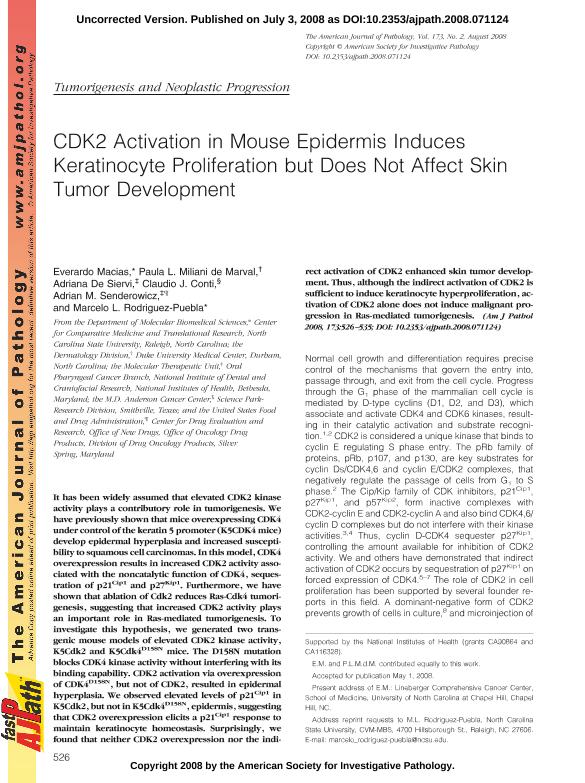
It has been widely assumed that elevated CDK2 kinase activity plays a contributory role in tumorigenesis. We have previously shown that mice overexpressing CDK4 under control of the keratin 5 promoter (K5CDK4 mice) develop epidermal hyperplasia and increased susceptibility to squamous cell carcinomas. In this model, CDK4 overexpression results in increased CDK2 activity associated with the noncatalytic function of CDK4, sequestration of p21Cip1 and p27Kip1. Furthermore, we have shown that ablation of Cdk2 reduces Ras-Cdk4 tumorigenesis, suggesting that increased CDK2 activity plays an important role in Ras-mediated tumorigenesis. To investigate this hypothesis, we generated two transgenic mouse models of elevated CDK2 kinase activity, K5Cdk2 and K5Cdk4D158N mice. The D158N mutation blocks CDK4 kinase activity without interfering with its binding capability. CDK2 activation via overexpression of CDK4D158N, but not of CDK2, resulted in epidermal hyperplasia. We observed elevated levels of p21 Cip1 in K5Cdk2, but not in K5Cdk4D158N, epidermis, suggesting that CDK2 overexpression elicits a p21Cip1 response to maintain keratinocyte homeostasis. Surprisingly, we found that neither CDK2 overexpression nor the indirect activation of CDK2 enhanced skin tumor development. Thus, although the indirect activation of CDK2 is sufficient to induce keratinocyte hyperproliferation, activation of CDK2 alone does not induce malignant progression in Ras-mediated tumorigenesis. Copyright © American Society for Investigative Pathology.
Palabras clave:
Cdk2
,
Transgenic Mice
Archivos asociados

Tamaño:
2.061Mb
Formato:
PDF
Licencia
 Excepto donde se diga explícitamente, este item se publica bajo la siguiente descripción:
Atribución-NoComercial-SinDerivadas 2.5 Argentina (CC BY-NC-ND 2.5 AR)
Excepto donde se diga explícitamente, este item se publica bajo la siguiente descripción:
Atribución-NoComercial-SinDerivadas 2.5 Argentina (CC BY-NC-ND 2.5 AR)
Identificadores
Colecciones
Articulos(IQUIBICEN)
Articulos de INSTITUTO DE QUIMICA BIOLOGICA DE LA FACULTAD DE CS. EXACTAS Y NATURALES
Articulos de INSTITUTO DE QUIMICA BIOLOGICA DE LA FACULTAD DE CS. EXACTAS Y NATURALES
Citación
Macias, Everardo; Miliani De Marval, Paula L.; de Siervi, Adriana; Conti, Claudio J.; Senderowicz, Adrian M.; et al.; CDK2 activation in mouse epidermis induces keratinocyte proliferation but does not affect skin tumor development; American Society of Investigative Pathology; American Journal Of Pathology; 173; 2; 12-2008; 526-535
Compartir


Altmétricas