Artículo
UV habitability and dM stars: an approach for evaluation of biological survival

Fecha de publicación:
06/2009
Editorial:
International Astronomical Union
Revista:
Proceedings of the International Astronomical Union
ISSN:
1743-9221
Idioma:
Inglés
Tipo de recurso:
Artículo publicado
Clasificación temática:
Resumen
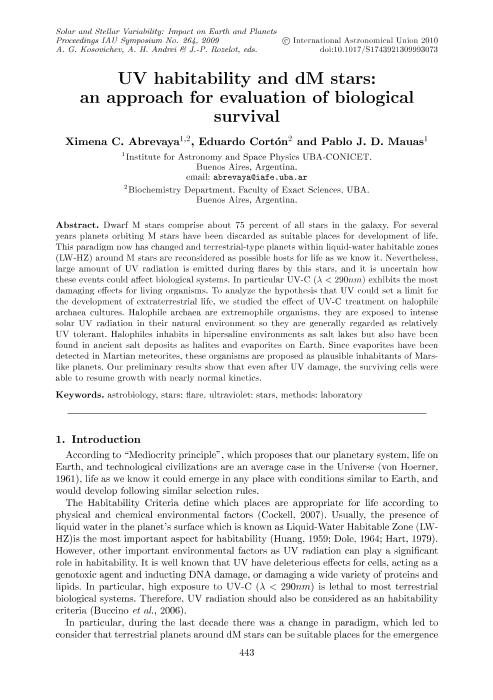
Dwarf M stars comprise about 75 percent of all stars in the galaxy. For several years planets orbiting M stars have been discarded as suitable places for development of life. This paradigm now has changed and terrestrial-type planets within liquid-water habitable zones (LW-HZ) around M stars are reconsidered as possible hosts for life as we know it. Nevertheless, large amount of UV radiation is emitted during flares by this stars, and it is uncertain how these events could affect biological systems. In particular UV-C λ < 290nm) exhibits the most damaging effects for living organisms. To analyze the hypothesis that UV could set a limit for the development of extraterrestrial life, we studied the effect of UV-C treatment on halophile archaea cultures. Halophile archaea are extremophile organisms, they are exposed to intense solar UV radiation in their natural environment so they are generally regarded as relatively UV tolerant. Halophiles inhabits in hipersaline environments as salt lakes but also have been found in ancient salt deposits as halites and evaporites on Earth. Since evaporites have been detected in Martian meteorites, these organisms are proposed as plausible inhabitants of Mars-like planets. Our preliminary results show that even after UV damage, the surviving cells were able to resume growth with nearly normal kinetics.
Palabras clave:
Astrobiology
,
Stars
,
Ultraviolet
,
Life
Archivos asociados

Tamaño:
116.9Kb
Formato:
PDF
Licencia
 Excepto donde se diga explícitamente, este item se publica bajo la siguiente descripción:
Creative Commons Attribution-NonCommercial-ShareAlike 2.5 Unported (CC BY-NC-SA 2.5)
Excepto donde se diga explícitamente, este item se publica bajo la siguiente descripción:
Creative Commons Attribution-NonCommercial-ShareAlike 2.5 Unported (CC BY-NC-SA 2.5)
Identificadores
Colecciones
Articulos(IQUIBICEN)
Articulos de INSTITUTO DE QUIMICA BIOLOGICA DE LA FACULTAD DE CS. EXACTAS Y NATURALES
Articulos de INSTITUTO DE QUIMICA BIOLOGICA DE LA FACULTAD DE CS. EXACTAS Y NATURALES
Citación
Abrevaya, Ximena Celeste; Corton, Eduardo; Mauas, Pablo Jacobo David; UV habitability and dM stars: an approach for evaluation of biological survival; International Astronomical Union; Proceedings of the International Astronomical Union; 5; S264; 6-2009; 443-445
Compartir


Altmétricas