Artículo
The Moral Performativity of Credit and Debt in the Slums of Buenos Aires

Fecha de publicación:
09/2015
Editorial:
Routledge
Revista:
Cultural Studies
ISSN:
1466-4348
Idioma:
Inglés
Tipo de recurso:
Artículo publicado
Clasificación temática:
Resumen
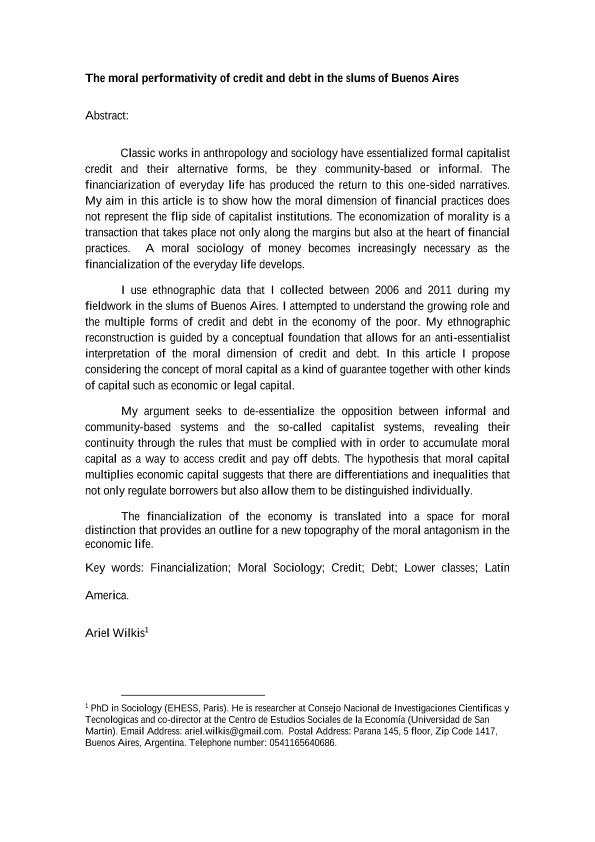
Classic works in anthropology and sociology have essentialized formal capitalist credit and their alternative forms, be they community-based or informal. The financialization of everyday life has produced the return to this one-sided narrative. My aim in this article is to show how the moral dimension of financial practices does not represent the flip side of capitalist institutions. The economization of morality is a transaction that takes place not only along the margins but also at the heart of financial practices. A moral sociology of money becomes increasingly necessary as the financialization of the everyday life develops. I use ethnographic data that I collected between 2006 and 2011 during my fieldwork in the slums of Buenos Aires. I attempted to understand the growing role and the multiple forms of credit and debt in the economy of the poor. My ethnographic reconstruction is guided by a conceptual foundation that allows for an anti-essentialist interpretation of the moral dimension of credit and debt. In this article I propose considering the concept of moral capital as a kind of guarantee together with other kinds of capital such as economic or legal capital. My argument seeks to deessentialize the opposition between informal and community-based systems and the so-called capitalist systems, revealing their continuity through the rules that must be complied with in order to accumulate moral capital as a way to access credit and pay-off debts. The hypothesis that moral capital multiplies economic capital suggests that there are differentiations and inequalities that not only regulate borrowers but also allow them to be distinguished individually. The financialization of the economy is translated into a space for moral distinction that provides an outline for a new topography of the moral antagonism in the economic life.
Palabras clave:
Credit
,
Debt
,
Financialization
,
Latin America
,
Lower Classes
,
Moral Sociology
Archivos asociados

Tamaño:
249.9Kb
Formato:
PDF
Licencia
 Excepto donde se diga explícitamente, este item se publica bajo la siguiente descripción:
Creative Commons Attribution-NonCommercial-ShareAlike 2.5 Unported (CC BY-NC-SA 2.5)
Excepto donde se diga explícitamente, este item se publica bajo la siguiente descripción:
Creative Commons Attribution-NonCommercial-ShareAlike 2.5 Unported (CC BY-NC-SA 2.5)
Identificadores
Colecciones
Articulos(SEDE CENTRAL)
Articulos de SEDE CENTRAL
Articulos de SEDE CENTRAL
Citación
Wilkis, Ariel; The Moral Performativity of Credit and Debt in the Slums of Buenos Aires; Routledge; Cultural Studies; 29; 5-6; 9-2015; 760-780
Compartir


Altmétricas