Mostrar el registro sencillo del ítem
dc.contributor.author
Molina, María Fernanda
dc.contributor.author
Musich, Francisco Martín
dc.date.available
2019-02-07T20:07:49Z
dc.date.issued
2016-05
dc.identifier.citation
Molina, María Fernanda; Musich, Francisco Martín; Perception of Parenting Style by Children with ADHD and Its Relation with Inattention, Hyperactivity/Impulsivity and Externalizing Symptoms; Springer; Journal of Child and Family Studies; 25; 5; 5-2016; 1656-1671
dc.identifier.issn
1062-1024
dc.identifier.uri
http://hdl.handle.net/11336/69726
dc.description.abstract
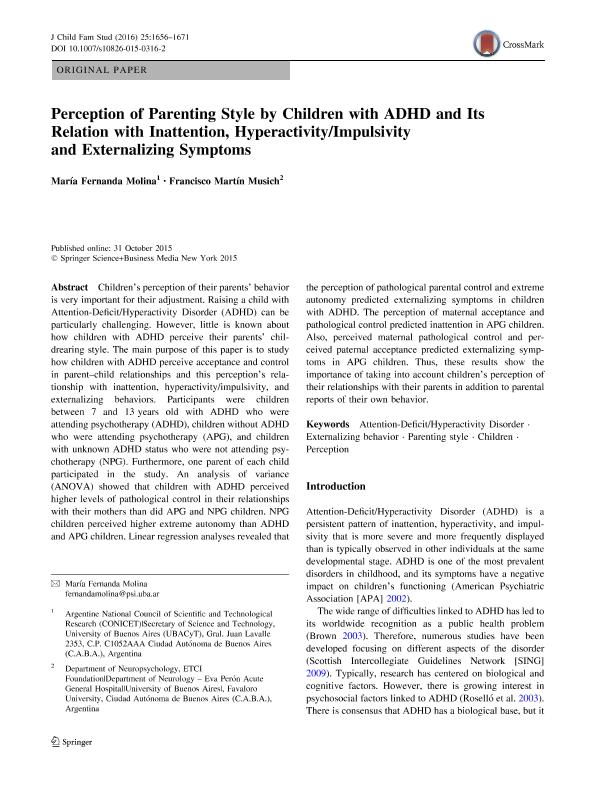
Children’s perception of their parents’ behavior is very important for their adjustment. Raising a child with Attention-Deficit/Hyperactivity Disorder (ADHD) can be particularly challenging. However, little is known about how children with ADHD perceive their parents’ childrearing style. The main purpose of this paper is to study how children with ADHD perceive acceptance and control in parent–child relationships and this perception’s relationship with inattention, hyperactivity/impulsivity, and externalizing behaviors. Participants were children between 7 and 13 years old with ADHD who were attending psychotherapy (ADHD), children without ADHD who were attending psychotherapy (APG), and children with unknown ADHD status who were not attending psychotherapy (NPG). Furthermore, one parent of each child participated in the study. An analysis of variance (ANOVA) showed that children with ADHD perceived higher levels of pathological control in their relationships with their mothers than did APG and NPG children. NPG children perceived higher extreme autonomy than ADHD and APG children. Linear regression analyses revealed that the perception of pathological parental control and extreme autonomy predicted externalizing symptoms in children with ADHD. The perception of maternal acceptance and pathological control predicted inattention in APG children. Also, perceived maternal pathological control and perceived paternal acceptance predicted externalizing symptoms in APG children. Thus, these results show the importance of taking into account children’s perception of their relationships with their parents in addition to parental reports of their own behavior.
dc.format
application/pdf
dc.language.iso
eng
dc.publisher
Springer
dc.rights
info:eu-repo/semantics/openAccess
dc.rights.uri
https://creativecommons.org/licenses/by-nc-sa/2.5/ar/
dc.subject
Attention-Deficit/Hyperactivity Disorder
dc.subject
Children
dc.subject
Externalizing Behavior
dc.subject
Parenting Style
dc.subject
Perception
dc.subject.classification
Psicología
dc.subject.classification
Psicología
dc.subject.classification
CIENCIAS SOCIALES
dc.title
Perception of Parenting Style by Children with ADHD and Its Relation with Inattention, Hyperactivity/Impulsivity and Externalizing Symptoms
dc.type
info:eu-repo/semantics/article
dc.type
info:ar-repo/semantics/artículo
dc.type
info:eu-repo/semantics/publishedVersion
dc.date.updated
2019-02-07T15:02:43Z
dc.identifier.eissn
1573-2843
dc.journal.volume
25
dc.journal.number
5
dc.journal.pagination
1656-1671
dc.journal.pais
Estados Unidos
dc.description.fil
Fil: Molina, María Fernanda. Universidad de Buenos Aires; Argentina. Consejo Nacional de Investigaciones Científicas y Técnicas; Argentina
dc.description.fil
Fil: Musich, Francisco Martín. Provincia de Buenos Aires. Ministerio de Salud. Hospital Interzonal de Agudos "Eva Perón"; Argentina. Universidad Favaloro; Argentina
dc.journal.title
Journal of Child and Family Studies
dc.relation.alternativeid
info:eu-repo/semantics/altIdentifier/url/http://link.springer.com/article/10.1007/s10826-015-0316-2
dc.relation.alternativeid
info:eu-repo/semantics/altIdentifier/doi/http://dx.doi.org/10.1007/s10826-015-0316-2
Archivos asociados

Tamaño:
517.9Kb
Formato:
PDF