Mostrar el registro sencillo del ítem
dc.contributor.author
Bonini, Ricardo Adolfo
dc.contributor.author
Georgieff, Sergio Miguel
dc.contributor.author
Candela, Adriana Magdalena
dc.date.available
2019-02-06T17:29:52Z
dc.date.issued
2017-11
dc.identifier.citation
Bonini, Ricardo Adolfo; Georgieff, Sergio Miguel; Candela, Adriana Magdalena; Stratigraphy, geochronology, and paleoenvironments of Miocene - Pliocene boundary of San Fernando, Belén (Catamarca, northwest of Argentina); Pergamon-Elsevier Science Ltd; Journal of South American Earth Sciences; 79; 11-2017; 459-471
dc.identifier.issn
0895-9811
dc.identifier.uri
http://hdl.handle.net/11336/69522
dc.description.abstract
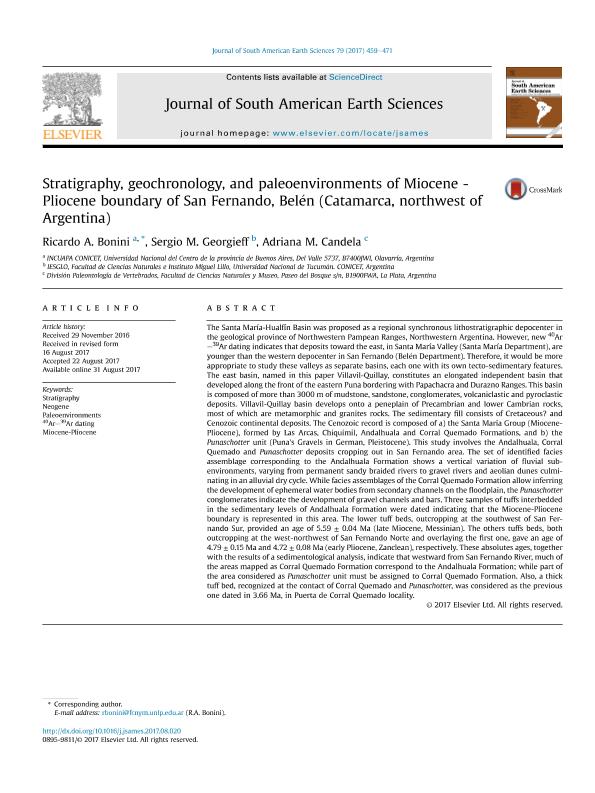
The Santa María-Hualfín Basin was proposed as a regional synchronous lithostratigraphic depocenter in the geological province of Northwestern Pampean Ranges, Northwestern Argentina. However, new 40Ar–39Ar dating indicates that deposits toward the east, in Santa María Valley (Santa María Department), are younger than the western depocenter in San Fernando (Belén Department). Therefore, it would be more appropriate to study these valleys as separate basins, each one with its own tecto-sedimentary features. The east basin, named in this paper Villavil-Quillay, constitutes an elongated independent basin that developed along the front of the eastern Puna bordering with Papachacra and Durazno Ranges. This basin is composed of more than 3000 m of mudstone, sandstone, conglomerates, volcaniclastic and pyroclastic deposits. Villavil-Quillay basin develops onto a peneplain of Precambrian and lower Cambrian rocks, most of which are metamorphic and granites rocks. The sedimentary fill consists of Cretaceous? and Cenozoic continental deposits. The Cenozoic record is composed of a) the Santa María Group (Miocene-Pliocene), formed by Las Arcas, Chiquimil, Andalhuala and Corral Quemado Formations, and b) the Punaschotter unit (Puna's Gravels in German, Pleistocene). This study involves the Andalhuala, Corral Quemado and Punaschotter deposits cropping out in San Fernando area. The set of identified facies assemblage corresponding to the Andalhuala Formation shows a vertical variation of fluvial sub-environments, varying from permanent sandy braided rivers to gravel rivers and aeolian dunes culminating in an alluvial dry cycle. While facies assemblages of the Corral Quemado Formation allow inferring the development of ephemeral water bodies from secondary channels on the floodplain, the Punaschotter conglomerates indicate the development of gravel channels and bars. Three samples of tuffs interbedded in the sedimentary levels of Andalhuala Formation were dated indicating that the Miocene-Pliocene boundary is represented in this area. The lower tuff beds, outcropping at the southwest of San Fernando Sur, provided an age of 5.59 ± 0.04 Ma (late Miocene, Messinian). The others tuffs beds, both outcropping at the west-northwest of San Fernando Norte and overlaying the first one, gave an age of 4.79 ± 0.15 Ma and 4.72 ± 0.08 Ma (early Pliocene, Zanclean), respectively. These absolutes ages, together with the results of a sedimentological analysis, indicate that westward from San Fernando River, much of the areas mapped as Corral Quemado Formation correspond to the Andalhuala Formation; while part of the area considered as Punaschotter unit must be assigned to Corral Quemado Formation. Also, a thick tuff bed, recognized at the contact of Corral Quemado and Punaschotter, was considered as the previous one dated in 3.66 Ma, in Puerta de Corral Quemado locality.
dc.format
application/pdf
dc.language.iso
eng
dc.publisher
Pergamon-Elsevier Science Ltd
dc.rights
info:eu-repo/semantics/openAccess
dc.rights.uri
https://creativecommons.org/licenses/by-nc-sa/2.5/ar/
dc.subject
40ar&Ndash;39ar Dating
dc.subject
Miocene-Pliocene
dc.subject
Neogene
dc.subject
Paleoenvironments
dc.subject
Stratigraphy
dc.subject.classification
Meteorología y Ciencias Atmosféricas
dc.subject.classification
Ciencias de la Tierra y relacionadas con el Medio Ambiente
dc.subject.classification
CIENCIAS NATURALES Y EXACTAS
dc.title
Stratigraphy, geochronology, and paleoenvironments of Miocene - Pliocene boundary of San Fernando, Belén (Catamarca, northwest of Argentina)
dc.type
info:eu-repo/semantics/article
dc.type
info:ar-repo/semantics/artículo
dc.type
info:eu-repo/semantics/publishedVersion
dc.date.updated
2019-01-14T16:31:22Z
dc.journal.volume
79
dc.journal.pagination
459-471
dc.journal.pais
Estados Unidos
dc.journal.ciudad
Nueva York
dc.description.fil
Fil: Bonini, Ricardo Adolfo. Consejo Nacional de Investigaciones Científicas y Técnicas. Centro Científico Tecnológico Conicet - Tandil. Investigaciones Arqueológicas y Paleontológicas del Cuaternario Pampeano. Universidad Nacional del Centro de la Provincia de Buenos Aires. Investigaciones Arqueológicas y Paleontológicas del Cuaternario Pampeano; Argentina
dc.description.fil
Fil: Georgieff, Sergio Miguel. Consejo Nacional de Investigaciones Científicas y Técnicas. Centro Científico Tecnológico Conicet - Tucumán; Argentina. Universidad Nacional de Tucumán. Facultad de Ciencias Naturales e Instituto Miguel Lillo; Argentina
dc.description.fil
Fil: Candela, Adriana Magdalena. Consejo Nacional de Investigaciones Científicas y Técnicas. Centro Científico Tecnológico Conicet - La Plata; Argentina. Universidad Nacional de La Plata. Facultad de Ciencias Naturales y Museo. Departamento Científico de Paleontología de Vertebrados; Argentina
dc.journal.title
Journal of South American Earth Sciences
dc.relation.alternativeid
info:eu-repo/semantics/altIdentifier/doi/https://dx.doi.org/10.1016/j.jsames.2017.08.020
dc.relation.alternativeid
info:eu-repo/semantics/altIdentifier/url/https://www.sciencedirect.com/science/article/pii/S0895981116302930
Archivos asociados

Tamaño:
6.297Mb
Formato:
PDF