Mostrar el registro sencillo del ítem
dc.contributor.author
Maiez Tribut, S.
dc.contributor.author
Pascault, J. P.
dc.contributor.author
Soulé, Ezequiel Rodolfo
dc.contributor.author
Borrajo Fernandez, Julio
dc.contributor.author
Williams, Roberto Juan Jose
dc.date.available
2019-02-01T20:40:40Z
dc.date.issued
2007-02
dc.identifier.citation
Maiez Tribut, S.; Pascault, J. P.; Soulé, Ezequiel Rodolfo; Borrajo Fernandez, Julio; Williams, Roberto Juan Jose; Nanostructured epoxies based on the self-assembly of block copolymers: A new miscible block that can be tailored to different epoxy formulations; American Chemical Society; Macromolecules; 40; 4; 2-2007; 1268-1273
dc.identifier.issn
0024-9297
dc.identifier.uri
http://hdl.handle.net/11336/69243
dc.description.abstract
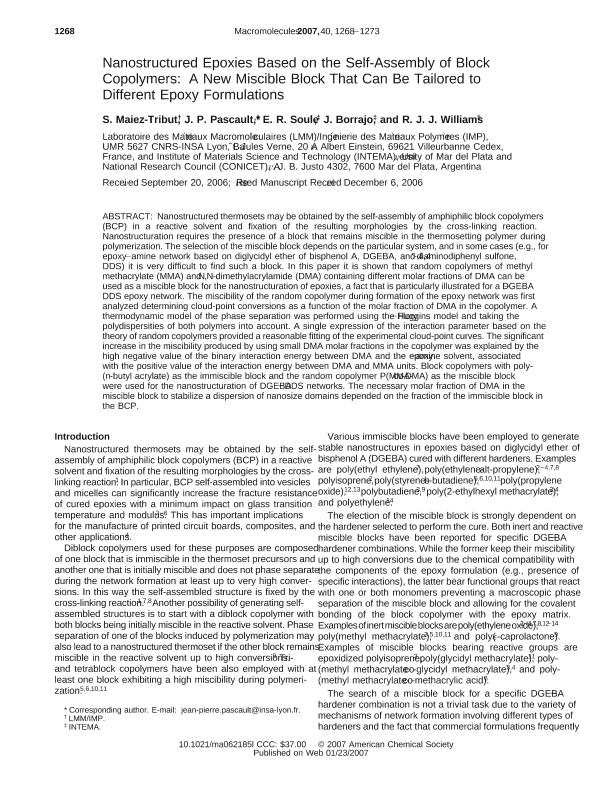
Nanostructured thermosets may be obtained by the self-assembly of amphiphilic block copolymers (BCP) in a reactive solvent and fixation of the resulting morphologies by the cross-linking reaction. Nanostructuration requires the presence of a block that remains miscible in the thermosetting polymer during polymerization. The selection of the miscible block depends on the particular system, and in some cases (e.g., for epoxy-amine network based on diglycidyl ether of bisphenol A, DGEBA, and 4,4′-diaminodiphenyl sulfone, DDS) it is very difficult to find such a block. In this paper it is shown that random copolymers of methyl methacrylate (MMA) and N,N-dimethylacrylamide (DMA) containing different molar fractions of DMA can be used as a miscible block for the nanostructuration of epoxies, a fact that is particularly illustrated for a DGEBA-DDS epoxy network. The miscibility of the random copolymer during formation of the epoxy network was first analyzed determining cloud-point conversions as a function of the molar fraction of DMA in the copolymer. A thermodynamic model of the phase separation was performed using the Flory-Huggins model and taking the polydispersities of both polymers into account. A single expression of the interaction parameter based on the theory of random copolymers provided a reasonable fitting of the experimental cloud-point curves. The significant increase in the miscibility produced by using small DMA molar fractions in the copolymer was explained by the high negative value of the binary interaction energy between DMA and the epoxy-amine solvent, associated with the positive value of the interaction energy between DMA and MMA units. Block copolymers with poly-(n-butyl acrylate) as the immiscible block and the random copolymer P(MMA-co-DMA) as the miscible block were used for the nanostructuration of DGEBA-DDS networks. The necessary molar fraction of DMA in the miscible block to stabilize a dispersion of nanosize domains depended on the fraction of the immiscible block in the BCP.
dc.format
application/pdf
dc.language.iso
eng
dc.publisher
American Chemical Society
dc.rights
info:eu-repo/semantics/openAccess
dc.rights.uri
https://creativecommons.org/licenses/by-nc-sa/2.5/ar/
dc.subject.classification
Físico-Química, Ciencia de los Polímeros, Electroquímica
dc.subject.classification
Ciencias Químicas
dc.subject.classification
CIENCIAS NATURALES Y EXACTAS
dc.subject.classification
Recubrimientos y Películas
dc.subject.classification
Ingeniería de los Materiales
dc.subject.classification
INGENIERÍAS Y TECNOLOGÍAS
dc.title
Nanostructured epoxies based on the self-assembly of block copolymers: A new miscible block that can be tailored to different epoxy formulations
dc.type
info:eu-repo/semantics/article
dc.type
info:ar-repo/semantics/artículo
dc.type
info:eu-repo/semantics/publishedVersion
dc.date.updated
2019-01-14T17:47:48Z
dc.journal.volume
40
dc.journal.number
4
dc.journal.pagination
1268-1273
dc.journal.pais
Estados Unidos
dc.description.fil
Fil: Maiez Tribut, S.. Centre National de la Recherche Scientifique; Francia
dc.description.fil
Fil: Pascault, J. P.. Centre National de la Recherche Scientifique; Francia
dc.description.fil
Fil: Soulé, Ezequiel Rodolfo. Consejo Nacional de Investigaciones Científicas y Técnicas. Centro Científico Tecnológico Conicet - Mar del Plata. Instituto de Investigaciones en Ciencia y Tecnología de Materiales. Universidad Nacional de Mar del Plata. Facultad de Ingeniería. Instituto de Investigaciones en Ciencia y Tecnología de Materiales; Argentina
dc.description.fil
Fil: Borrajo Fernandez, Julio. Consejo Nacional de Investigaciones Científicas y Técnicas. Centro Científico Tecnológico Conicet - Mar del Plata. Instituto de Investigaciones en Ciencia y Tecnología de Materiales. Universidad Nacional de Mar del Plata. Facultad de Ingeniería. Instituto de Investigaciones en Ciencia y Tecnología de Materiales; Argentina
dc.description.fil
Fil: Williams, Roberto Juan Jose. Consejo Nacional de Investigaciones Científicas y Técnicas. Centro Científico Tecnológico Conicet - Mar del Plata. Instituto de Investigaciones en Ciencia y Tecnología de Materiales. Universidad Nacional de Mar del Plata. Facultad de Ingeniería. Instituto de Investigaciones en Ciencia y Tecnología de Materiales; Argentina
dc.journal.title
Macromolecules
dc.relation.alternativeid
info:eu-repo/semantics/altIdentifier/url/https://pubs.acs.org/doi/abs/10.1021/ma062185l
dc.relation.alternativeid
info:eu-repo/semantics/altIdentifier/doi/http://dx.doi.org/10.1021/ma062185l
Archivos asociados

Tamaño:
275.1Kb
Formato:
PDF