Mostrar el registro sencillo del ítem
dc.contributor.author
Ferretti, Valentina
dc.contributor.author
Massoni, Viviana
dc.contributor.author
Bulit, Florencia
dc.contributor.author
Winkler, David Ward
dc.contributor.author
Lovette, Irby J.
dc.date.available
2019-01-25T20:23:40Z
dc.date.issued
2011-11
dc.identifier.citation
Ferretti, Valentina; Massoni, Viviana; Bulit, Florencia; Winkler, David Ward; Lovette, Irby J.; Heterozygosity and fitness benefits of extrapair mate choice in White-rumped Swallows (Tachycineta leucorrhoa); Oxford University Press; Behavioral Ecology; 22; 6; 11-2011; 1178-1186
dc.identifier.issn
1045-2249
dc.identifier.uri
http://hdl.handle.net/11336/68659
dc.description.abstract
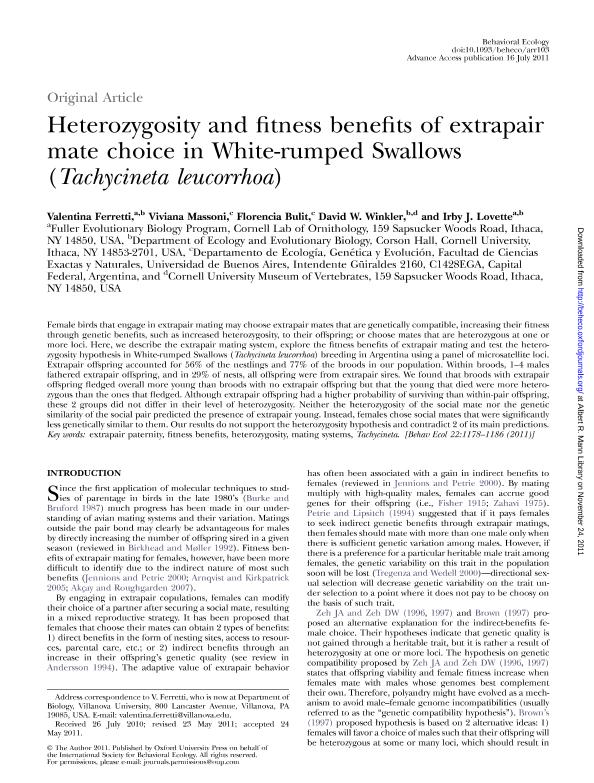
Female birds that engage in extrapair mating may choose extrapair mates that are genetically compatible, increasing their fitness through genetic benefits, such as increased heterozygosity, to their offspring; or choose mates that are heterozygous at one or more loci. Here, we describe the extrapair mating system, explore the fitness benefits of extrapair mating and test the heterozygosity hypothesis in White-rumped Swallows (Tachycineta leucorrhoa) breeding in Argentina using a panel of microsatellite loci. Extrapair offspring accounted for 56% of the nestlings and 77% of the broods in our population. Within broods, 1-4 males fathered extrapair offspring, and in 29% of nests, all offspring were from extrapair sires. We found that broods with extrapair offspring fledged overall more young than broods with no extrapair offspring but that the young that died were more heterozygous than the ones that fledged. Although extrapair offspring had a higher probability of surviving than within-pair offspring, these 2 groups did not differ in their level of heterozygosity. Neither the heterozygosity of the social mate nor the genetic similarity of the social pair predicted the presence of extrapair young. Instead, females chose social mates that were significantly less genetically similar to them. Our results do not support the heterozygosity hypothesis and contradict 2 of its main predictions.
dc.format
application/pdf
dc.language.iso
eng
dc.publisher
Oxford University Press
dc.rights
info:eu-repo/semantics/openAccess
dc.rights.uri
https://creativecommons.org/licenses/by-nc-sa/2.5/ar/
dc.subject
Extrapair Paternity
dc.subject
Fitness Benefits
dc.subject
Heterozygosity
dc.subject
Mating Systems
dc.subject
Tachycineta
dc.subject.classification
Otras Ciencias Biológicas
dc.subject.classification
Ciencias Biológicas
dc.subject.classification
CIENCIAS NATURALES Y EXACTAS
dc.title
Heterozygosity and fitness benefits of extrapair mate choice in White-rumped Swallows (Tachycineta leucorrhoa)
dc.type
info:eu-repo/semantics/article
dc.type
info:ar-repo/semantics/artículo
dc.type
info:eu-repo/semantics/publishedVersion
dc.date.updated
2019-01-25T13:38:10Z
dc.journal.volume
22
dc.journal.number
6
dc.journal.pagination
1178-1186
dc.journal.pais
Reino Unido
dc.journal.ciudad
Oxford
dc.description.fil
Fil: Ferretti, Valentina. Cornell University; Estados Unidos
dc.description.fil
Fil: Massoni, Viviana. Universidad de Buenos Aires. Facultad de Ciencias Exactas y Naturales. Departamento de Ecología, Genética y Evolución; Argentina. Consejo Nacional de Investigaciones Científicas y Técnicas; Argentina
dc.description.fil
Fil: Bulit, Florencia. Universidad de Buenos Aires. Facultad de Ciencias Exactas y Naturales. Departamento de Ecología, Genética y Evolución; Argentina. Consejo Nacional de Investigaciones Científicas y Técnicas; Argentina
dc.description.fil
Fil: Winkler, David Ward. Cornell University; Estados Unidos
dc.description.fil
Fil: Lovette, Irby J.. Cornell University; Estados Unidos
dc.journal.title
Behavioral Ecology
dc.relation.alternativeid
info:eu-repo/semantics/altIdentifier/doi/http://dx.doi.org/10.1093/beheco/arr103
dc.relation.alternativeid
info:eu-repo/semantics/altIdentifier/url/https://academic.oup.com/beheco/article/22/6/1178/218912
Archivos asociados

Tamaño:
178.5Kb
Formato:
PDF