Artículo
A molecular phylogeny and classification of Verbenaceae
Marx, Hannah E.; O'Leary, Nataly Cristina ; Yuan, Yao Wu; Lu Irving, Patricia; Tank, David C.; Mulgura, Maria Ema
; Olmstead, Richard G.
; Yuan, Yao Wu; Lu Irving, Patricia; Tank, David C.; Mulgura, Maria Ema
; Olmstead, Richard G.
; Yuan, Yao Wu; Lu Irving, Patricia; Tank, David C.; Mulgura, Maria Ema
; Olmstead, Richard G.
Fecha de publicación:
10/2010
Editorial:
Botanical Society of America
Revista:
American Journal of Botany
ISSN:
0002-9122
Idioma:
Inglés
Tipo de recurso:
Artículo publicado
Clasificación temática:
Resumen
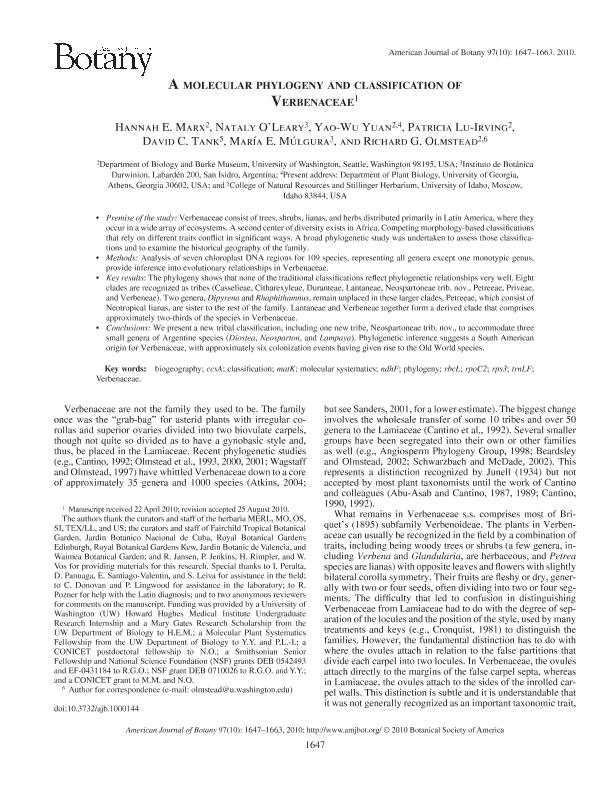
Premise of the study: Verbenaceae consist of trees, shrubs, lianas, and herbs distributed primarily in Latin America, where they occur in a wide array of ecosystems. A second center of diversity exists in Africa. Competing morphology-based classifications that rely on different traits conflict in significant ways. A broad phylogenetic study was undertaken to assess those classifications and to examine the historical geography of the family. Methods: Analysis of seven chloroplast DNA regions for 109 species, representing all genera except one monotypic genus, provide inference into evolutionary relationships in Verbenaceae. Key results: The phylogeny shows that none of the traditional classifications reflect phylogenetic relationships very well. Eight clades are recognized as tribes (Casselieae, Citharexyleae, Duranteae, Lantaneae, Neospartoneae trib. nov., Petreeae, Priveae, and Verbeneae). Two genera, Dipyrena and Rhaphithamnus, remain unplaced in these larger clades. Petreeae, which consist of Neotropical lianas, are sister to the rest of the family. Lantaneae and Verbeneae together form a derived clade that comprises approximately two-thirds of the species in Verbenaceae. Conclusions: We present a new tribal classification, including one new tribe, Neospartoneae trib. nov., to accommodate three small genera of Argentine species (Diostea, Neosparton, and Lampaya). Phylogenetic inference suggests a South American origin for Verbenaceae, with approximately six colonization events having given rise to the Old World species.
Archivos asociados

Tamaño:
1.469Mb
Formato:
PDF
Licencia
 Excepto donde se diga explícitamente, este item se publica bajo la siguiente descripción:
Creative Commons Attribution-NonCommercial-ShareAlike 2.5 Unported (CC BY-NC-SA 2.5)
Excepto donde se diga explícitamente, este item se publica bajo la siguiente descripción:
Creative Commons Attribution-NonCommercial-ShareAlike 2.5 Unported (CC BY-NC-SA 2.5)
Identificadores
Colecciones
Articulos(IBODA)
Articulos de INST.DE BOTANICA DARWINION (I)
Articulos de INST.DE BOTANICA DARWINION (I)
Citación
Marx, Hannah E.; O'Leary, Nataly Cristina; Yuan, Yao Wu; Lu Irving, Patricia; Tank, David C.; et al.; A molecular phylogeny and classification of Verbenaceae; Botanical Society of America; American Journal of Botany; 97; 10; 10-2010; 1647-1663
Compartir


Altmétricas